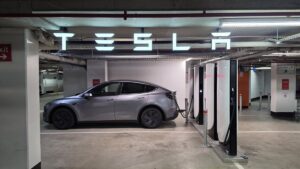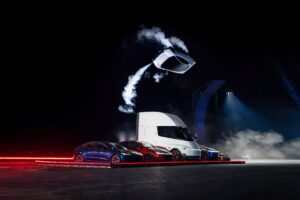

Tesla has finally rolled out vehicle-to-load technology in Australia – at least in one of its Model Y variants – and is hinting that vehicle-to-grid is not far away, and likely to be considerably cheaper than other offerings currently being developed in the market.
Australia last week super-sized its first major commercial pilot on V2G technology, through the retailer Amber and using BYD Atto 3 EVs, although it is looking for at least another three car-makers to join the 1,000 vehicle pilot and help validate the technology with their vehicles.
Tesla has a different approach, according to Josef Tadich, the head of Tesla Energy in the Asia Pacific, largely because it will focus on using its own inverter in the car and tap into its existing ecosystem of charging technology and apps.
“The cheapest way to do (V2G) is to fit the inverter at the factory, do it in serial production,” Tadich says in the latest episode of the Energy Insiders podcast, hosted on The Driven’s sister site Renew Economy.
“The marginal cost is relatively small, then you can connect to the grid, and you can either control vehicle-to-home or vehicle-to- grid.”
V2L technology was first made available in a Tesla EV with the Cybertruck, which is called “Power Share” in the US, and enables users to run their power tools and other devices. It is now being made available in Australia with the new six-seater Model Y L.
Tesla is unlikely to participate in the ARENA-sponsored V2G pilot through Amber because it is focusing on a completely different system for V2G.
“It’s effectively a third-party inverter, which connects over DC to the vehicle, which you can then grid connect,” Tadich says, “But our view on that is the cost of doing that is a little prohibitive, so you’re much better off just to use the onboard inverter and make it as cheap as possible.”
Would it be retrospective, and be available in existing models, given that the part itself is relatively inexpensive?
Tadich wouldn’t comment specifically on that but said the big challenge at the moment is to deal with the Australian regulatory requirements to allow a vehicle’s inverter to connect to the grid. Most of the discussion in Australian energy circles is the 4777 standard based around a separate standalone inverter.
Tadich says the EV data over the last few months – a series of record-breaking sales periods, a peak of 20 per cent EV share in May and the Model Y become the first EV to outsell all other cars in Australia, top-selling car of any type in Australia – indicates a fundamental change i the market.
“It’s interesting when you look at all technology adaptation, there is this S curve … and I feel like the last, probably last 10 years of my career, we’ve seen it both from the battery storage side and now on the EV side,” he says.
“I think that first that first 5% of market share was really hard, convincing customers to completely change the way they’re doing transport. Same with utility scale batteries, convincing market operators and developers and owners and banks and investors that battery storage could have a return.
“But now I think that that demonstration, that track record has gone through, we’re in that S curve with that high growth now.
“There’s nothing like a good crisis to provide the opportunity, … historians will probably call this the third oil shock, I think that has really propelled it through, and I think we’re going to see the increase in EV penetration really rapidly.”
You can listen to the full interview with Josef Tadich, and the discussions on solar abundance, battery storage, hybrids, EV uptake and V2G, here. Energy Insiders Podcast: Tesla Energy boss on energy abundance, EVs, V2G and big and small batteries
Sign up for The Driven’s free daily newsletter and get the latest EV news and analysis delivered straight to your inbox.