The ACT has long been a leader on climate action. You could say that if it can’t be done in the ACT, it probably can’t be done anywhere – the territory has a small population, no major industrial emissions activity, and a well-educated populace that accepts climate science.
The recently released ACT Climate Change Strategy 2026-36 and its first Action Plan are critical documents because we are truly now at the pointy end of climate mitigation. We have just 19 years until 2045 and we need concrete policies that will steer us to net zero with a high likelihood of success.
Unfortunately, the ACT Climate Change Strategy is short on detailed plans for the limited time. The strategy highlights transport as the largest contributor to the ACT’s emissions (over 60 percent), but then offers little in commensurate actions to deal with them.
The strategy rightly identifies decreased dependence on private cars and better public transport service and active travel options as important levers for reducing transport emissions, but then largely places its bets on high levels of mode shifting.
An all-of-the-above approach to reducing transport emissions is clearly needed, but measures relying on high levels of mode shift to public and active travel have an unfortunate record of achievement in Australia.
Moreover, relying on changes to urban form that reduce dependence on private cars, while really desirable, are too slow to make a substantial difference by 2045.
Vehicle fleet turnover
A lot of emphasis in the past decade has been placed on increasing the share of electric vehicles in new car sales and getting beyond the early adoption phase.
That’s a natural place to start, but it also allows us to avoid the unpleasant thought that all of the new fossil cars in the vehicle fleet will hang around for a very long time. Almost every petrol guzzling car sold today will still be on the road in 2040 unless scrapped early. I do not see this kind of analysis in the Climate Change Strategy.
I have used a ‘stock and flow’ model of the ACT light vehicle fleet to see what can be achieved by 2045 with current ACT Government policies. The model incorporates two key policies and assumes that these goals are achieved – and both are a big ‘if’:
- Reaching 80-90% EV sales share by 2030 (June 2026 had 43% EV sales); and
- Prohibiting the registration of new ICE vehicles from 2035.
I have assumed growth in vehicle numbers in line with recent years, a scrappage rate of internal combustion engine (ICE) vehicles of 5% per year, an EV scrappage rate of zero until 2035, and then 2% thereafter, reflecting the much younger EV fleet.
The existing vehicle fleet is assumed to have an average fuel economy based on 2024-25 ground transport emissions and average distance travelled each year in the ACT.
New vehicles are assumed to have an average fuel economy in line with the New Vehicle Efficiency Standard targets until 2029. Beyond 2030, the targets are conservatively kept at 2029 levels as the Federal Government is yet to set targets beyond 2029.
The model assumes that the only way a vehicle enters the ACT fleet is as a new vehicle. Second-hand vehicles are routinely traded between Canberrans (either privately or via a dealership) without leaving the ACT.
Vehicles leave the fleet when scrapped, crashed, or transferred interstate. If a vehicle is transferred interstate, it is usually replaced with a similar used vehicle, so no significant improvement in fuel economy is assumed other than through the improvement in new vehicles.
This reflects ACT Government policy which targets incentives mainly at new vehicles as the way to move the fleet composition towards lower emissions vehicles. There is a modest CO2 component in annual vehicle registration fees in the ACT, but consumers tend to strongly discount future running costs.
Here is what we can expect the vehicle fleet to look like in 2045:
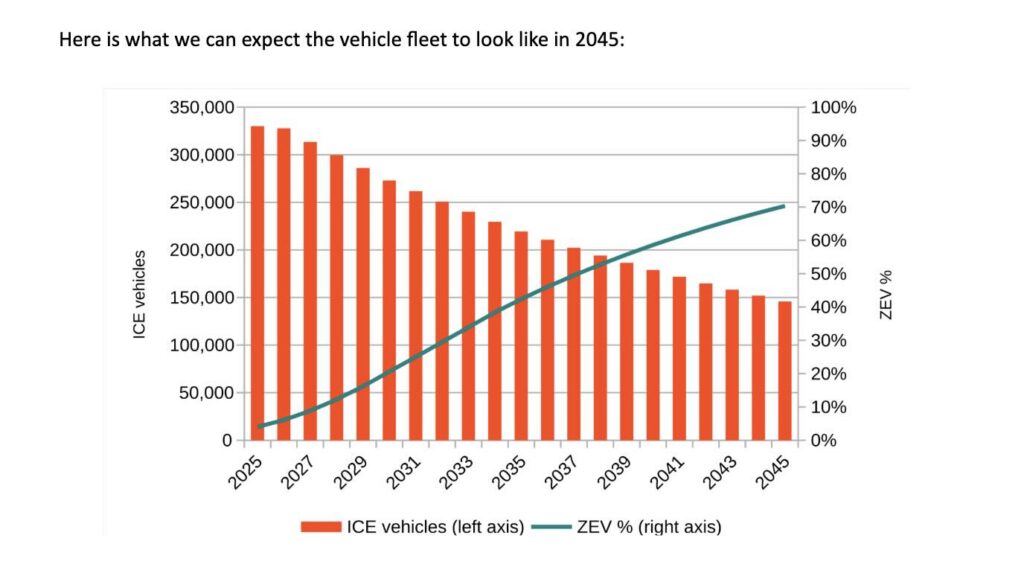
Assuming that current policies are achieved, we can get to about 70% of the ACT vehicle fleet being battery EV by 2045. This broadly aligns with projections made by AEMO (80% by 2050). There are obviously uncertainties in the assumptions.
What about the emissions, then? We see residual transport emissions in the chart below of 450 kilotonnes of CO2 per year, which is about half the current transport emissions and about ten times higher than the transport emissions in the net zero scenario in the Climate Change Strategy.
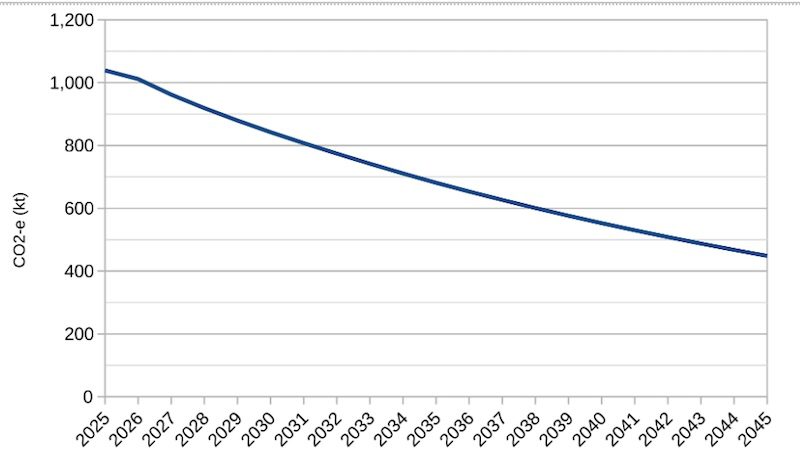
The effort of removing polluting ICE vehicles from the fleet has been seriously underestimated in the Climate Change Strategy.
Wishful thinking can be found in the section headed “Completing the transition (2040-2045)”. In this section, the large residual fleet of internal combustion engines is removed in just five years via this statement: “This stage will target residual emissions and legacy infrastructure. Fossil fuel vehicles will be phased out …”
The numbers simply do not line up as they need to.
What can we do?
This is where models can be useful. We can play with different parameters and experiment with various strategies. If the ACT Government were to introduce policies to encourage the purchase of more efficient used vehicles (including EVs, plug-in hybrids and hybrids) when existing vehicles are traded, much more progress can be made on transport emissions.
Effectively, rather than thinking about the vehicle fleet as a pipeline where new cars go in one end and scrapped cars come out the other, we can think about it as a cohort that can be continuously improved every time a vehicle is purchased.
The right financial incentives would encourage car dealerships to stock much more efficient used vehicles on their lots. High emissions traded vehicles would likely be sent interstate where they would be easier to sell. Dealerships routinely source used vehicles from interstate auctioneers and wholesalers.
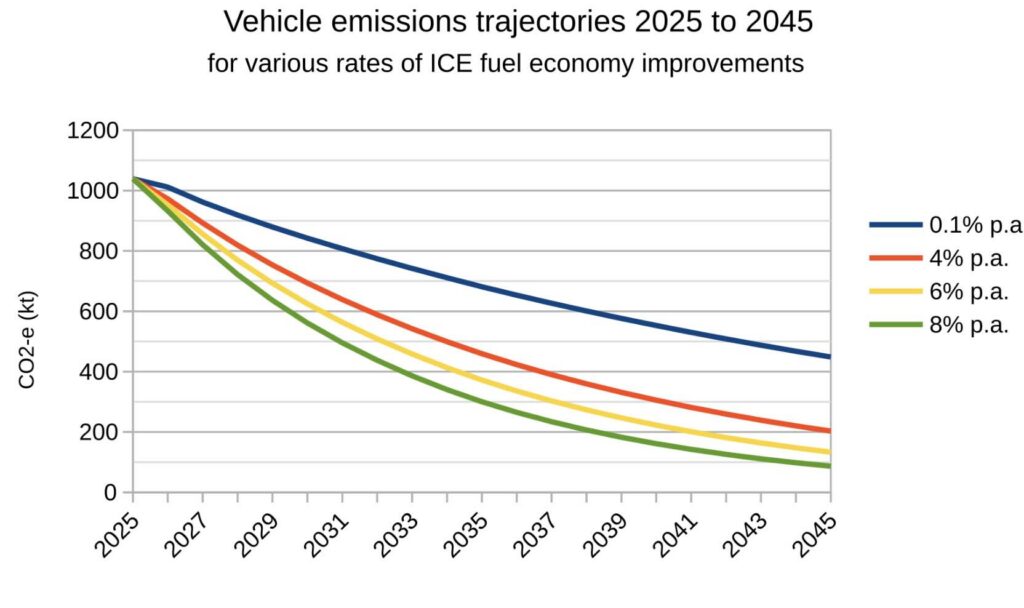
The modelling shows that if the average fuel economy of the existing vehicle fleet were improved by 4% per year from now until 2045, it would cut the residual transport emissions in half.
An 8% per year improvement would roughly achieve the emissions reductions needed to reach net zero even with almost 150,000 ICE vehicles still in the fleet. The remaining vehicles would be much more fuel efficient and likely be a mix of EVs, hybrids and plug-in hybrids as the fleet-wide average fuel economy would need to be about 1.6 L/100km.
Conclusion
This exercise shows that relying on new zero emissions vehicles and ‘natural’ fleet turnover is too slow to meet the ACT Government’s net zero target by 2045.
However, it is not necessary to eliminate every ICE vehicle, either. Critically, ACT Government policies need to focus on improving the tailpipe emissions of all vehicles in the fleet, not just the new ones. This could be achieved by ensuring that the existing differential vehicle duty scheme in the ACT is strengthened and applied to all vehicles, new and used.
The good news is that transport emissions can be sufficiently reduced to reach net zero by 2045, but it requires more ambitious plans than can be found in the Climate Change Strategy.
Dr Ben Elliston is the chair of the ACT branch of the Australian Electric Vehicle Association (AEVA) and energy systems modeller at UNSW. The views expressed in this article are not necessarily those of AEVA.