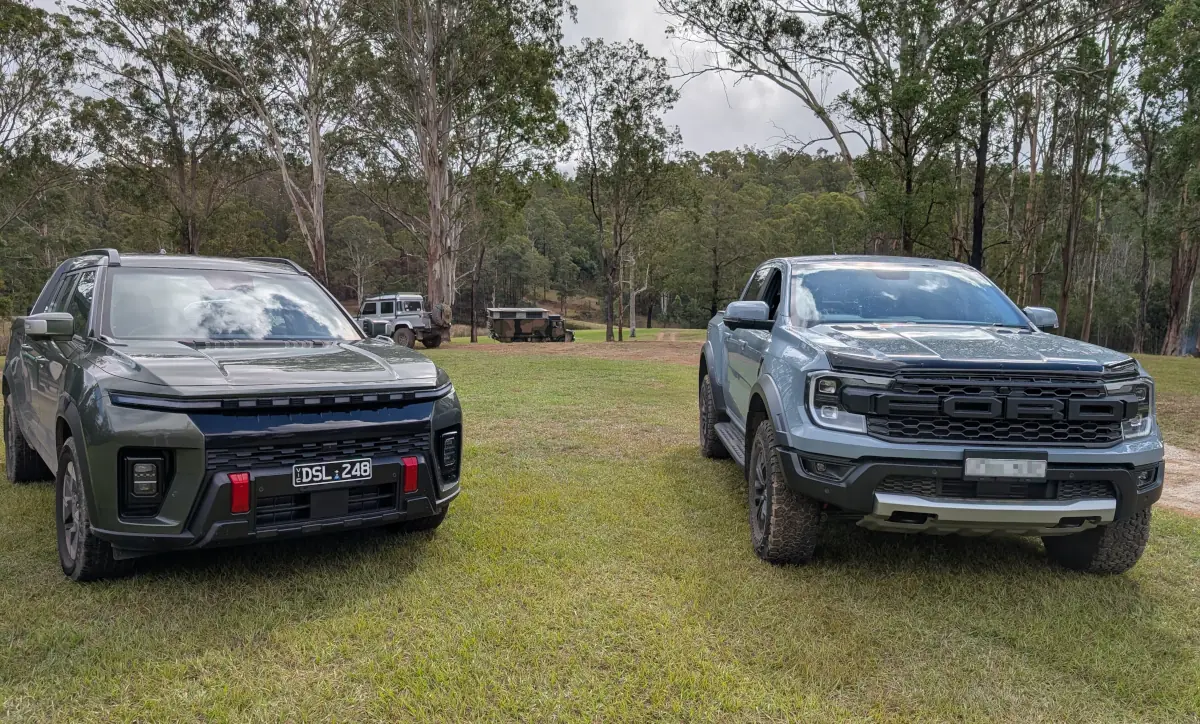
I recently took the KGM Musso EV on a road trip to my brother’s 50th birthday party and his surprise wedding. I chose the Musso electric ute because I needed a suitable vehicle that would get me out there. And I thought it would be a good opportunity to see what the 4WD enthusiast crowd made of the Musso, because it resembles something they may consider driving one day.
My brother Ant helped me determine that the Musso EV is not going to replace a tricked out 4WD anytime soon, due to its low ground clearance and rudimentary traction control system. Still, it enabled me to collect some ground truth, as Dr Karl Kruszelnicki calls it, by speaking to real 4WD enthusiasts about electric vehicles.
The headline to this article starts with the word “even” because I have long thought that 4WDs and utes would be the last vehicle segment to realise the numerous benefits of EVs. I have talked to my brother and his mates about them many times in the past, although this time I noticed a significant shift in their opinions and a genuine curiosity rather than upfront dismissal.
A quick example helps to illustrate this subtle, but important shift in sentiment. Less than 3 years ago, around the time of my very first article on The Driven, one of my brother’s mates Paulie was giving me a lift to Ant’s place for a working bee weekend to pour concrete slabs for the shed he had just built.
On the drive out Paulie said something along the lines of, “I won’t buy an EV until it has 1,000 km range from a tiny battery the size of a lead-acid 12 V.” After I tried to explain why physics dictates this is unlikely to happen, at least with known technologies, we moved onto other topics.
This time around however, I offered Paulie a quick drive of the Musso and he came back with a huge grin on his face saying, “That’s awesome!”
Concerns around range and charging remain
Over the weekend whenever the topic of EVs came up, invariably started by people wondering what the Musso EV was, I was pleasantly surprised that most people were openly asking questions and receptive to the stories I shared from my experience. I only heard one person spouting misinformation about heavy EVs ruining car parks.
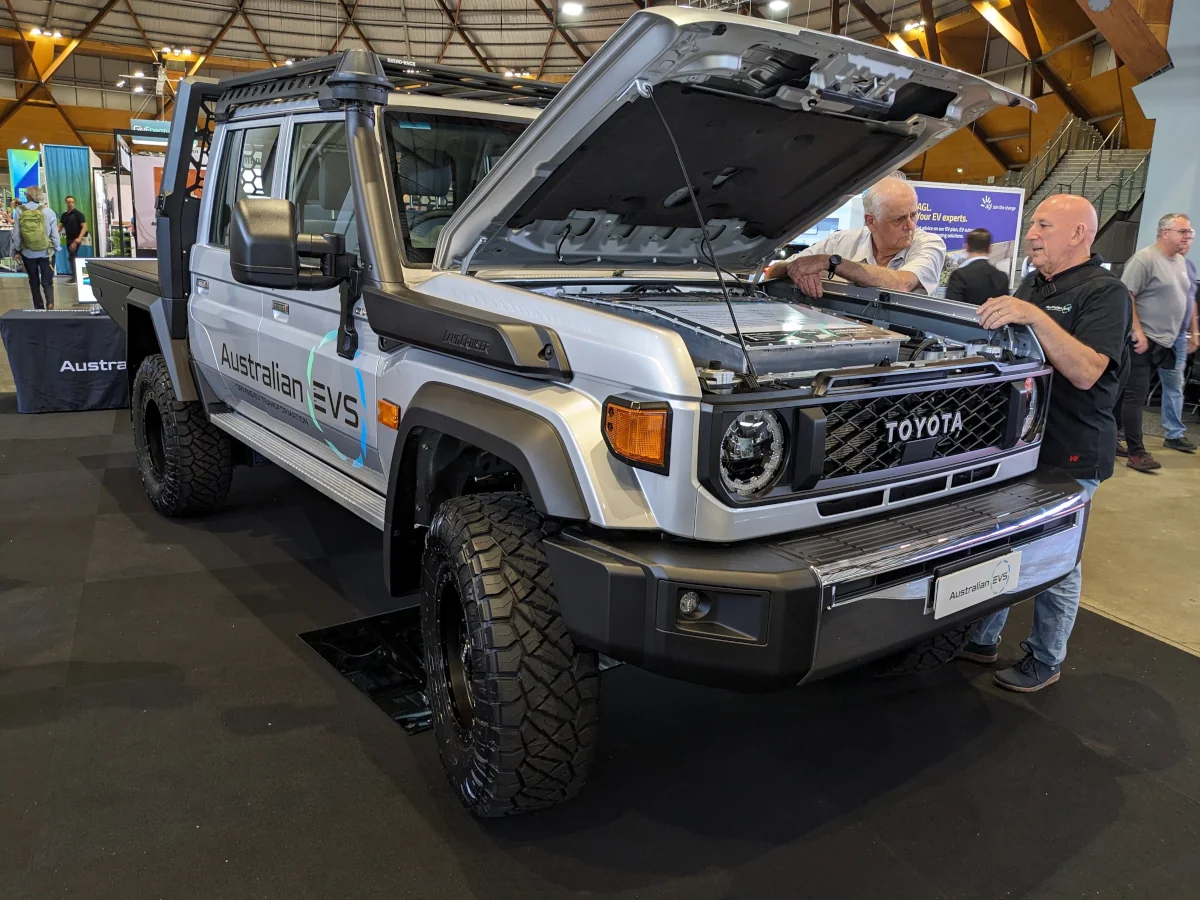
Range and charging stood out as the biggest concerns holding 4WD owners back from making the shift, as well as a lack of serious options aside from the $250,000 Mercedes-Benz G580 with EQ Technology or expensive 4WD conversions from places like Australian EVS and Electrogusto.
On the topic of range and charging, I talked about the time I borrowed a Tesla Model 3 Long Range Rear-Wheel Drive and drove it from Sydney to Canberra and back on a single charge. I also mentioned the crazy fast charging times enabled by BYD’s flash charging technology and the subsequent one-upmanship by CATL.
While sharing these stories I could start to see peoples eyes light up and minds ticking over at the possibilities, especially with newer EVs coming out boasting over 800 km range and less than 5 minute charging times.
Why the shift in sentiment?
I should have asked my brother’s friends this exact question, but unfortunately I didn’t, so these are my best guesses. I think the biggest reason has been the recent rise in fuel prices from the Iran war. My brother said his 4WD club, which includes most of his mates at the party, were making changes to upcoming trips to stay more local and reduce travel costs.
The impact of rising fuel prices on people with combustion cars often escapes me, as I have been driving an electric car for nearly 7 years now. However, during a chat with the builder down the road who drives a diesel VW Amarok ute, he told me it has a 200 L tank and cost him over $500 last time he filled it up, which stunned me.
One of my new nephews as a result of the wedding shared his perspective. Jake bought a Shark 6 and a mild hybrid within the last 12 months, but says he now wishes he’d gone full EV because they also recently got solar and a big home battery. For them, it is more about being able to make the most of the renewable energy assets they now have.
Another reason that springs to mind is that people who 4WD and camp have first hand experience with battery technology advancements, through the transition from lead-acid to lithium-ion batteries to power their fridges, combined with portable solar panels and in some cases induction cooking to remove the need for gas bottles.
Indefinite travel with zero fuel cost
For a while now I’ve had visions of people being able to explore the wide open countryside of Australia or elsewhere with a zero emissions all-electric setup. Think of an EV combined with enough portable solar to recharge the high-voltage battery in a reasonable timeframe, enabling indefinite travel with zero fuel cost.
As long as you can carry enough food and water, or live off the land, combined with an atmospheric water generator or water maker for emergencies, it opens up all kinds of possibilities. You could travel Martian style across deserts or camp out in remote areas as long as you feel like it, without needing to head to the nearest civilisation to refuel.
In terms of how much solar would actually be required in the form of a pull out solar canopy or solar trailer, this depends on how quickly you want to recharge. Assuming you want to charge via a 7 kW AC connection, you would probably need at least 10 kW of panels. With a standard rooftop solar panel at around 22 – 23 % efficiency, this equates to 45 square metres.
Flexible panels that could be rolled up or stored more easily are not as efficient, ranging from just 10 % to 20 %. Space and weight of a big enough solar system are going to be the limiting factor, so at this stage it seems like you would need at least a few days to recharge until flexible panels become lighter and more efficient.
My ultimate camping setup
Once our kids have both finished school in a few years time my wife and I are planning on doing some more travelling and camping with an EV. We only have rough plans at this stage, but my ultimate setup combines a rooftop tent and portable power station like those from Anker Solix or EcoFlow in the boot to run lights, a fridge and induction cooking.
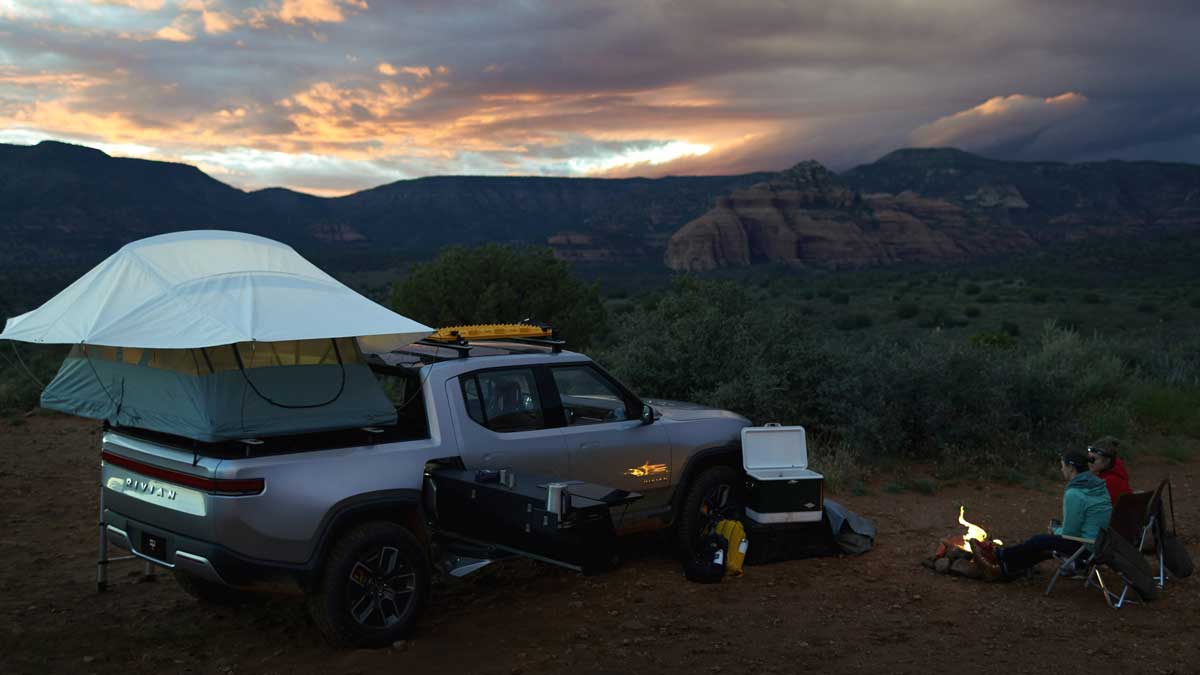
Originally I thought mounting some solar on the rooftop tent would be a good idea so it would trickle charge the power station while driving, but I think the overall setup would be cleaner if using a fold out solar panel as necessary while stationary. The EV would also have V2L so this could be used to quickly recharge the power station or act as backup if the power station dies.
Using data from my own experiments, a 2-3 kWh portable power station should easily run this kind of setup for a few days even without charging. This would be enough energy to cook at least a few meals or boil up to 20-25 L of water.
A portable power station can also act as an electric jerry can, providing a small amount of range to the vehicle in an emergency situation. I have seen some YouTubers use this approach when testing EVs until they stop, then plugging them into a power station to get enough charge into the battery to drive to the nearest charging station.
Exciting times are ahead
As described above, I always thought it would be a long while until decent electric 4WD options were available, and the die hard enthusiasts would consider switching. After my recent chats however, I now think this segment of the market is keen and ready to explode once some compelling and affordable options arrive.
This shift in sentiment also gives me more confidence that we will see another drastic uptick in EV sales once those compelling ute or 4WD models arrive, propelling us towards 80 % EV sales by 2030 or soon after.
My experience also caused me to reflect on my career. In the past I thought things might get less interesting and I may do something else when electric cars became more mainstream. In contrast, I think things are actually getting more exciting than ever as EV technology pushes the boundaries and makes its way into all segments of transport.
One last interesting conversation worth mentioning is with a guy called Rory, who is into rock crawling, an extreme and highly specialised sub-segment of 4WDing. He wants to build an insane electric rock crawler with 4 hub motors, and believes it could change the sport forever.
Rory currently drives a big American ute so he can tow his rock crawler around on a trailer, but he would be happy to switch to a viable electric alternative if that would save on fuel and enable him to recharge his electric rock crawler’s relatively small battery using V2L between races. This all just goes to show you shouldn’t judge a book by its cover.
Sign up for The Driven’s free daily newsletter and get the latest EV news and analysis delivered straight to your inbox.