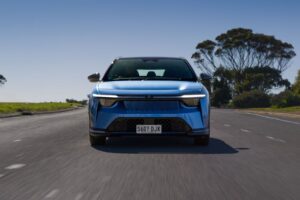
Sydney to Melbourne in an EV with just two 5 minute charge stops, or one 15 minute charge. This is not some claim by Toyota about a solid state battery coming in 2 years time, it is here and now in Tesla’s newest Model 3 Long Range Rear-Wheel Drive.
This new version of the Model 3 takes the crown for the longest range EV on sale with up to 750 km WLTP, comfortably beating the Polestar 3 Long range Single motor offering 706 km, the only other EV currently boasting over 700 km range.
As EV drivers already know and the naysayers like to point out, WLTP range is not an accurate figure of how far you can drive in the real world, especially on the highway. WLTP testing is performed in ideal conditions so that it is repeatable, but the average vehicle speed during the test is only 46.5 km/h.
So, to determine just how far the longest range EV will actually take you on a single charge, I borrowed one from Tesla and replicated my Polestar 2 range test from 2 years ago. At that time, the Polestar 2 Long range Single motor was the longest range EV on sale with 654 km WLTP.
Joining the Polestar 2 in the 600+ km club back then were just 6 EV models, including Mercedes-Benz EQS 450 4MATIC in second place with 631 km followed closely by the now obsolete Model 3 Long Range All-Wheel Drive in third with 629 km.
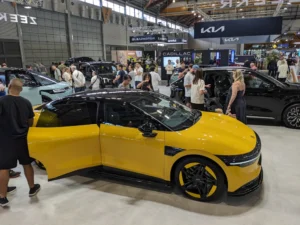
This number has more than tripled to 20 different EV models since then, or nearly 40 if you count all the different variants of those models with advertised range of 600 km or more. Some noteworthy entrants to the list are the MG IM5 (655 km), updated Porsche Taycan (642 km), Renault Scenic E-Tech (625 km), Zeekr 7X (615 km) and Kia EV3 (604 km).
EV manufacturers’ obsession with adding more range does not appear to be slowing down anytime soon either, evidenced by upcoming models like the facelifted BMW iX3 due to arrive next year, featuring 805 km WLTP range and 400 kW charging speeds.
How much range do you really need?
The answer depends on where you plan on driving and the amount of patience you and your passengers possess. Having driven an EV between Sydney and Melbourne or Brisbane several times, I can say that travelling on busy routes that are well served by DC fast chargers is already easy and requires little thought.
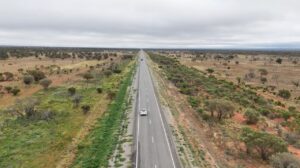
As shown by the number of people doing laps of Australia in their EVs, including one brave family in a BYD Dolphin, less travelled routes are also getting easier than they used to be, thanks in part to innovative off-grid solutions in remote areas.
However, venturing into the middle of the country where reliable DC fast chargers are harder to find will likely remain challenging for a while. Enter the new Model 3 Long Range Rear-Wheel Drive, which should help to quell any remaining range anxiety.
There are occasions where I wish my old Model 3 had more range too. Either to arrive somewhere without needing a charge or the ability to skip a charging stop for a later one with better amenities and food options nearby, so I can definitely see the appeal.
Plugging Sydney to Melbourne into the new Model 3 at 100 % state of charge revealed a trip plan with 2 very brief charging stops totaling 11 minutes, 5 minutes at Coolac, NSW followed by 6 minutes at Euroa, VIC. This was starting from the Tesla store at Miranda in the south of Sydney, and a remaining range of 620 km was also visible when fully charged.
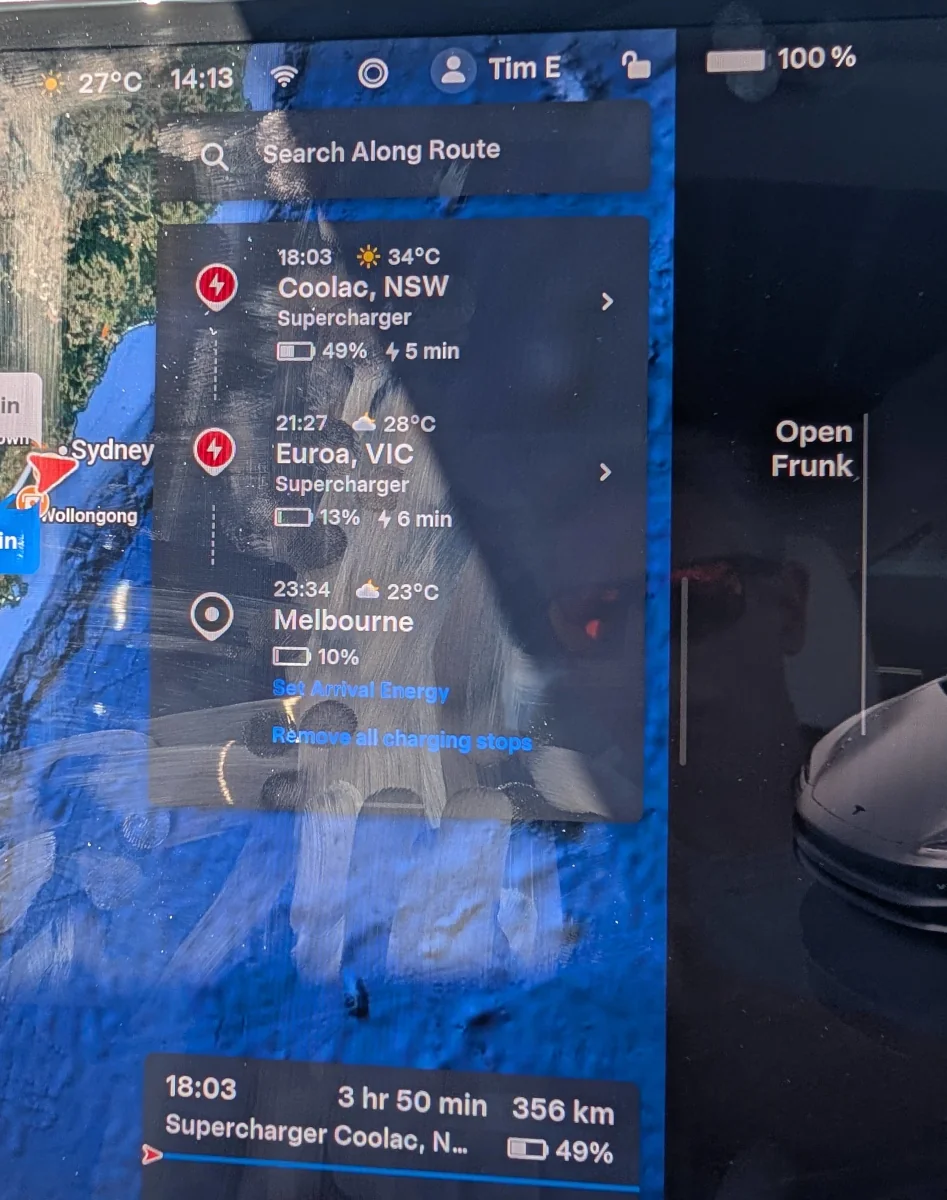
5 or 6 minutes is barely long enough for toilet breaks, let alone meals and proper rest breaks so I would not recommend travelling like this. To be clear, on long trips you should be taking regular breaks to stop, revive and survive. What it does show clearly though, is that charging an EV can be just as quick as refuelling an ICE vehicle.
You could already argue an EV is just as quick on long trips provided you are taking the recommended breaks every 2 hours and charging at the same time. Naysayers would probably disagree though, but surely even they need to stop for a 5 minute break here and there.
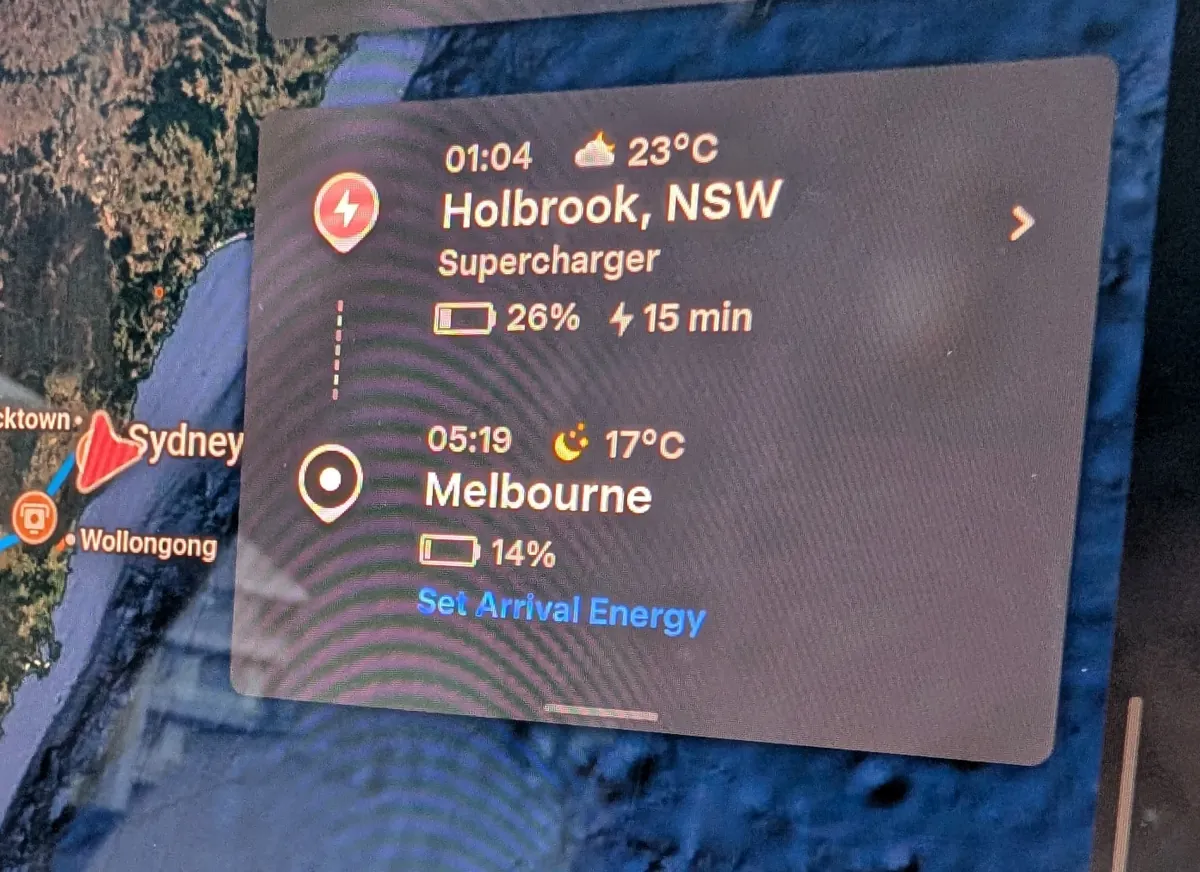
A single charge strategy is also possible, with the car estimating -19 % on arrival when all charging stops were removed, or in other words requiring 119 % of the battery to complete the trip. Manually adding a single stop at Holbrook, the car showed 15 minutes charging time, this was starting at about 90 % state of charge as I thought of this option later.
Highway range test
From my own experience on long drives in the past, the Tesla trip planner is generally pretty accurate with its estimates, and has also improved greatly since I first got my car over 6 years ago. Still, the only way to truly find out how accurate they are is to actually run the experiment.
Similar to last time around with the Polestar, my plan was to charge the car to 100 % and try driving from Sydney to Canberra and back. Again, this is not something I would normally do without charging while I’m stopped anyway, but is a good test at roughly 550 km in total and something I thought should be achievable in the new Model 3.
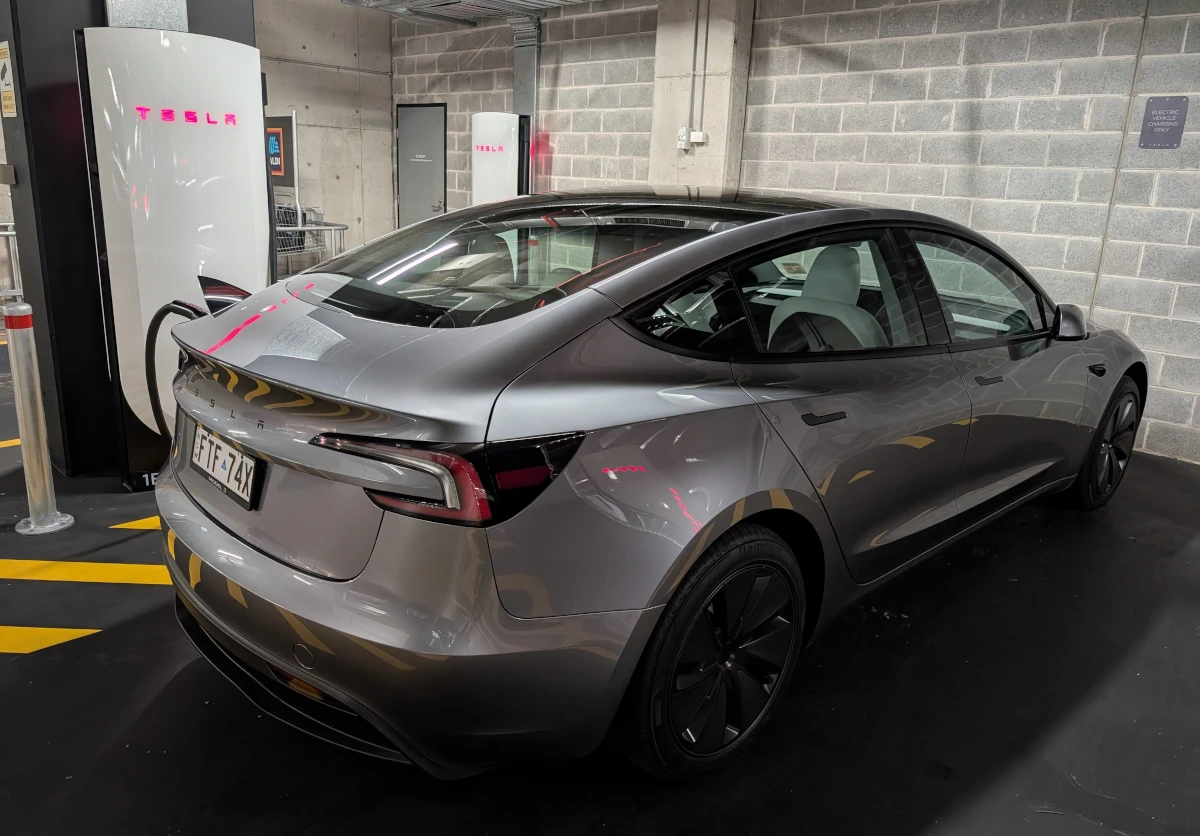
Firstly, I needed to charge up before starting the test, so I used one of Tesla’s newly opened Supercharger sites in Eastlakes, down the road from Tesla Sydney where I picked up the Model 3. This site has 8 stalls providing up to 300 kW, is open to all EVs and was not busy at all when I arrived.
While the car was charging, I grabbed some supplies and then waited patiently for it to creep up to 100 %. With the same destination in Canberra set, I watched the estimated state of charge upon arrival settle on 53 % which was an early positive sign that I’d be able to make the return trip as planned this time.
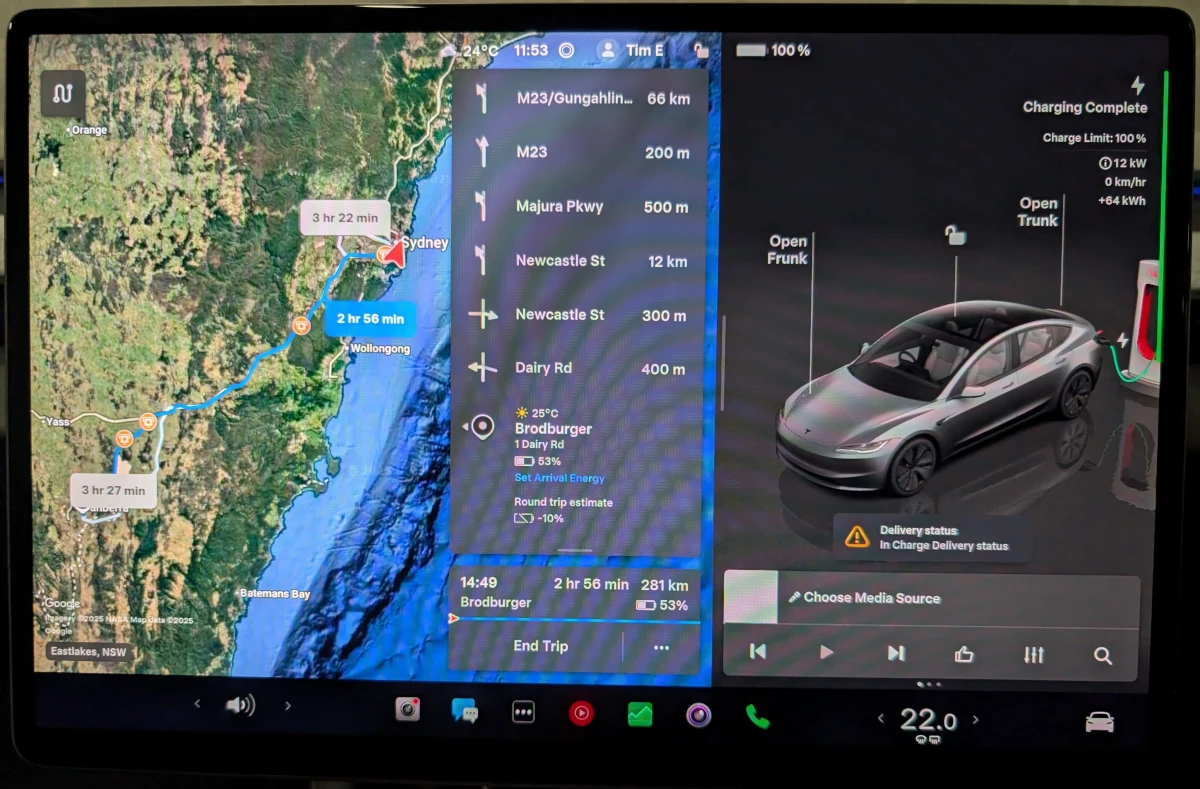
Along the journey to Canberra the estimated arrival meandered up by a few percent, peaking at 57 % before dropping back down to finish the first leg on 53 % as originally forecast. In comparison, the Polestar 2 navigation system estimated 24 % on arrival and ended up with 40 % remaining at the same point.
I had already eaten lunch earlier, so after stretching the legs I hopped back in the car and swiped down on the navigation search bar (one of my favourite Tesla shortcuts) to begin the journey back home.
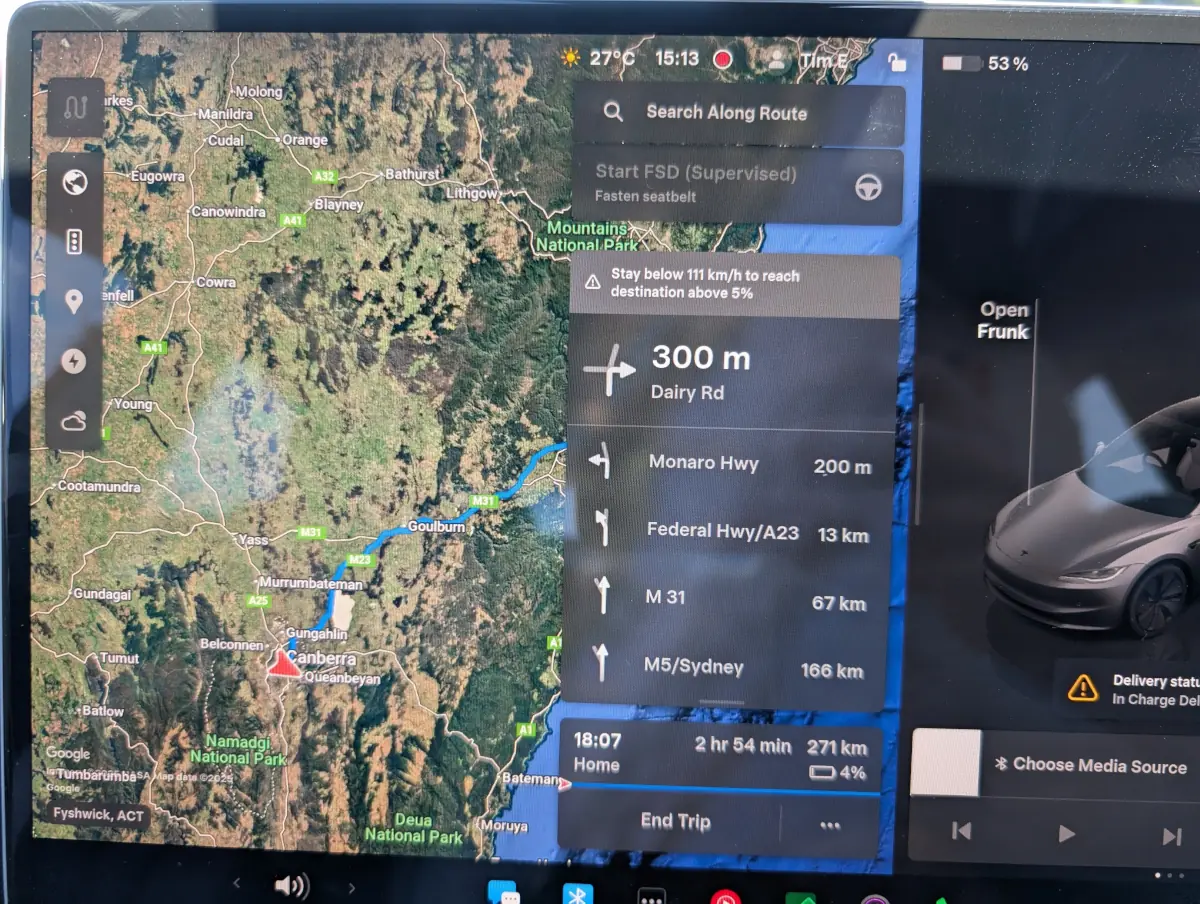
Given the return leg drops in elevation by nearly 600 m, I expected the car to use less energy on the way home, and thought the initial estimate of 4 % on arrival might be pessimistic as it was actually 2 % more battery than required to get there.
With plenty of time to test FSD (Supervised) on the highway again, a couple of new issues surfaced that I had not come across before. Several times on the trip, the car slowed down suddenly when it detected a drop in speed limit from 110 to 100 km/h, even though no signs were visible at all, so I assume it must be some kind of map data issue.
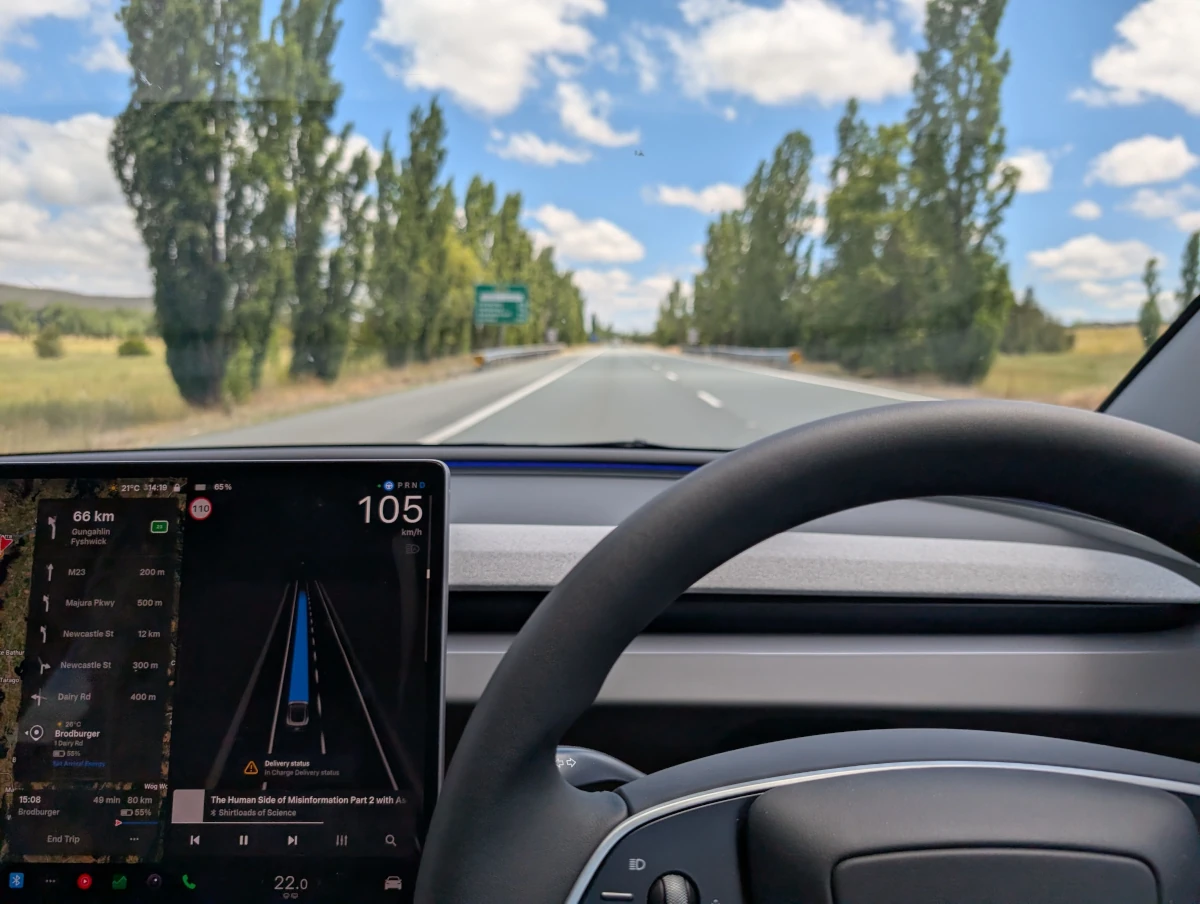
Instead of sticking to the set speed like glue as I’m used to with Autopilot, FSD (Supervised) also has a tendency to randomly slow down slightly even on straight stretches of road, which is why the first image above shows the car on 105 km/h. A quick tap on the accelerator was usually enough to remind the car to speed up again.
Automatic overtaking of slower vehicles worked fairly well most of the time, but occasionally FSD (Supervised) would not move back into the left lane after overtaking and required a hint with the indicator stalk to do so. This behaviour was not consistent either which I found strange.
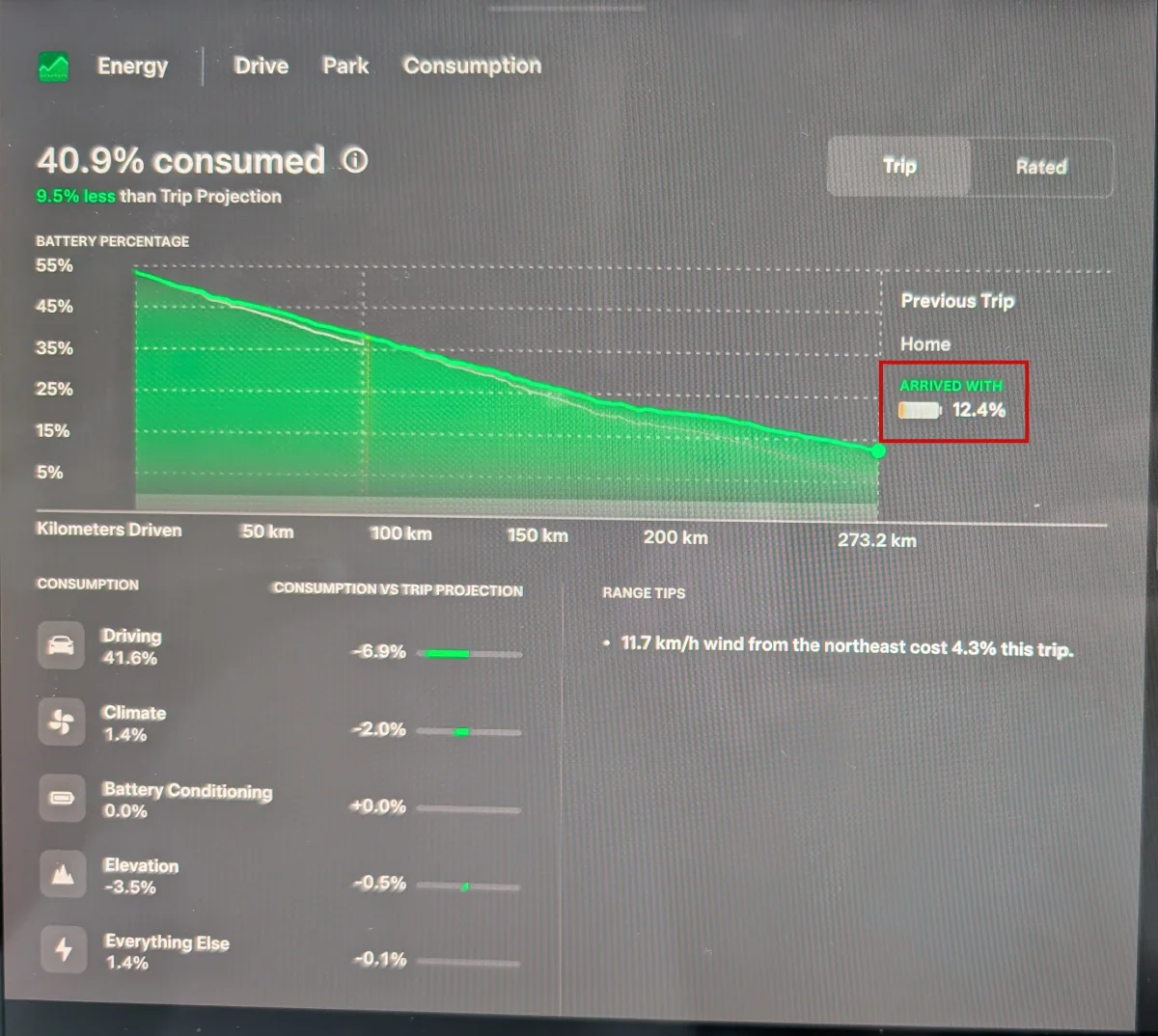
Rather than needing 49 % of the battery to get home, the Model 3 made the return leg using just 41 % of the battery and had a healthy buffer of 12 % remaining. The consumption information from the energy statistics app showed that roughly 7 % of this improvement from the original estimate was due to more efficient driving and 2 % savings from climate.
Overall energy efficiency for the 557 km trip was an astounding 122.8 Wh/km, with the last 2 hour stint after a rest break using just 108.4 Wh/km. Unsurprisingly, this is lower again than what I found in the Model Y refresh, which was already more efficient compared to the smallest EVs I have tested.
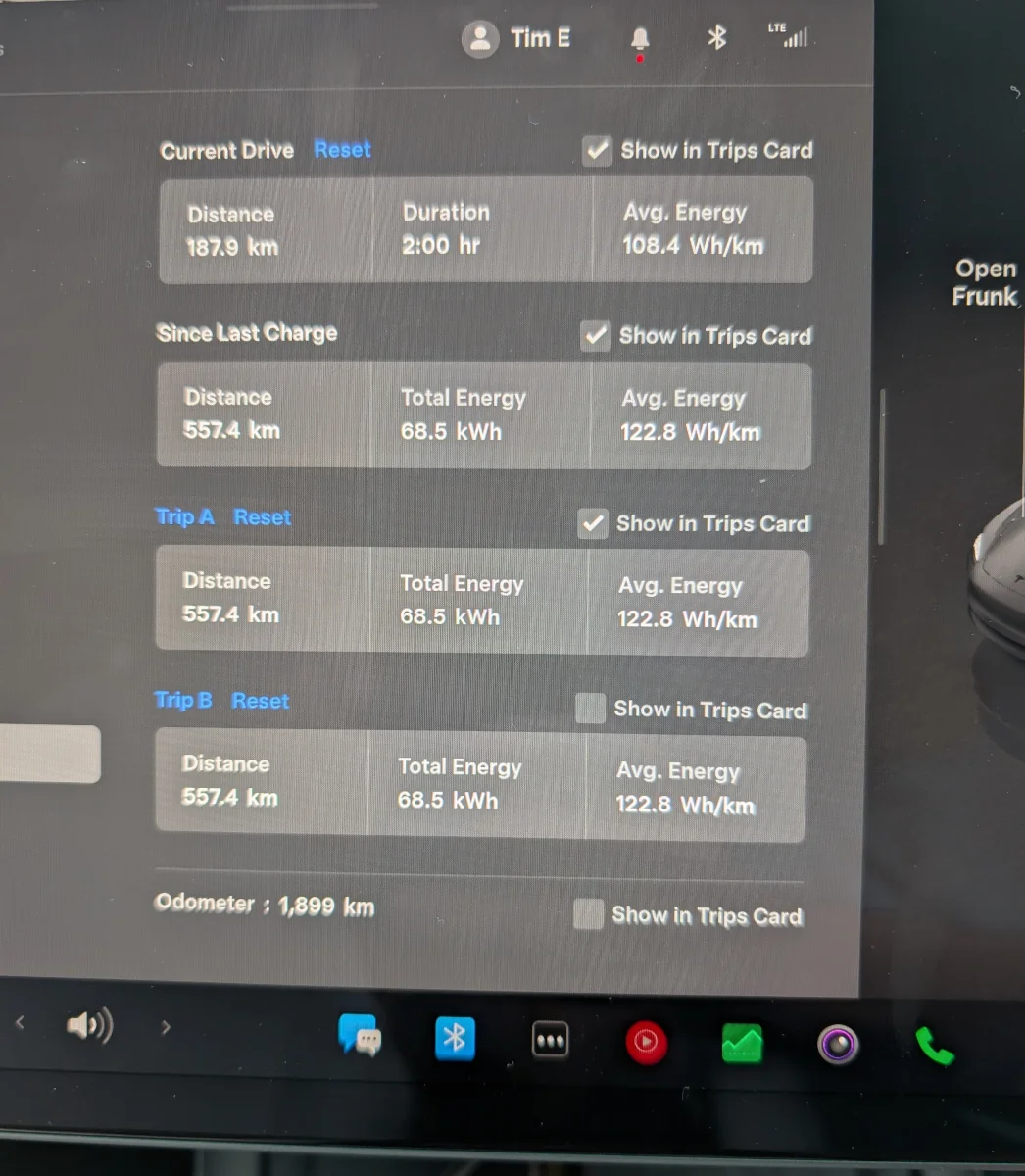
Calculating the real world range using this data results in 633 km from a full battery, slightly above 620 km that the car showed at 100 % state of charge. This is particularly impressive given we are talking about highway range while travelling at 110 km/h, with basically no opportunity for regenerative braking.
Looking at WLTP figures, the Model 3 Long Range Rear-Wheel Drive achieved 84 % of its advertised 750 km range, similar to what the Australian Automobile Association (AAA) found with the Model 3 Rear-Wheel Drive during testing conducted earlier in 2025.
For comparison with my own Polestar 2 results, that car was able to drive 485 km on the highway which equated to 74 % of its advertised 654 km WLTP range.
2 weeks between charges in town
Average consumption around town in the Model 3 was 147 Wh/km after covering roughly 100 km, although this result can be written off as an anomaly because it is the opposite to what you normally find with EVs being more efficient in the city.
The anomalous result must be because most of my city driving was done during heatwave conditions in Sydney, often on short trips where the air conditioning was working extra hard to cool the car down at the start.
Taking the result from the highway test instead, 633 km is enough for more than 2 weeks of average daily Australian driving, assuming 38 km per day. Most people will top up much more often too, meaning even for those without access to charge at home or work there is no rush to plug in.
Charging curve needs improvement
While Tesla continues to make some of the most efficient electric vehicles out there as demonstrated above, charging speeds have not kept pace with the competition. My 6 year old Model 3 has a peak charge rate of 250 kW which was great at the time, but this brand new Model 3 Long Range has the exact same figure.
Peak charge rates offered by the competition have clearly surpassed Tesla, such as the Zeekr 7X which is capable of around 470 kW at peak and a lightning fast 10-80 % charge in just 13 minutes. Hyundai and Kia EVs built on the 800 V E-GMP platform can charge from 10-80 % in 18-20 minutes, even though peak charge rates are roughly 230 kW.
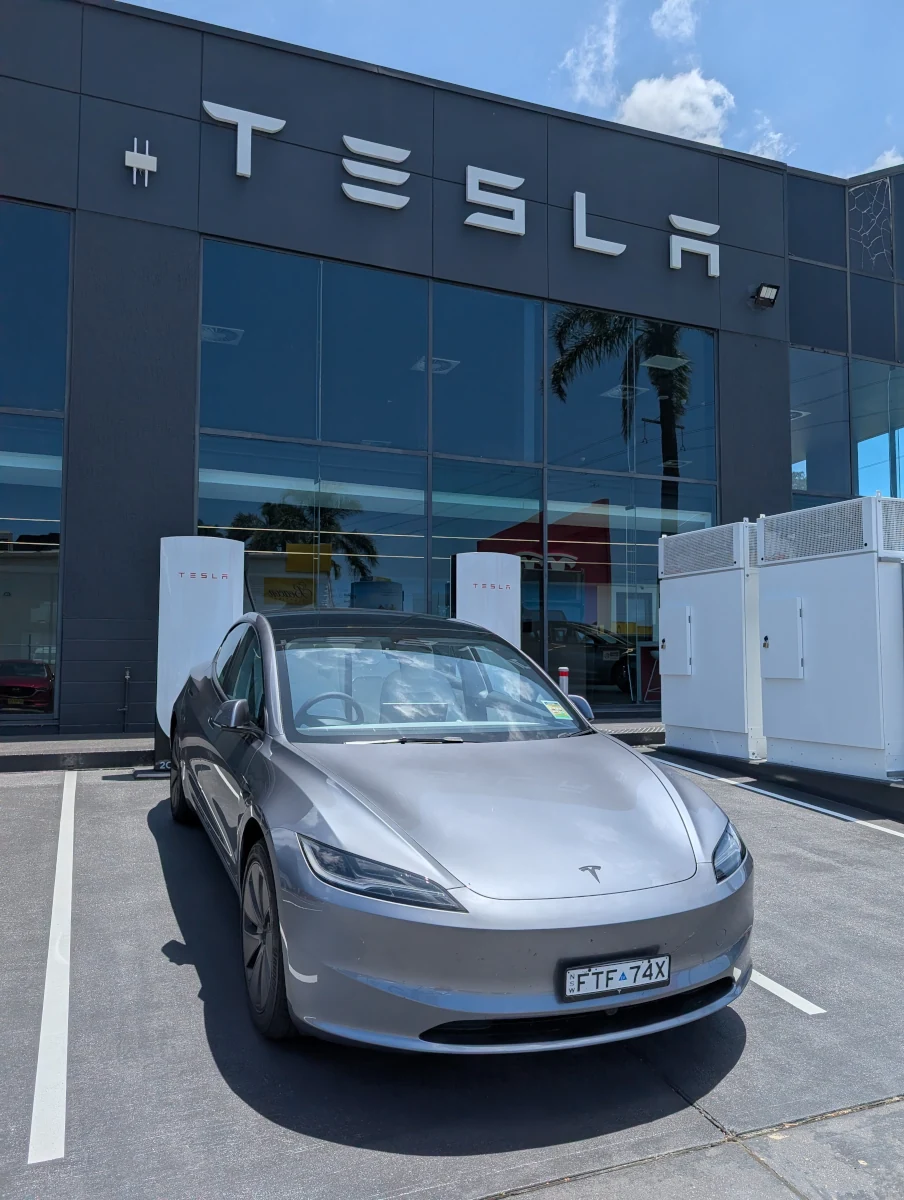
Tesla does not advertise 10-80 % times for their vehicles, so I timed 2 separate Supercharging sessions with the new Model 3 to see if they have improved recently. Charging at Eastlakes before the highway test, the car went from 22 % to 80 % in 29 minutes, while the final 20 % took another 31 minutes.
A second charging session at Miranda Supercharger the next day was similar, taking 32 minutes from 10 % to 80 %, and reaching 100 % in another 31 minutes. This session briefly hit the advertised 250 kW soon after I plugged in, but quickly dropped towards 200 kW and then 10 minutes later it was down to 102 kW at 46 % state of charge.
The slow trickle to 100 % is also a good reminder of why it is generally much quicker and more courteous to other drivers to unplug at 80 % and continue your trip. A good analogy I like to use is filling a glass of water to the brim with a jug, you need to pour very slowly at the top to avoid spilling anything.
Conclusion
While the Polestar 2 Long range Single motor from 2 years ago was already overkill for most, the new Model 3 Long Range Rear-Wheel Drive is even more impressive in real world testing, taking things to a new level thanks to its supreme efficiency.
Over 600 km of real world range at highway speeds unlocks the capability of EV road trips that do not take any longer than travelling in an ICE car. Just 10 or 15 minutes of charging over a 9 hour journey is certainly shorter than what it takes to refuel or take the necessary toilet or rest breaks anyway.
As an early adopter I have grown accustomed to taking regular breaks to rest and recharge on long road trips, arriving feeling refreshed. As we move into the early majority stage of uptake though, EVs like the new Model 3 Long Range might just be the cure for range anxiety and convince more people to finally make the switch to driving electric.