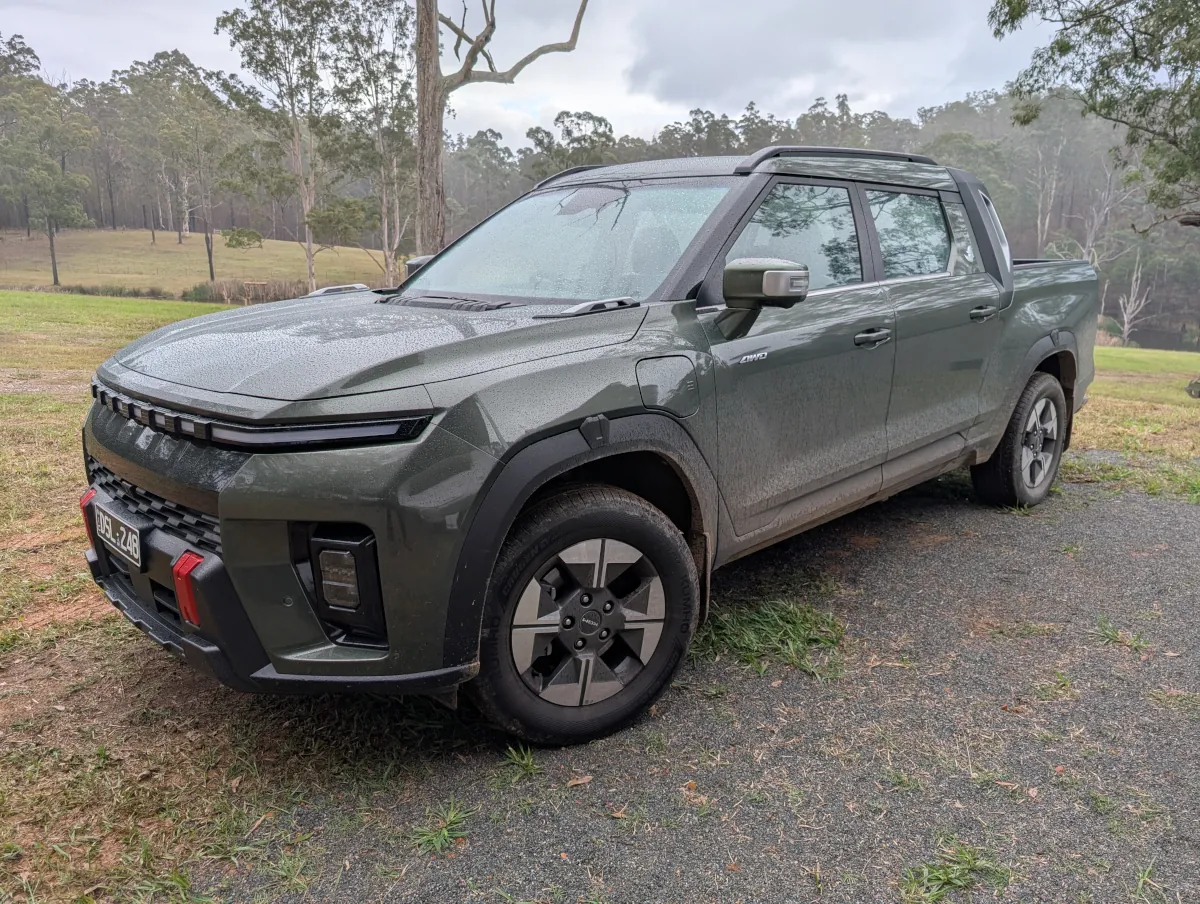
Korean automaker KG Mobility, or KGM, and ormerly known as SsangYong, released their first 2 EVs in Australia at the start of this year – the Musso EV ute and Torres EVX mid-size SUV.
They share many components, including their BYD blade batteries, and they look nearly identical from the C-pillar forwards. But it is the Musso EV ute that stands out as an important vehicle because it is the first practical and reasonably affordable dual-cab electric ute on the market.
It follows the lacklustre LDV eT60, which launched at the end of 2022 with a lofty price tag of $100,000 including on-road costs, although near-new demonstrators can easily be found for just over $40,000 now.
As Giles Parkinson wrote recently, the lack of electric utes is a problem for fleet buyers, but the Musso EV may just change that as it comes with decent specifications and a much lower price tag than the LDV eT60 first launched with. If KGM can market the Musso EV well, and secure enough supply, it could potentially replace many of the diesel utes on our roads.
Unlike the LDV eT60 which comes in rear-wheel drive only, the Musso EV comes in either front-wheel drive for $60,000, or all-wheel drive for $64,000 driveaway. There is also a 2WD Black Edge version for $62,000 which swaps out the fake leather seats for real leather and suede, as well as black alloy wheels and black exterior trim components.
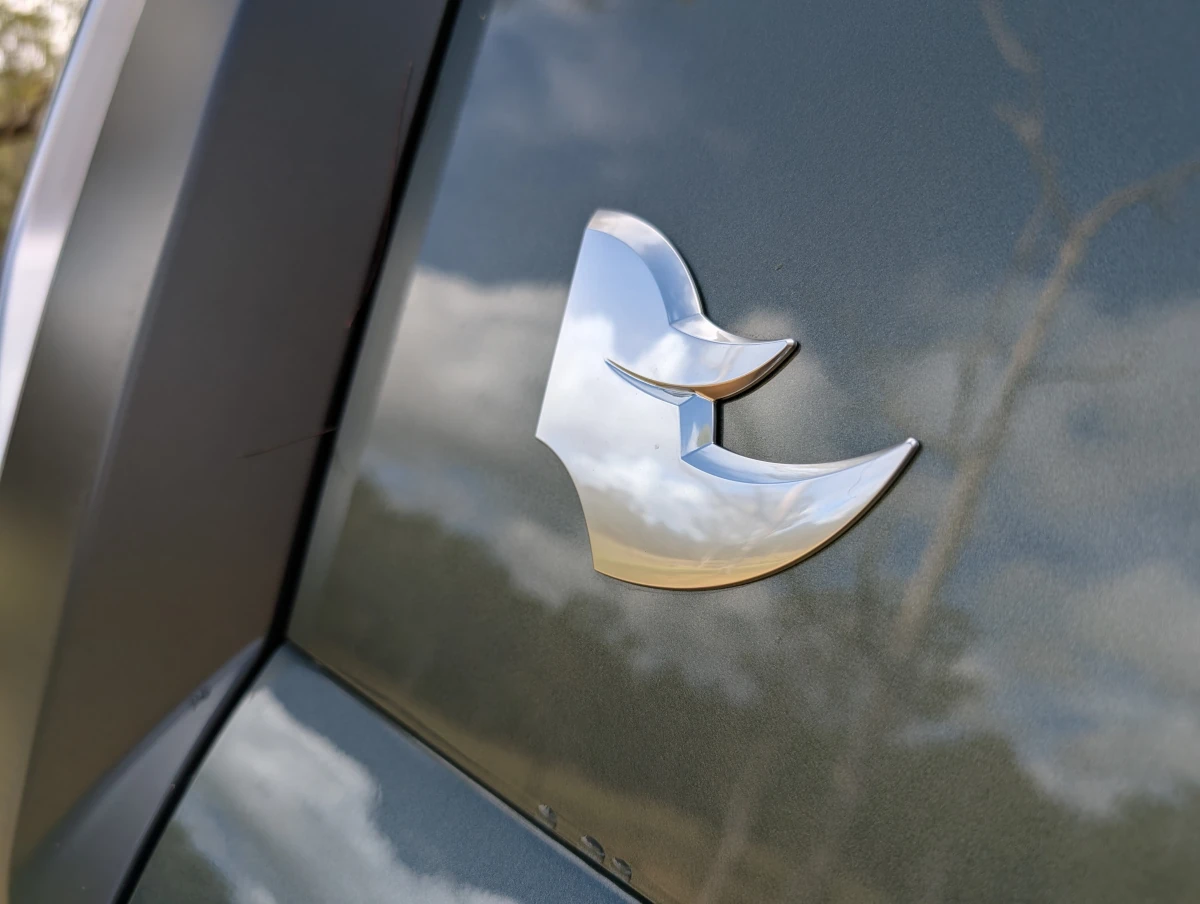
In terms of design, I think the Musso EV looks reasonably tough from the outside, like a ute or work vehicle should. I also like the horizontal front daytime running lights which give it a unique look at night time. If you were wondering what Musso means, it roughly translates to rhinoceros in Korean, hence the rhino logo found on the C-pillar behind the rear door.
I recently borrowed an all-wheel drive Musso EV from KGM for 11 days to visit my brother in northern NSW. The occasion was his 50th birthday party, which also turned out to be his surprise wedding! The road trip gave me the opportunity to test the Musso EV in all kinds of situations including a bit of light off-roading.
SUV-like performance on the road
Sharing its car-derived monocoque chassis with the Torres EVX, rather than a body-on-frame chassis of its diesel Musso counterpart, means the Musso EV comes with both pros and cons over a traditional diesel ute. We will get to the compromises in off-road ability and practicality later, but first the positives of this platform.
In short, it feels more like a normal SUV to drive, with McPherson strut suspension on the front and a multi-link setup with self-levelling shock absorbers on the rear. Around town I found it comfortable and easy to drive, and the excellent 360-degree cameras meant parking this 5 m long vehicle wasn’t too bad either.
As for drive modes, the Musso defaults to eco each time you start, or you can engage sport mode by pressing the left-hand shortcut button on the steering wheel. When I first drove it home, I thought eco was a bit slow and dull because I was expecting more power from the all-wheel drive example I borrowed.
At the first red-light opportunity I was keen to try out sport mode, which quickly transforms the Musso into an angry, charging rhino. I planted my foot and was shocked when the tyres screeched off the line in dry weather, embarrassing the poor old HiLux next to me, although they probably just thought I was some kind of insecure weirdo. It was also hilarious.
There is a third drive mode called Smart, enabled by holding down the left-hand regenerative braking paddle. However, it did an odd thing where it cut power in the middle of an intersection, even after I took my foot off and tried accelerating again twice. I meant to try reproducing it later when it was safe to do so, but completely forgot.
It would be great if there was a normal mode somewhere between eco and sport, for every day driving with a bit more response than eco offers. Traction control also needs some work, as it feels like KGM have simply taken the system from an ICE vehicle without considering the immediate response and torque you get from an EV.
Tesla has been in the EV game for a long time, but their traction control is night and day compared to the Musso. For example, I can stomp the accelerator in my dual motor Model 3 in the wet and there is no detectable wheelspin at all. To be fair, the Model 3 would have more natural grip and mine is fitted with Michelin Pilot Sport 5 tyres which make a difference.
Another advantage of the Musso EV platform is better comfort over long distances. I drove the Musso between Sydney and Coffs Harbour in one day and found it to be very spacious and comfortable. I arrived refreshed after 6-7 hours of driving with a couple of charging stops along the way.
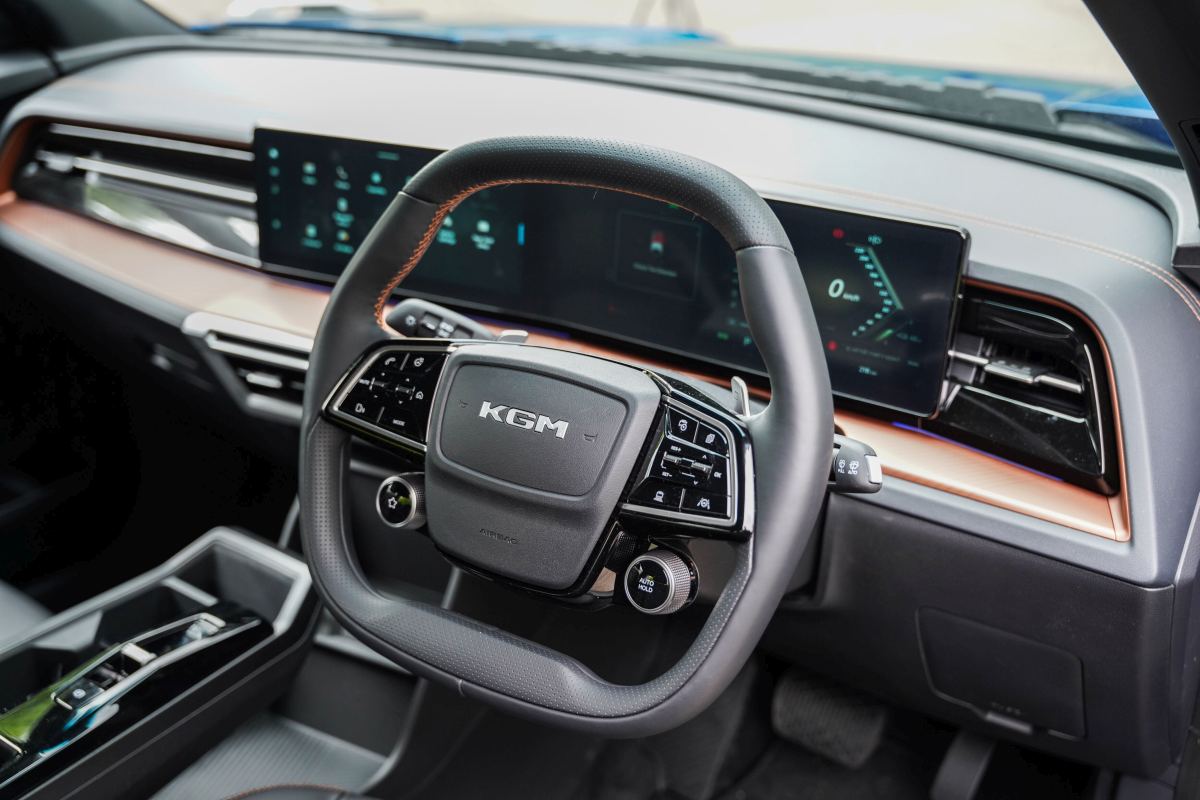
Adding to the comfort are standard features like heated and ventilated seats in the front, as well as heated rear outer seats. At first I thought the sound system was a bit weak sauce, but someone before me had turned the bass right down and mids right up, it sounded decent after fixing that.
The Musso EV infotainment does not include any built-in connectivity or navigation on the 12.3-inch screen, so you need to use wired Apple CarPlay or Android Auto for this. On my test car the audio kept glitching, but I believe it was a dodgy USB-C port, because the cable felt a bit loose and I was able to fix it each time by reconnecting the car side of the cable.
For long highway drives, the adaptive cruise and lane centering functions worked as expected, albeit with an occasional wander that triggers the emergency lane keeping system. Emergency lane keeping can be set to warning instead of assist, but it changes back to assist on the next drive, which I assume is an ANCAP safety requirement.
Overall using Bryce Gaton’s ADAS scale, I would agree the Musso is in the slightly annoying category, primarily because the emergency lane keeping system is too eager to interfere on winding country roads, and sometimes incorrectly detects different patches of bitumen or road repairs as lane markings.
It won’t replace your tricked out 4WD anytime soon
To assess the off-road performance of the Musso EV, I asked my brother Ant to help me out on his off-grid bush property. We grew up around 4WDs in the 1980s and our parents were heavily involved in the local 4WD club. I have plenty of great memories from the trips we did in our Range Rover to places like Uluru and Cape York.
My brother definitely caught the 4WD bug, he used to practice 4WD’ing on our grandparents property and spent hours mucking around in the backyard with an ex-army Land Rover before he even got his learners permit. Ant has done countless 4WD trips with his local club, is a mechanic by trade, and previously owned Coffs Harbour 4WD Centre for 20 years.
Needless to say, he is far better skilled at judging off-road capability than me, so I let him drive the Musso on the bush tracks around his 1,200 acre property. We didn’t attempt anything too serious, probably on par with some of the dirt roads you might traverse on your way to various campgrounds in national parks.
On paper the Musso starts off disadvantaged due to its monocoque chassis as described above, combined with only 181 mm ground clearance vs 215 mm for the diesel Musso ute. The traction control system also causes problems on dirt roads, the wheels tend to lose grip and spin more than you would like, especially after stopping and starting up a hill.
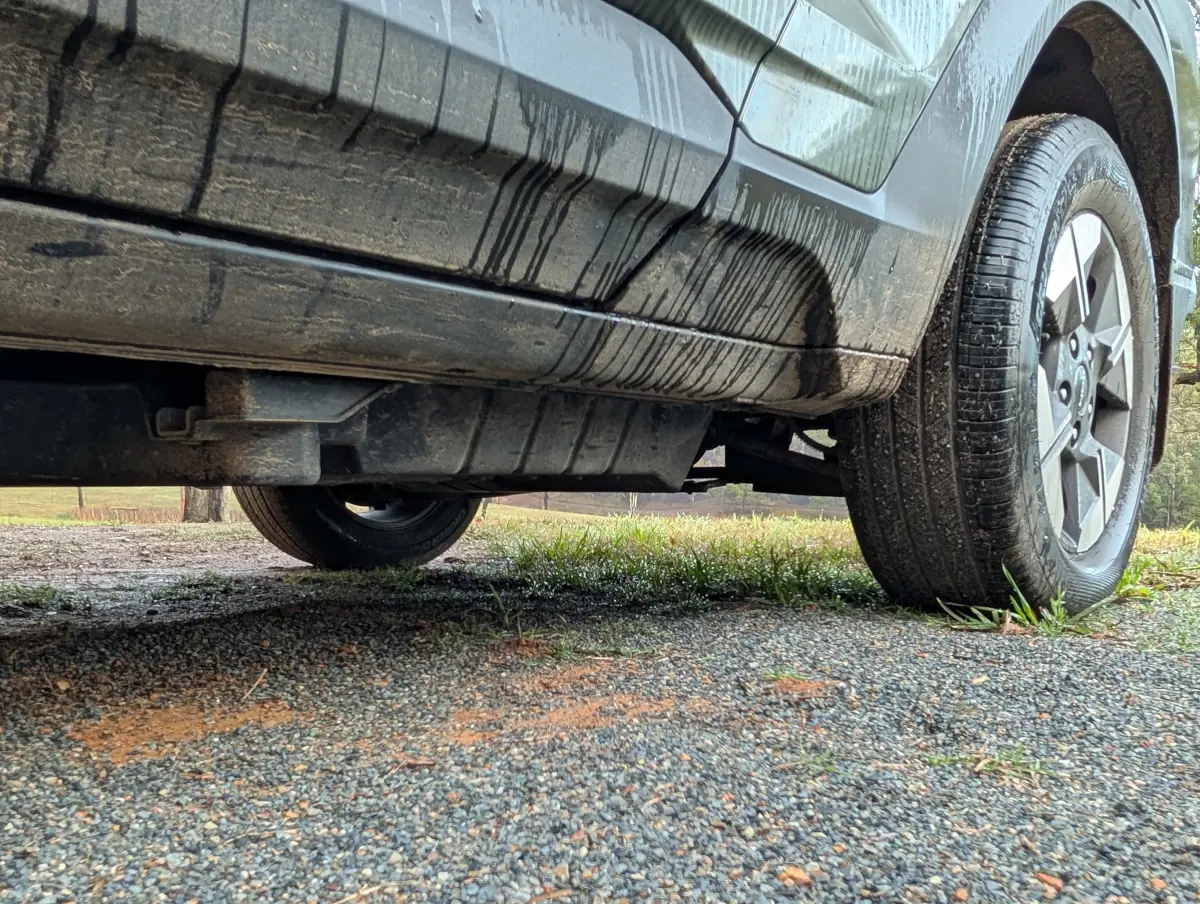
As Ant explained to me, the low point of a traditional diesel ute is usually the differentials along the axles, whereas the battery pack between the wheels in the Musso EV hangs down below the body, meaning it scraped over some water bars where a typical 4WD would have no issue.
There are no off-road specific drive modes either, apart from a hill descent mode that is enabled through an on-screen shortcut. In comparison, soft-roaders such as the Subaru range of EVs at least come with several dedicated off-road modes and grip control, as well as 211 mm ground clearance.
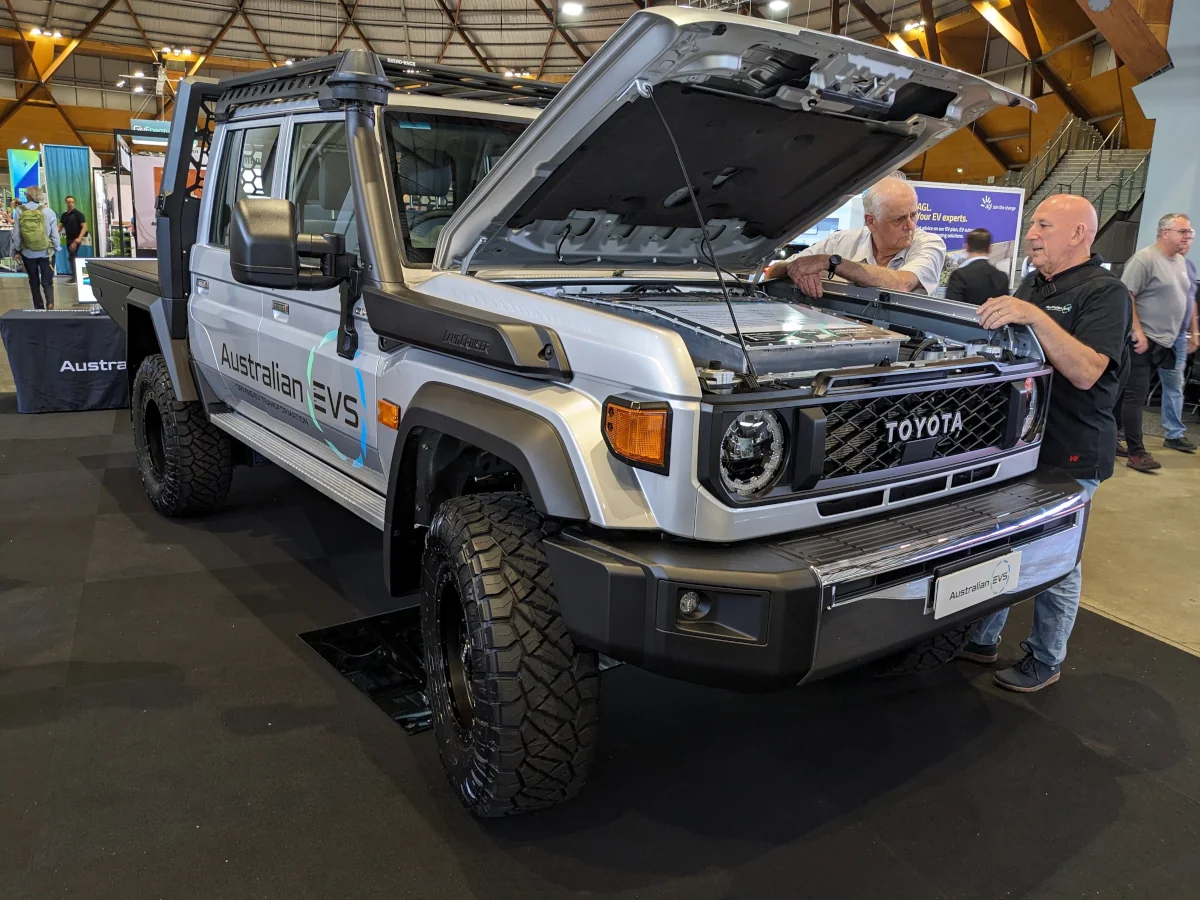
Unfortunately there are limited options if you want a fully electric 4WD today. There is the $250,000 electric Mercedes-Benz G-Wagen which could probably go anywhere with its 4 electric motors, or something like the Australian EVS converted Toyota Land Cruiser which is in the same price range. You could also convert your existing 4WD, but that is pricey too.
Practical for some things, highly impractical for others
Australians love their utes, and I can totally empathise, after my mates and I developed a strange obsession with them during a camping trip after high school to Coolendel near Nowra, NSW. We basically ran out of food and decided to hike the 30 km into town to buy more, and couldn’t drive in as our parents had dropped us out there for the holiday.
We had been walking along the dirt road for hours, probably without enough water, when a ute came to our rescue and gave us all a ride into town. After stuffing ourselves silly at the all-you-can-eat Pizza Hut until they kicked us out, we started the long trek home. We were saved again by a different ute that dropped us most of the way back to camp.
So yes, I still have a soft spot for utes, and I understand the appeal of being able to throw your bikes or camping gear in the back. However, I reckon that most of the utes I see driving around Sydney are rarely used for that sort of thing. The tax loopholes available for commercial vehicles are also partly responsible for their popularity I assume.
The car-like platform of the Musso EV hinders practicality in terms of heavy workloads, limiting towing capacity to 750 kg unbraked and 1,800 kg braked on both variants, which is half of a typical diesel dual-cab ute. Payload capacity is 905 kg for the 2WD and 805 kg on the AWD, slightly below a diesel which ranges between 900 kg to just over 1 tonne.
KGM has also given the Musso EV more cabin room at the expense of a tray tub that is 200 mm shorter than those found on a HiLux, Ford Ranger and so on. While there is still plenty of room for your dog in the back, it means there is less room for hauling around building materials or recreational gear.

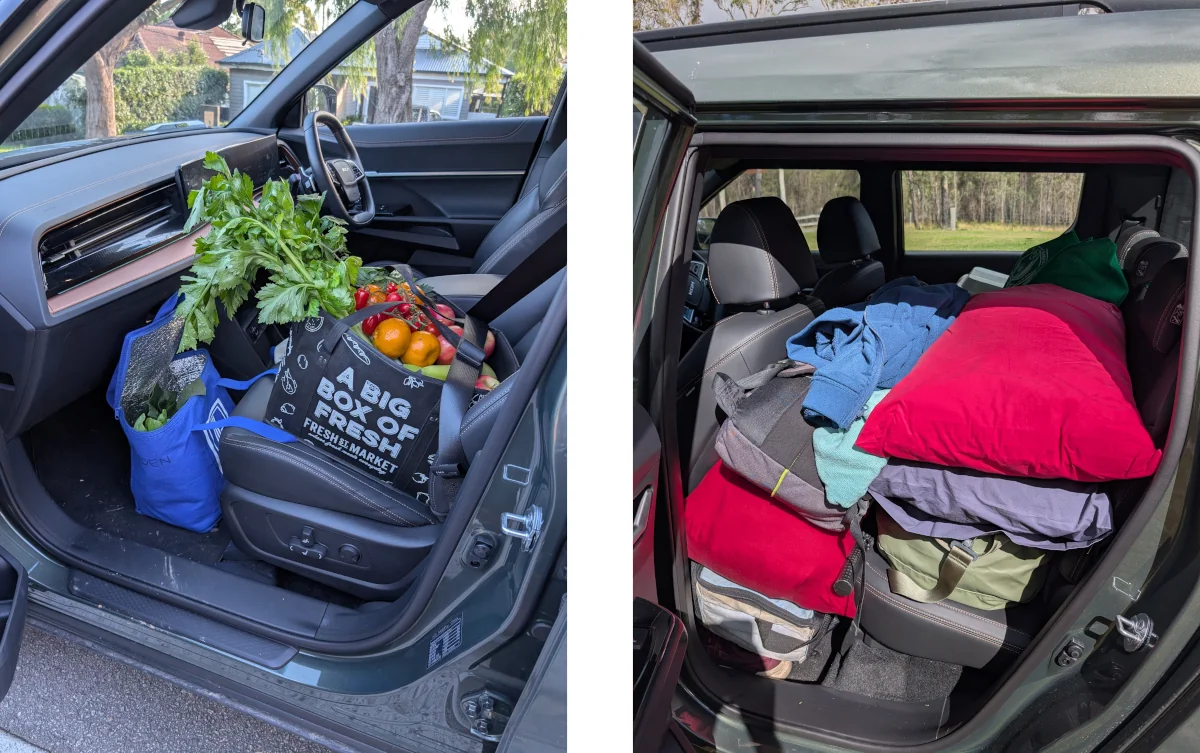
When it comes to everyday stuff like carrying groceries or luggage for a road trip, I found the Musso EV was highly impractical. There is no frunk for storing items under cover either, so you need to use the cabin area if you don’t want to throw things in the tray. This is probably fine most of the time, but would be an issue if you are also carrying a few passengers.
On the drive between my mum’s place in Coffs Harbour and my brother’s, we basically filled the back seats with our luggage and food for the weekend. Unfortunately my mum’s partner was unable to make the trip, but if he did, half of our stuff would need to be thrown in the tray and would have gotten wet as I forgot to bring a tarp.
KGM currently lists about 10 accessories for the Musso EV on their website, including an $1,800 manual roll top cover for the tray, which I would say is nearly essential if you plan on carrying more than 1 passenger around as well as groceries or luggage at any point.
Accurate range estimates, with room for efficiency improvements
KGM quotes a WLTP range of 420 km for the 2WD Musso EV and 380 km for the AWD I tested, and efficiency figures of 230 Wh/km and 260 Wh/km respectively. While these sound a little short on paper, the good news is that they are more realistic than most EVs, as Bryce also noted in his experience with the Musso EV.
This accuracy gave me the confidence to push the Musso EV further than I usually do. On the way back home I arrived at Taree Tesla Supercharger with 1 % left, after Brad Trethewey from Essential Energy kindly let me AC charge the Musso for 2 hours while he gave me a tour of their Innovation Hub in Port Macquarie where they test V2G equipment.
Over my entire 1,300 km road trip, the Musso EV averaged 270 Wh/km. This is certainly on the high side, even for a large and boxy vehicle, but I believe efficiency could be improved drastically with some hardware and software tweaks in the future. Keeping the tray closed with the roll top cover would also help in terms of aerodynamics.
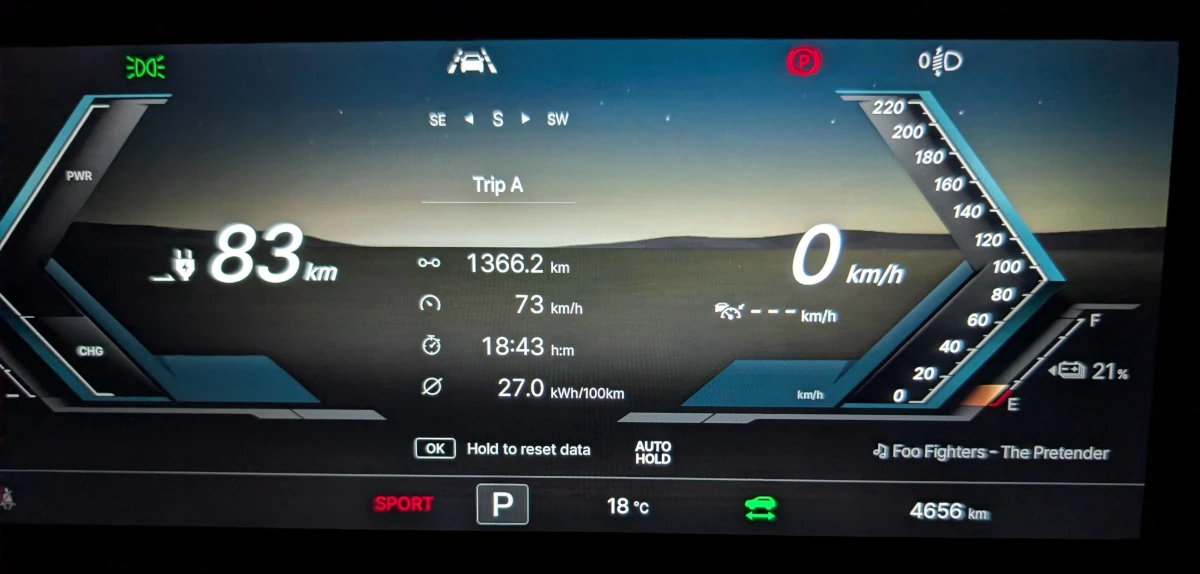
The Musso EV is KGM’s first generation, and automakers usually learn a lot so they can improve efficiency in refreshed versions by switching to silicone carbide inverters, more efficient battery packs and better software for managing the electric motors and regenerative braking for example.
Around town where there is more opportunity for regen and less impact from aerodynamics, the Musso EV consumed 234 Wh/km, beating the quoted figure of 260 Wh/km by a decent margin.
For the full list of charging stations I used on the road trip, along with their cost, see the table below. Interestingly, I found the Tesla Superchargers are now the cheapest option even without the Tesla subscription. My trip also included a few AC charging sessions that were free.
| Location | Price / kWh | Energy, kWh | Total |
| Evie Cameron Park | 79 c | 41.44 | $32.74 |
| Tesla Supercharger Thrumster | 68 c | 65.93 | $44.83 |
| Trickle charge at mum and Phil’s overnight | Free | ~25 | $0.00 |
| Chargefox Dorrigo | 83 c | 57.09 | $47.39 |
| Trickle charge at mum and Phil’s overnight | Free | ~25 | $0.00 |
| AC 10.5 kW charge at Essential Energy Innovation Hub | Free | ~21 | $0.00 |
| Tesla Supercharger Taree | 68 c | 75.31 | $51.21 |
| Tesla Supercharger Raymond Terrace | 68 c | 39.63 | $26.95 |
| Total | 350.4 | $203.12 |
My entire trip came to a total of $203.12, vs roughly $260 if I had made the same trip in a 3.0 L V6 diesel Ford Ranger, using the quoted efficiency of 8.4 L/100 km and current diesel price of 226.6 c/L. When diesel returns to more than $3 per litre as our fuel reserves start to run dry, this will increase to $350 or more.
KGM quotes a DC charging time of 10 – 80 % in 36 minutes when using a 300 kW charger, although the maximum actual charge speed is around 130 kW, so this BYD blade battery is certainly not the newest flash charging breed. Also worth keeping in mind is the charge speed drops to just 27 kW at 79 % state of charge, so it’s not worth going past this.

The Musso charge port is located on the front passenger side, behind the front wheel. Normally I would prefer the back left, but I realised front left may actually be advantageous when towing. If the charging station has room, you may be able to pull into a charging bay and leave your trailer connected, as long as there is enough room behind you.
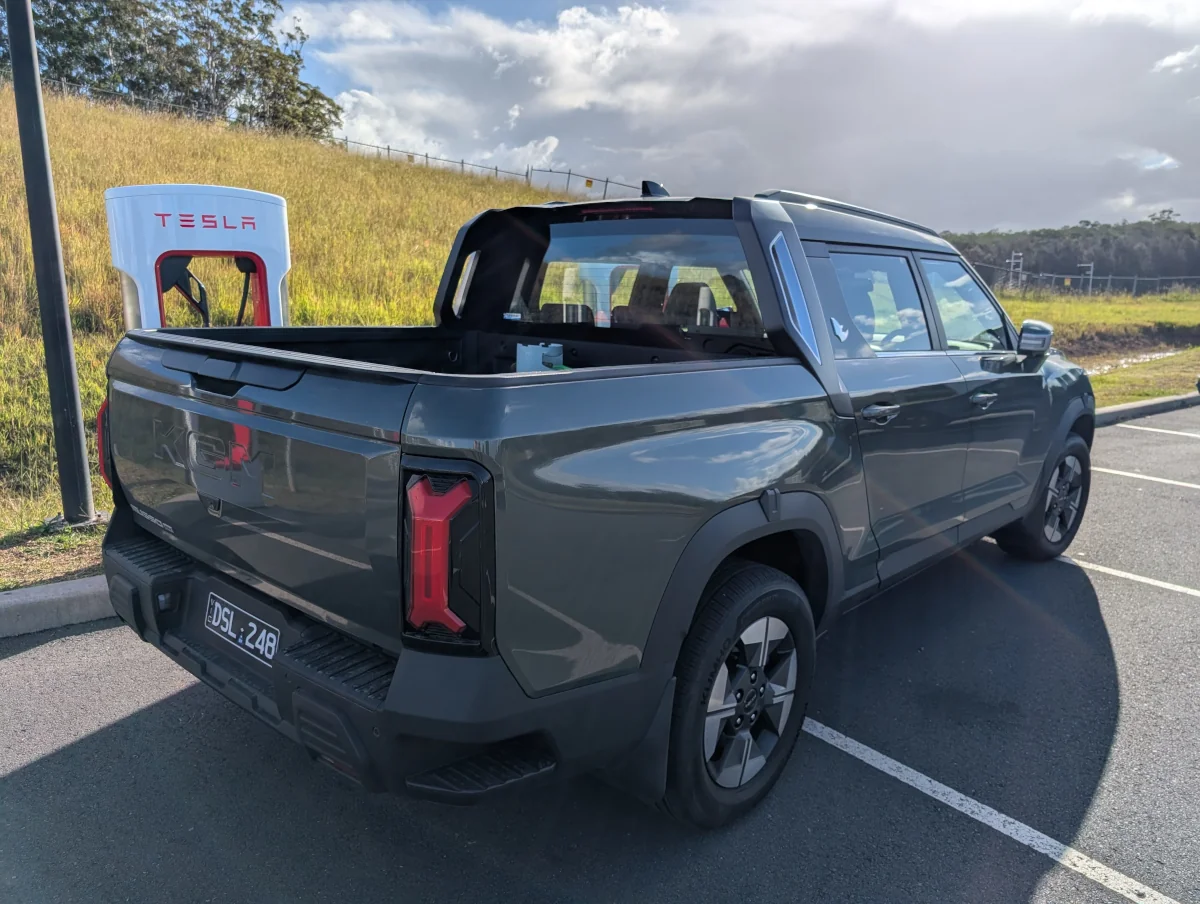
I usually say the front left isn’t ideal for Tesla Superchargers either, which is still true, but it only really matters when using the older V2 or V3 stations with short cables. For example, at Tesla Thrumster I tried everything to park my nose in, but the cable just would not reach until I parked sideways across 2 bays. Luckily there were only 2 out of 12 bays occupied at the time.
Conclusion
Overall I really like the KGM Musso EV and had fun taking it on a road trip as well as driving it around Sydney. I believe it can potentially replace most of the combustion powered dual cab utes on our roads today, with a couple of important caveats. If you don’t ever do proper off-roading or need to tow more than 1,800 kg, then the Musso EV is definitely worth a look.
I think it really makes sense for those tradies who drive a lot, currently spending hundreds each week filling their fuel tanks. The circa 400 km range should be plenty, and you can always top it up during smoko if you drive further than that each day.
Paired with an electricity plan with cheap overnight charging, the running costs would be insanely cheap. Assuming you drive 200 km per day and charge 40 kWh each night, this comes to $1.80 a day or less than $10 per week.
The phrase game changer is thrown around a lot, but in this case it is justified in my opinion. $500 per year on electricity vs $10,000 or more for the same V6 diesel Ranger I used above is a huge saving that could be put into your mortgage or reinvested into the business. Not to mention the many other benefits of driving an electric vehicle.
As for the Musso itself, I would recommend spending the extra $4,000 for the AWD for better traction, especially if you plan on towing things regularly. Sales of the Musso EV only started in January this year, so far KGM has only sold 138 vehicles, but 86 of those were in April which shows they are just beginning to ramp up.
As mentioned above, if KGM can market the Musso EV well, and secure enough supply for the Australian market then you may start seeing plenty more of these on our roads. There is also the MG U9 EV ute coming soon, which gives buyers another fully electric option in this segment to consider.
Table of key specifications for KGM Musso EV
The full PDF specification sheet is available here on the KGM website.
| Variant | 2WD | AWD | ||
| Driveaway price | $60,000 | $64,000 | ||
| Paint colours and options | 6 exterior colours:
|
|||
| Battery size | 80.6 kWh | |||
| Battery chemistry and manufacturer | Lithium Iron Phosphate (LifeP04), BYD | |||
| Range, WLTP | 420 km | 380 km | ||
| Driven wheels | Front-wheel drive | All-wheel drive | ||
| Power / Torque | 152 kW / 339 Nm | 266 kW / 630 Nm | ||
| Maximum charging speed | 10.5 kW AC, 130 kW DC | |||
| Charging time | 11 kW AC (0 – 100 %) – 10 hours 20 minutes 150 kW DC (10 – 80 %) – 36 minutes |
|||
| Bidirectional charging | V2L up to 3.5 kW, via external adapter |
|||
| Exterior dimensions | Length: 5,160 mm Width: 1,920 mm Height: 1,750 mm Wheelbase: 3,150 mm Ground clearance: 181 mm |
|||
| Kerb mass | 2,165 kg | 2,285 kg | ||
| Storage space | Frunk: N/A Tub length: 1,345 mm Tub width: 1,515 mm Tub depth: 510 mm |
|||
| Service interval | 12 months / 20,000 km | |||