Evelyn and I are now 4 weeks into our 15-week EV road tour of central Australia. The aim was to retrace the honeymoon we took driving a Holden V8 sedan towing a Cabana caravan a lifetime ago.
This time we are not just testing our relationship but also our luck driving an EV across the outback, even where there are as yet no fast chargers, while also exploring the attitudes of the people there.
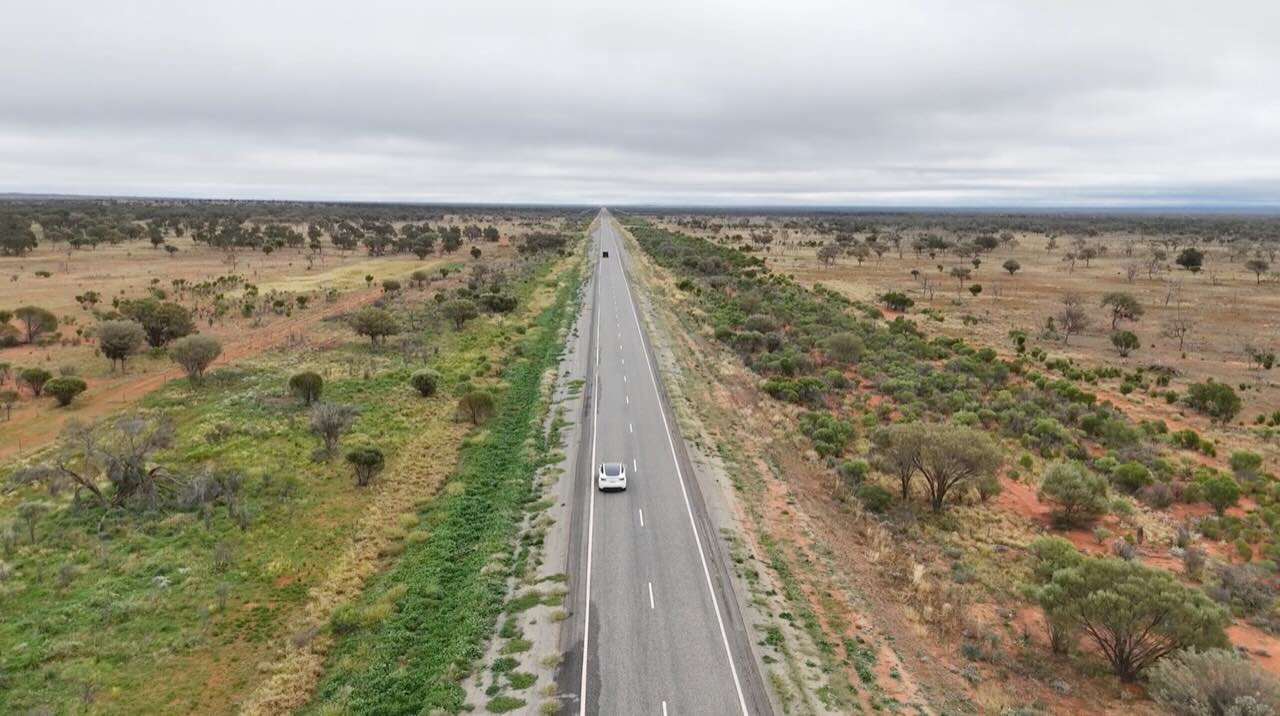
We left our Shellharbour, NSW home in early June and have now arrived safely at Uluru in our stock standard 2022 Tesla Y (with a few precautions, like a spare wheel, and a bit of planning).
Taking our time to experience the places we pass, so far we’ve stayed a few nights at each of: Katoomba, Dubbo, Cobar, Wilcannia, Broken Hill, Peterborough, Renmark (a diversion to catch up with friends and family), Flinders Ranges, Pimba, Coober Pedy, Marla, and most recently the ‘centre of the centre’ Erldunda.
We had hoped to follow the Oodnadatta Track as we had done 43 years ago, when the main road to the NT, the Stuart Highway, was also dirt to the border. We wanted to relive the experience of visiting Marree, William Creek and Oodnadatta itself while perhaps getting to see some of the flooded Lake Ayre, and a greener outback than usual.
Sadly we had to abandon that 600 km of gravel road from our plans as authorities have had the road closed. The abnormally wet weather over the last few months has marooned people along the Track for days at a time and it is still only open to 4WDs. ( I considered attempting it anyway in our 2WD ‘with great care’ just as we did in 1983, but sadly and safely my good wife would not have a bar of it! 🙂
“What about charging the EV?” I hear you say. There are no fast chargers out that way. Well, we had teed up with all the hotel and camp sites we have booked (planning no more than around 250km between stops) that we could happily plug into to their power overnight.
Some do have destination charging points, but mostly a regular power point or spare powered campsite could be found. We are travelling with 2 (really heavy duty) extension leads totalling around 25m with the Tesla charging lead (and a spare of that too, just in case). It’s great that 230v ac power is universally available anywhere in Australia.
From an environmental point of view, yes there will be diesel generators producing much of the power we use overnight, and I understand that makes our EV essentially a diesel burning vehicle for such legs. But we are trying to charge as much as possible during daylight hours to maximise use of the seemingly ample solar energy out here.
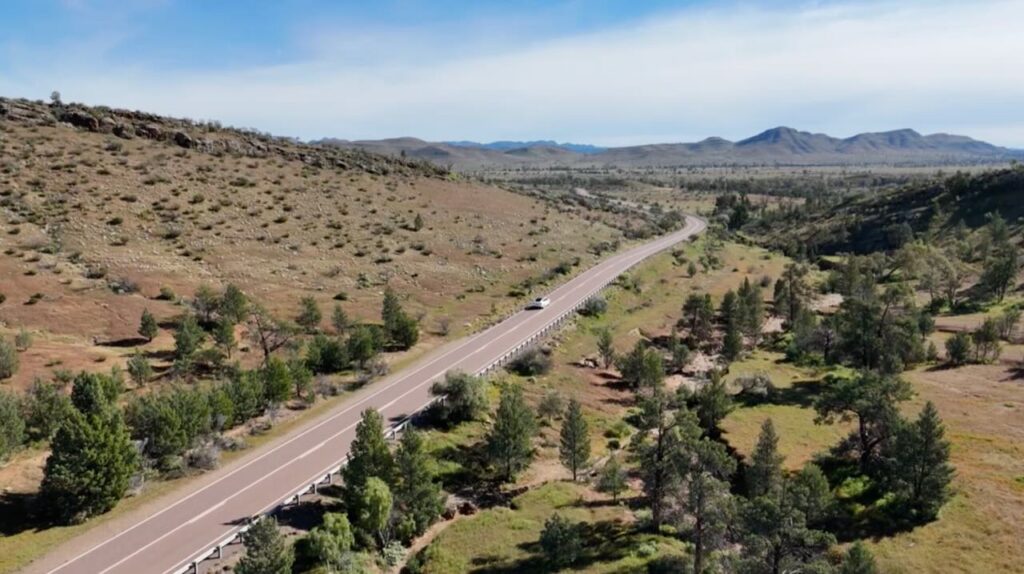
We had planned so that we could get by without needing the still growing fast charge network, but we find we have been making good use of the great works that the road service associations and federal government have kindly worked together on, along the major routes.
As we get further into our ‘circuit of central Australia’ we will however have to rely increasingly on the standard power points out there.
Our planned stops from here are inspired somewhat by ABC’s BackRoads: Kings Canyon, Alice Springs, Barrow Creek, Tennant Creek, Renner Springs (Pamayu), Daly waters, Katherine, Jabiru (Kakadu), Darwin, Litchfield NP, Pine Creek, Mataranka, Dunmara, Tennant Creek, Barkly Homestead, Camooweal, Gregory Downs, Normanton, Karumba, Croyden, Cobbard Gorge, Undara lava tubes, Lyndhurst, Hughenden, Winton, Longreach, Windorah (just in time for the Yabbie races), Eromanga, Thargominda, Cunamulla, Bourke, Lightning Ridge, Coonabarabran, and Lithgow.
So what’s it like touring in the Tesla?
Well, let’s face it, we could do with a little more range in the battery. When new, our Model Y gave an estimated range of around 430km fully charged. Nearly 4 years and 65,000 km later, it is telling us around 405km (dropping less than expected).
But that measure is the (Aust and EU standard) WLTP* calculation which works fine for driving around town averaging less than 80km/h. When travelling continuously on the open highway however the range is somewhat different.
(The USA’s less optimistic EPA measure of EV efficiency may be more accurate for highway travel than WLTP. It suggests a km range about 14% lower than WLTP for Tesla Ys).
High speed and the resultant wind resistance appears the biggest enemy of range. While fuel powered vehicles get their best economy travelling continuously in top gear, EVs don’t have clutches and torque converters, and hardly use the brakes, so waste little energy at slower speeds.
All types of car are more efficient below about 70km/h (in top gear) but EV’s don’t have a heap of energy to spare in their (not quite so energy dense, nor so flamable, batteries) when it comes to battling wind resistance.
We have found travelling at around 90km/h our range is about 330km. If you have a tail wind, you can do it faster. If you have a headwind (pushing you backwards) then slower it is you need to go.
The temperature also makes a difference. Less than 15 degrees and the EV uses energy warming the battery, and of course the air conditioner uses more power as temperatures become more extreme. The Teslas computer helps enormously by continuously monitoring the current power consumption and calculating the energy you’ll have to spare at your chosen destination.
We like to aim to have no less than 10% left ‘in the tank’ at our next stop. So if we want to travel more than 300km between chargers we need to go slower or find an intermediate roadhouse willing to share a powerpoint. Our current plans have just two of these legs planned in.
So our range is limited. There are EVs now with more capable batteries. But hey – the car we have is getting us there and very comfortably so. We’ve only done around 80km so far on unsealed roads, but so far so good.
While the computer is good, the Tesla’s navigation system currently has one major flaw. Despite having the ’Third-Party Charging Stations’ switch on, our car only seems capable of navigating using the Tesla charger locations. Worse still, it simply won’t change it’s mind about the route to take if it can see there are Tesla chargers along the alternative route.
Strangely though it can locate and navigate to the non-Tesla chargers when you search for their name yourself. Even stranger, we had one case where it automatically preconditioned the battery for charging at such a charger, even while seemingly denying it’s existence.
It ignored completely there are well established 3rd party chargers at Cobar, Wilcannia, Broken Hill, and Peterborough though could find all of those if you asked for them by name in the very same navigation system.
Annoyingly it repeatedly warns you when getting out of range of Tesla chargers.
Worst problem this caused was when driving the 283km from Broken Hill to Peterborough. The cars navigator, and it advice on desired speed to achieve the destination with a good margin, was completely useless.
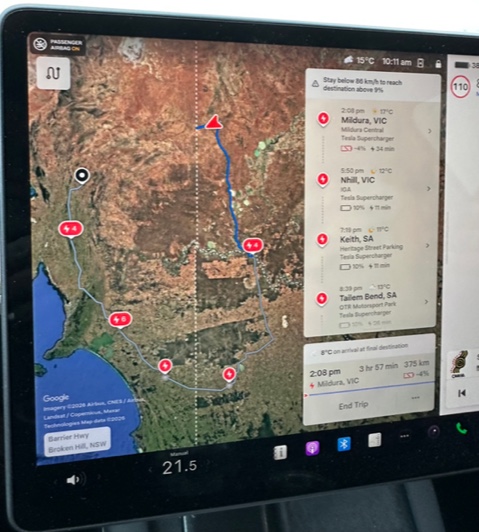
We knew we could charge when we got to Peterborough but the car did not. It would not give us any route except one taking us deep into Victoria and back again involving 5 Tesla superchargers along the way (see photo on left).
I have reported the problem to Tesla, so hopefully they have fixed this before you get to read it, but I include the story here because this is the type of problem that can really throw you. Be prepared to have to do the sums yourself occasionally.
Sometimes you are going to need to navigate another way. The Tesla navigator insisted we must turn around and take this route to get to Peterborough. We had to check, and no, the direct Barrier Highway route was not closed. The car simply would not accept a route where we would end up out of range of its nearest Tesla Supercharger.
Things out west here are not perfect for EVs yet, but let’s face it, it’s a big ask to transition our whole country to this ‘new’ less polluting technology without expecting a few hiccoughs along the way. And to me, so far on this journey, the positives far outweigh the negatives.
We were initially worried that we’d need to drive below the speed limit on the Stuart Highway, but it hasn’t been nearly the problem we expected. It seems most of the traffic is also travelling below the limit.
The road is mostly flat and very straight, and not nearly as busy as the highways back home. There are many places for safe overtaking. Road trains seem sparse – perhaps they travel at different times to us. We have passed around 20 going the other way so far, but we haven’t had a single one come up behind us, let alone want to pass. We are not pressed for time and is seems like we are not alone.
The really pleasing thing is that they still wave!
43 years ago we learned that travelling up the middle you were amongst friends. Back then, everybody you passed on the road would give you a wave – well, at the very least a few fingers raised politely from the steering wheel.
It still happens. We, along with many other tourists, may take a little time to get into the habit, and there are so many more vehicles these days, but still a good proportion of drivers show how friendly the outback is.
Note: Do you have your own interesting EV road trip story? We’d like to hear about it. Send us some details at [email protected]
Sign up for The Driven’s free daily newsletter and get the latest EV news and analysis delivered straight to your inbox.