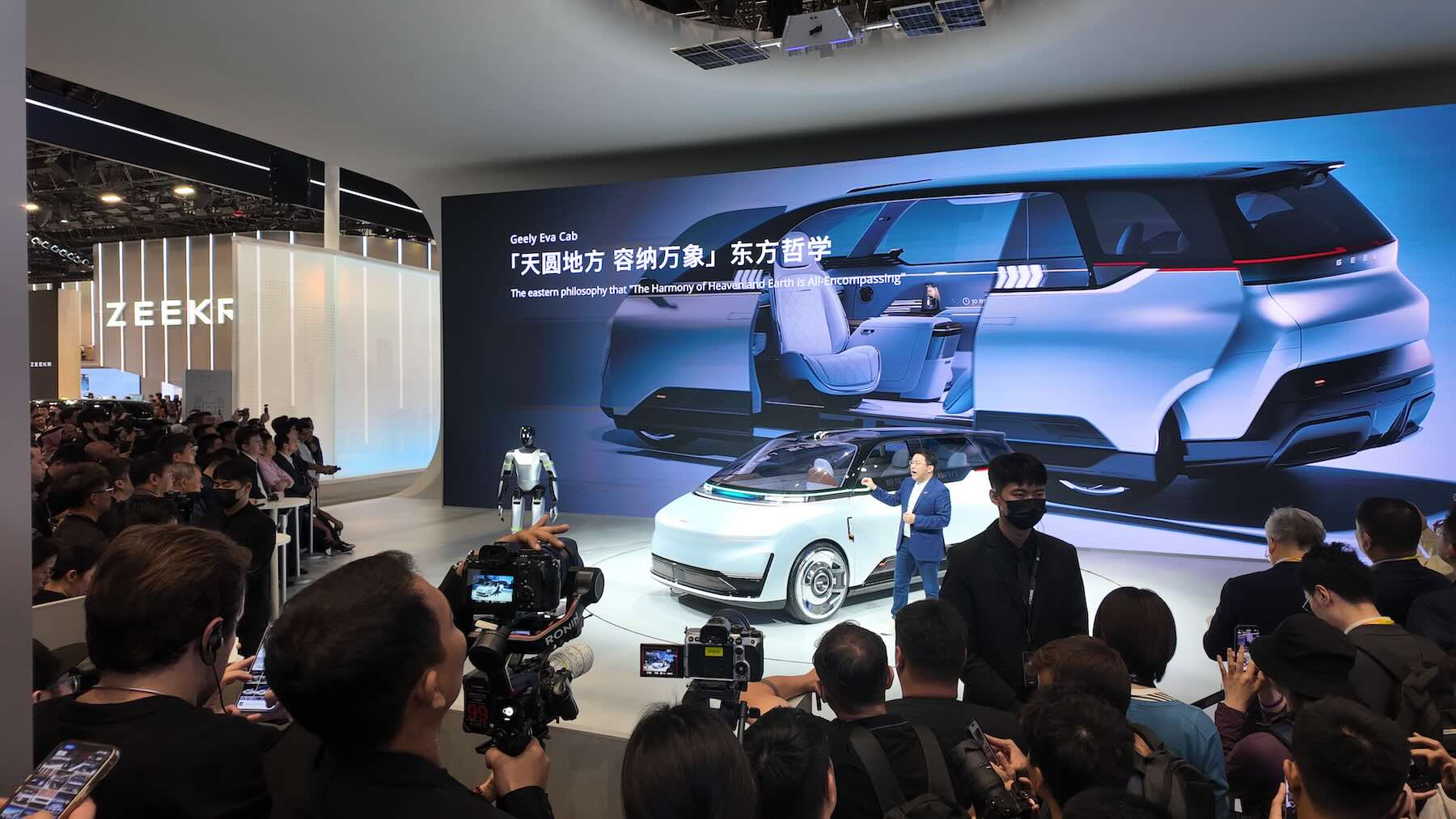
Geely has used the Auto China 2026 show in Beijing to unveil what it says is China’s first purpose-built robotaxi prototype, signalling a deeper push into autonomous, electric and software-defined mobility.
The new vehicle, called the EVA Cab, was revealed by Geely Auto Group alongside AFARI Technology and CaoCao Mobility, Geely’s ride-hailing and shared mobility arm.
Geely says the EVA Cab is designed as a showcase for its “Full-Domain AI 2.0” framework, bringing together autonomous driving hardware, in-car computing, vehicle-cloud security and software systems intended for future mobility services. The company says the prototype points to what it calls the future of new energy mobility through “embodied intelligence.”
At its Beijing stand, Geely also showed a broader technology ecosystem including 900V electric architecture, 12C ultra-fast charging technology, solid-state batteries, intelligent cockpits, AI bipedal robots and future assisted-driving solutions designed for mobility services.
The EVA Cab itself has been designed around robotaxi use from the outset. It features wide-opening electric sliding doors and a face-to-face cabin layout, designed to maximise interior space and make the vehicle feel more like a mobile room than a private passenger car.
Inside it looks like some sort of futuristic lounge, with a “Galaxy Skyroof” ceiling, “Drifting Galaxy” door panels and “Orchid Pavilion and Meandering Streams” armrests.
The hardware claims sound a bit more serious with the EVA Cab offering what it calls the world’s first “Quantum-Level AI Electronic and Electrical Architecture,” the world’s first 2160-line digital LiDAR system, and the industry’s first mass-production-ready L4-level assisted driving software solution.
The company says its new EEA 4.0 electrical and electronic architecture uses quantum encryption to provide vehicle-to-cloud security for features including Bluetooth keys, remote vehicle control, over-the-air updates and data privacy.
It also says the system includes SOVD, or Service-Oriented Vehicle-Cloud Integrated Diagnostics, intended to monitor and protect the vehicle across its life.
That all sounds quite abstract, but the issue of cybersecurity in vehicles as they become more connected and automated is real, and arguably as important as crash structures and braking distances.
Sign up for The Driven’s free daily newsletter to get the latest EV news and analysis delivered straight to your inbox.
Geely says the EVA Cab is powered by three flagship chips, the NVIDIA SuperChip, NVIDIA Thor U and Qualcomm Snapdragon 8397. All three delivering combined computing power of more than 3,000 TOPS. That is intended to support the demands of L4 autonomous driving and what Geely describes as extreme driving scenarios.
TOPS, or trillions of operations per second, is a measure of AI computing power. In vehicles, it is often used to describe how much processing capacity a car has for autonomous driving and advanced driver assistance systems.
The vehicle’s digital LiDAR system is claimed to deliver 25.92 million points per second and a detection range of up to 600 metres. Geely says the EVA Cab also uses AFARI G-ASD L4 software, which it says can enable fully unmanned shuttle services on open public roads.
Of course, robotaxi claims always deserve a healthy dose of caution. The global autonomous vehicle industry has spent the better part of a decade discovering that replacing a human driver is much easier in investor presentations than in actual traffic. Progress has been slower than expected.
But Geely is not starting from zero, with the company saying they have already conducted robotaxi pilot operations for more than a year in Hangzhou and Suzhou through CaoCao Mobility. It plans to launch a CaoCao Mobility customised version of the EVA Cab in 2027, with the goal of accelerating large-scale deployment and commercialisation of robotaxi services.
That gives the reveal more weight than a pure concept-car flight of fancy. CaoCao gives Geely a mobility service into which vehicles like EVA Cab could eventually be deployed, allowing the company to develop not just the vehicle, but the operating environment around it.
Geely’s presentations at the Autoshow in Beijing appeared to be sending a message that it wants to be seen as an intelligent mobility technology company as much as a traditional vehicle manufacturer.
The company says it has been developing foundational AI models since 2021, when it launched the Xingrui AI Large Model as part of its “Smart Geely 2025” strategy. It also says its Xingrui Intelligent Computing Center, established in 2022, now has computing power of 23.5 EFLOPS, which Geely claims ranks first among Chinese automakers.
Geely’s latest AI push includes its WAM, or World Behaviour Model, which it presented at CES 2026. The company describes WAM as a kind of “vehicle brain” that coordinates intelligent cockpit systems, advanced driver assistance and sub-domain agents across areas such as chassis, powertrain and body control.
That could matter enormously for future EVs. The next stage of electric vehicle development is not just about bigger batteries and faster charging, though those still matter. It is increasingly also about how intelligently the vehicle manages energy, traction, cabin systems, safety, charging, driver assistance and user interaction.
For Australian buyers, the EVA Cab itself is unlikely to be the immediate story. Purpose-built robotaxis are not about to start roaming suburban Sydney next week asking passengers whether they prefer “Drifting Galaxy” or “Meandering Streams.” For markets like Australia the question is how quickly this AI-heavy approach filters into local Geely models, and whether it arrives as genuinely useful technology.
For now, technologies such as high-voltage EV architecture, ultra-fast charging, intelligent cockpits, advanced driver assistance, vehicle-cloud systems and AI-managed vehicle functions, are the sort of features we’re likely to see in the near-term.
See The Driven’s detailed EV sales data here: Australian electric vehicle sales by month in 2026; by model and by brand.