Electric trucks recently found the spotlight in Australia during the current fuel crisis, with the long overdue conversation on how we start building the necessary infrastructure to electrify our heavy trucks finally taking place.
Overdue is a mild term, considering Australia is only second to the US in its reliance on road freight. As former The Driven lead writer and now New Energy Transport co-founder and co-CEO Daniel Bleakley said on a recent episode of The Driven Podcast – “if Australia’s trucks stop, Australia starves”.
In China, the conversation has already moved on from whether to electrify their trucking fleet. In December 2025, electric heavy-duty trucks outsold diesel trucks, capturing 54% of the monthly market share of new sales. There are now over half a million electric heavy-duty trucks on Chinese roads.
Now that fuel has been taken out of the cost equation in a majority of new heavy trucks sold in China, attention is turning to removing the driver itself
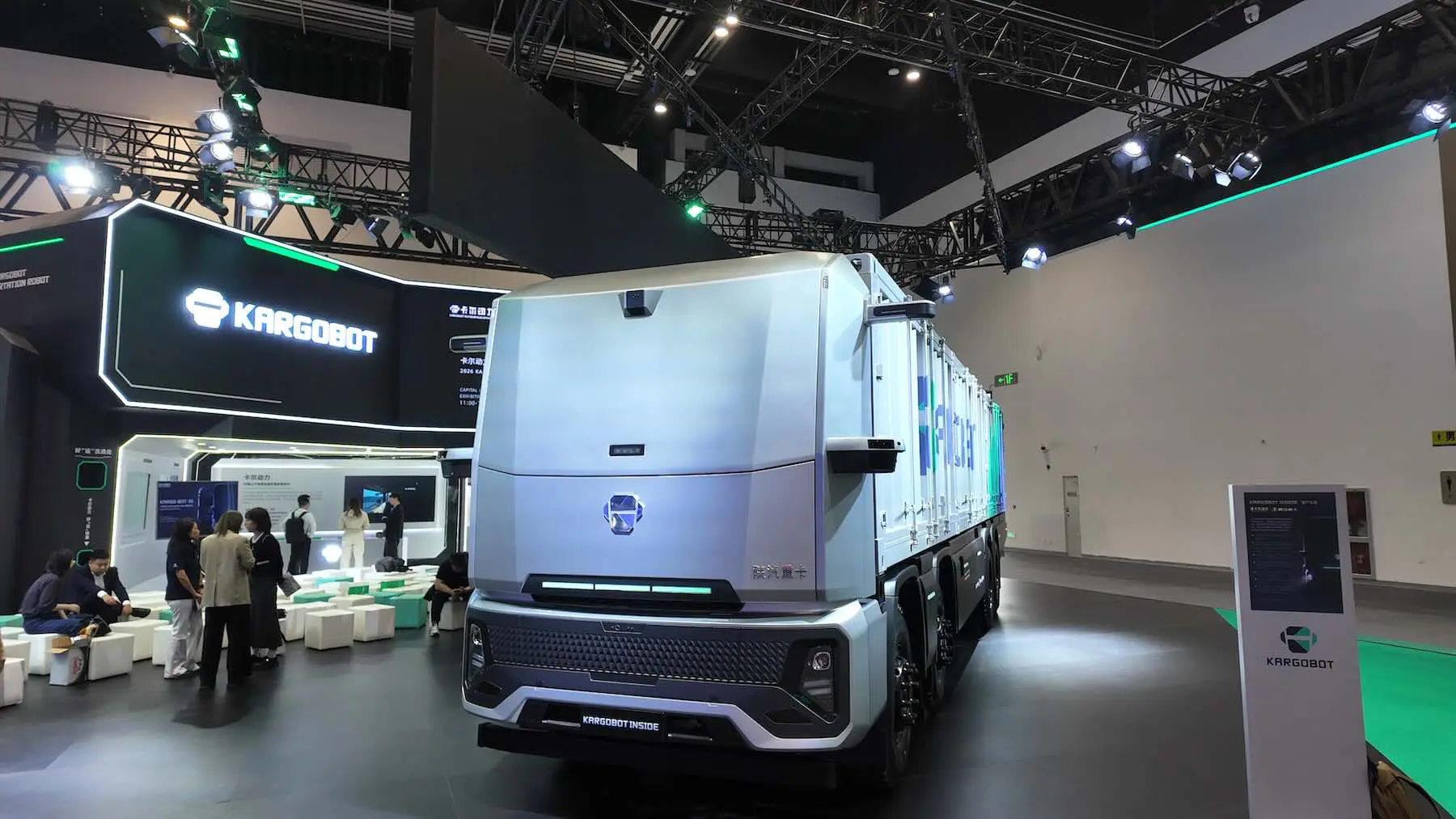
At the Beijing Autoshow this week, one of these autonomous heavy-duty trucks caught my attention. Built by Chinese company Kargobot, which is a spinoff from global rideshare company Didi, this autonomous truck is not a concept vehicle.
In fact, they have already integrated their autonomous heavy-duty trucks into the commercial supply chain in China, and have already surpassed 35 million kilometres of cumulative L4 driving (L4 being the term used for a vehicle that can drive itself entirely without any human intervention.)

These trucks operate on different types of models depending on the intended use case. For example, the “Kargo One” model uses a hybrid driverless solution, using a “1+N” platoon. One human-driven “pilot” truck leads a convoy of 2 to 6 fully automated L4 trucks.
The idea is that the human lead handles the most complex “long-tail” manoeuvres (like navigating a chaotic toll booth or a messy construction site), while the autonomous followers mimic the lead’s path. Kargobot says this reduces labour costs by up to 80%, and cuts energy consumption by 5-10% due to reduced wind resistance.
The latest cab-less model (like the one on display at the Beijing Autoshow) has no cockpit at all, which improves efficiency due to the lack of AC, seats etc, and increases more cargo. It carries a 1026kWh battery with an estimated range of 800km.
Another key factor to the scalability is China’s existing battery-swapping infrastructure, which allow its trucks to quickly swap out its battery rather than waiting to charge one up.
Whether Australia has an appetite for this kind of autonomous technology is an interesting question, but the first step is to ensure the electrification of our trucking fleet to protect our key supply chains from an increasingly unpredictable world.