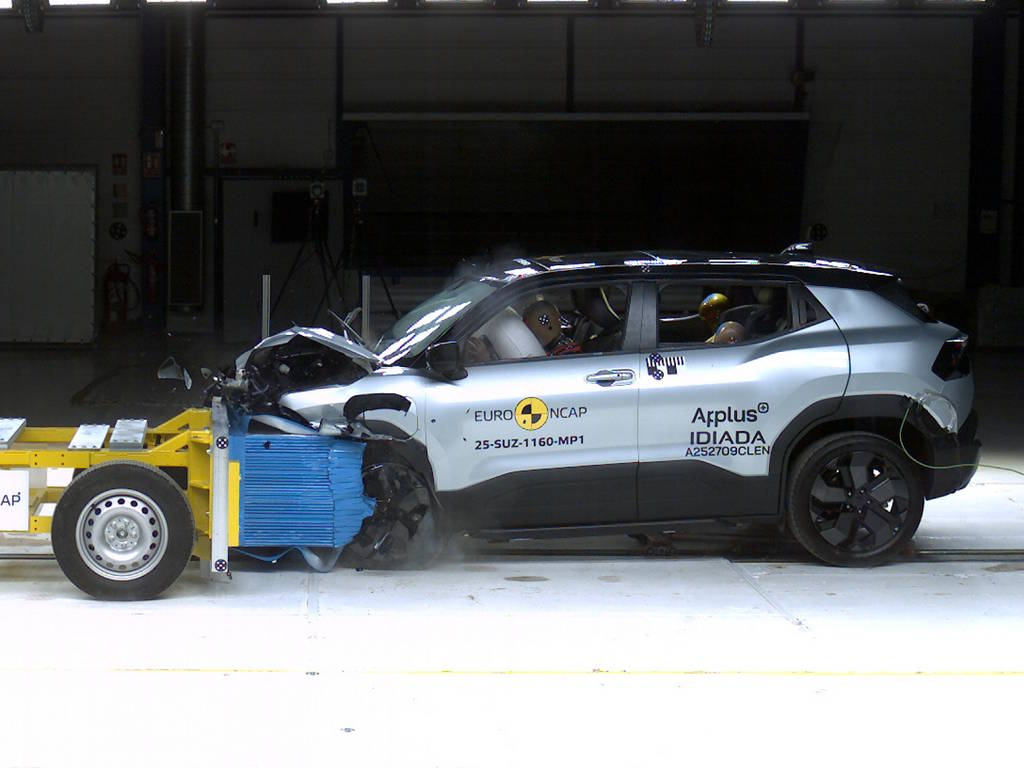
The Australasian New Car Assessment Program, more commonly referred to as ANCAP Safety, has handed a four-star safety rating to the all-electric Suzuki e Vitara, which is scheduled to launch in Australia in June.
Japanese automaker Suzuki confirmed in June last year that the e Vitara, the company’s first fully electric vehicle (EV), would make its way to Australia.
Approved for sale in October ahead of its full specifications dropping in February, The Driven’s own Riz Akhtar got a chance to drive the car last month, concluding that the e Vitara feels “like a next-gen car/” and “will be for those looking at an EV for the first time from a trustworthy brand.”
However, ANCAP Safety on Tuesday only awarded the Suzuki e Vitara a four-star safety rating, saying that the car “demonstrated sound capability in most areas of safety performance” but that “the overall rating for the e Vitara was constrained by its ‘Adult Occupant Protection’ score, with results ranging from ‘Good’ to ‘Weak’ noted in the full width test.”
Also marked against the e Vitara was the lack of a head-protecting centre airbag.
“It’s encouraging to see improvements in safety performance across the market, this latest rating achieved by the e Vitara is evidence Suzuki can produce a model that offers sound levels of safety performance,” said Carla Hoorweg, ANCAP CEO.
“These outcomes show that higher levels of safety are within reach, and that continued focus on delivering consistent performance across all areas is key to achieving the highest rating.”
The full safety rating for the Suzuki e Vitara can be found here, but its overall assessment saw the car score 77 per cent in the Adult Occupant Protection category, 87 per cent for Child Occupant Protection, 79 per cent for Vulnerable Road User Protection, and 71 per cent for Safety Assist.
The e Vitara was highlighted for having dual frontal, side chest-protecting, side head-protecting airbags, and driver knee airbag as standard.
Safety assist features recognised as standard across all variants included autonomous emergency braking for car-to-car, vulnerable road users, and junction & crossing and head-on, as well as a lane support system with lane keep assist, lane departure warning, and emergency lane keeping, and a speed assist system with speed sign recognition.
An autonomous emergency braking system that can detect and prevent or minimise the severity of a crash with a pedestrian when the car is reversing is not available on any variant.
The Suzuki e Vitara was one of two models to receive new safety ratings, along with the Audi Q3 which is available in a plug-in hybrid EV (PHEV) and which secured a full five-star safety rating.
Three additional models all with a hybrid variant – the Audi A3, Cupra Leon, and Nissan Qashqai – were also reassessed following specification changes and reassessment against eligible criteria. The Audi A3 and Cupra Leon each retained their five-star safety rating, but the Nissan Qashqai was reassessed to a four-star rating.