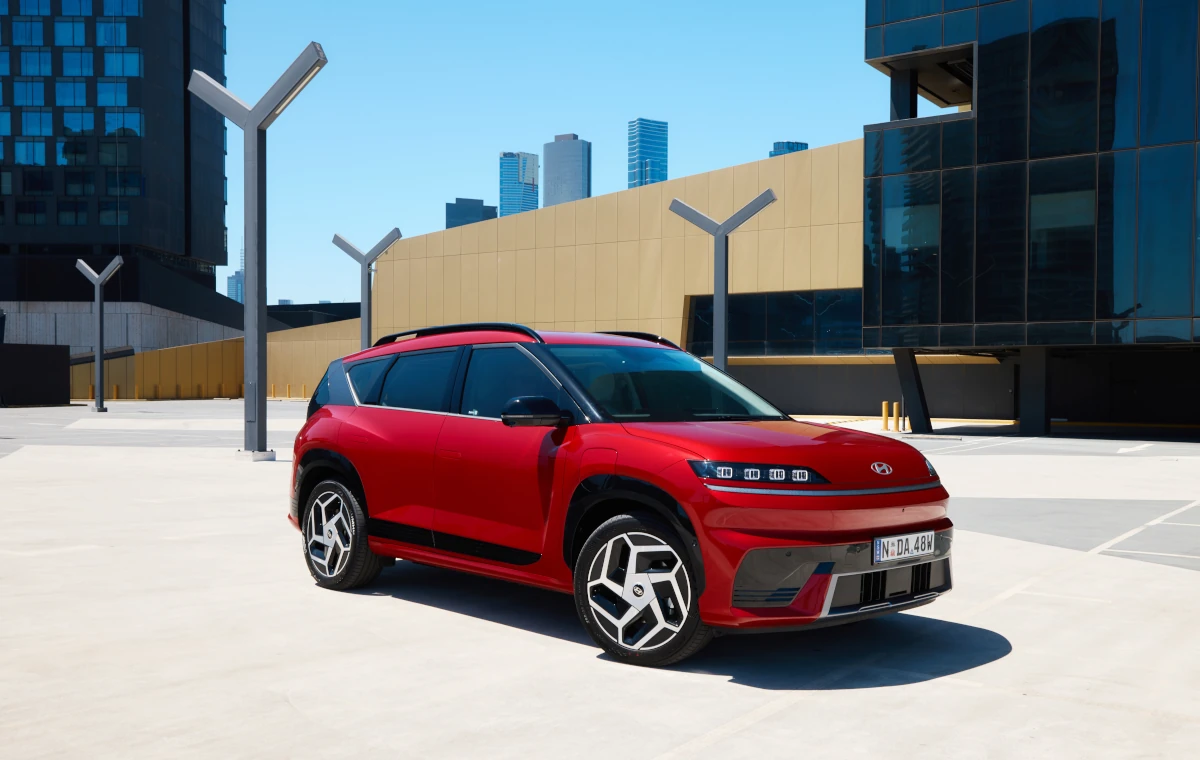
South Korean carmaker Hyundai has added a sixth model to its growing EV line-up with the launch of the Elexio, a family-focused mid-size SUV the brand hopes will become its best-selling battery-electric model.
Elexio is the first Hyundai passenger vehicle in Australia sourced from China, as part of their Beijing Hyundai 50/50 joint venture with BAIC Motor. Perhaps they are looking to replicate some of the success seen by sister brand Kia with their top-selling EV5, also manufactured in China.
Along with the Kia EV5, Elexio faces stiff competition from more than a dozen mid-size electric SUVs in the $50,000 – $60,000 price range, along with some significantly cheaper models from Chinese brands including the Geely EX5, Leapmotor C10, GAC Aion V and Deepal S07.
The Elexio is currently available in a single Elite variant, from $59,990 driveaway until the introductory offer runs out at the end of March 2026. A base Elexio will join the lineup during the second quarter with a starting price of $58,990 plus on-road costs, pushing the Elite up to $61,990 plus on-road costs.
Both Elexio variants share the same front-wheel drive powertrain, fed by an 88 kWh BYD Blade LFP battery pack. WLTP range for the Elexio Elite is up to 546 km, or 562 km in the upcoming base variant which uses smaller, more aerodynamic wheels than the Elite.
Hyundai invited The Driven to a launch event with the Elexio, where we got to spend a couple of days with the vehicle and see how it stacks up against the mountain of competition in the busiest segment of our EV market.
More mainstream design than Ioniq
My first impression seeing the Elexio in person was that the design seems to be a departure from the signature pixel theme featured prominently in the rest of Hyundai’s EVs. Hyundai said this was more to do with inheriting the design from China, and not necessarily the start of a new design language strategy.
The four ‘crystal square’ daytime running lights represent the ‘H’ logo in morse code, a pattern that repeats inside on the steering wheel too. A full-width rear light bar is the only place you will find the pixel pattern, although Hyundai refers to it as starlight-pattern in their marketing.
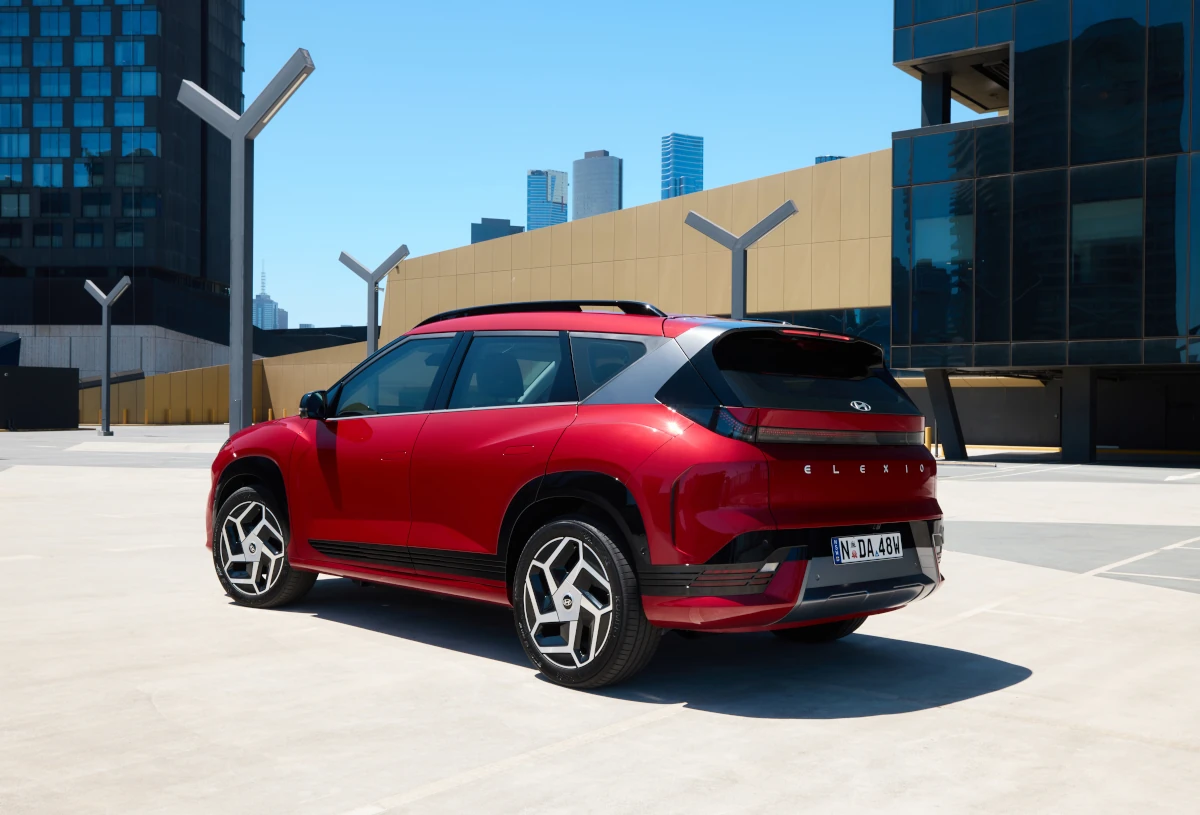
The Elexio is a reasonably good looking car, well proportioned with nothing particularly eye-catching or offensive about it. This more mainstream appeal compared to Ioniq 5, Ioniq 6 and Inster could potentially help Elexio outsell other Hyundai EVs, but it will be interesting to see how other people feel about the more generic design.
Similar to most of Hyundai’s lineup, the charge port is located on the right hand side of the vehicle, which is not ideal if you rely on kerbside charging a lot. Situated above the front wheel, charging cables will need to be draped across the bonnet to reach, potentially damaging the paint over time.

In terms of storage capacity, boot space in Elexio measures 506 L, expanding to 1,540 L with the 60/40 rear seats folded flat. There is no frunk under the bonnet, so charging cables and small items can be stowed in a shallow recess underneath the boot floor, where a tyre repair kit can also be found.
On the left hand side of the boot is a 15 A vehicle to load (V2L) outlet, providing up to 3.5 kW. Hyundai confirmed that Elexio will not be capable of vehicle to grid (V2G) unfortunately, a feature that is currently reserved for the flagship Ioniq 9, which is a shame given the level of interest and huge potential for this technology.
Odd screen placement in an otherwise great interior
At first glance, the Elexio interior could also be described as generic, with a minimalist dash void of buttons except for the hazard warning lights. However, your eyes are immediately drawn towards the oddly placed, giant 27-inch panoramic screen which is unlike anything I have come across before.
From right to left, the screen starts next to the steering wheel where most central touchscreens begin. However, it continues all the way across the dash, well beyond reach of the driver to finish in front of the passenger seat.

In another first, Elexio debuts a new generation Connect-C infotainment system, based on Android Automotive. I found the 4K panoramic screen was crisp and responsive, thanks to its underlying Snapdragon 8295 chip and Unreal 3D graphics engine.
Adjusting the air-conditioning settings while driving was a challenge though, as there are no dedicated controls at the bottom like other screen-based systems, and the small, fiddly buttons on the A/C panel end up at arms length away once you bring them up. At least there are physical controls for directing airflow across the dash.
Given this is a brand new system, some room for improvement is expected. I hope Hyundai takes customer feedback into account and provides a better user experience through future over the air updates.
Key driving information is displayed on a dedicated panel closest to the driver, as well as a new generation projector-based head-up display. The HUD was almost invisible while wearing polarised sunglasses unless I tilted my head, although without glasses it was clear and provided lots of useful information including maps, media and turn by turn directions.
Once you get past the screen location and settle into the plush Elexio seats, it is a very spacious and comfortable place to be. The Elite variant we were testing comes with leather appointed seats including heating and ventilation functions. I appreciated the latter keeping me cool given it was an especially hot and sticky day.
The base variant coming in Q2 has cloth seats instead, and therefore misses out on seat heating and cooling, as well as the heated steering wheel, power-adjusted passenger seat and driver seat memory functions. Apart from different seats, the only other downgrades are a single wireless charging pad instead of 2 and a manual tailgate.
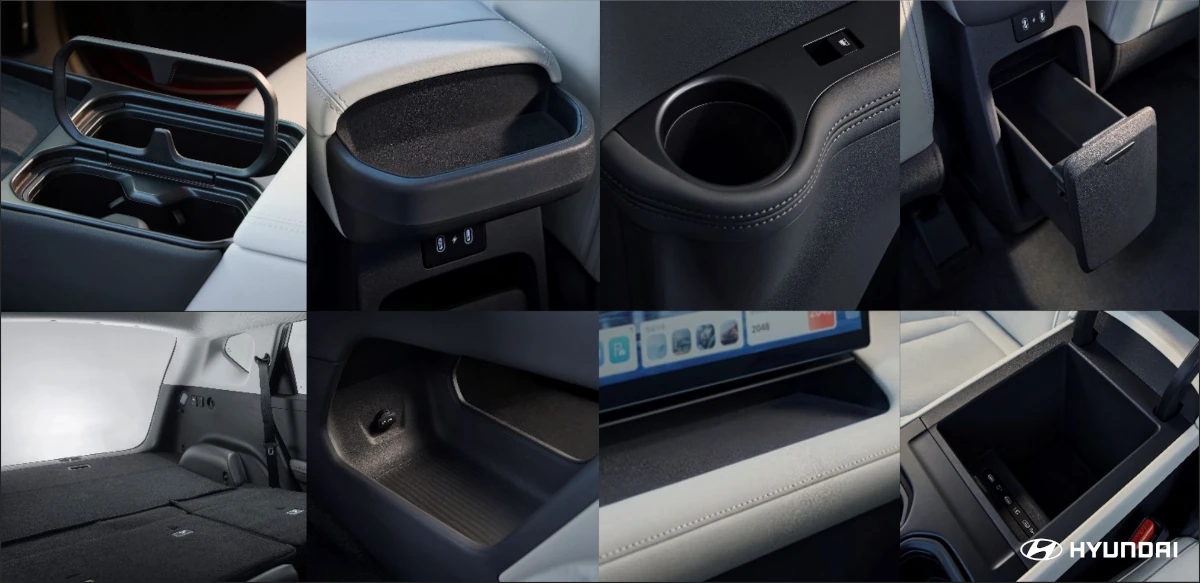
Being a family focused car, the Elexio cabin is full of storage nooks and shelves, all up Hyundai says there are 46 “flexible storage areas.” I have never counted the storage spaces in my own or other cars, but 46 sounds like a lot.
These include the usual places you’d expect to find up front like the centre console, cup holders and glovebox, plus interesting additions such as a shelf on the passenger side of the dash under the screen, rear centre facing tray, lower drawer compartment and cup holders on the rear door armrests as well as the fold down center armrest.
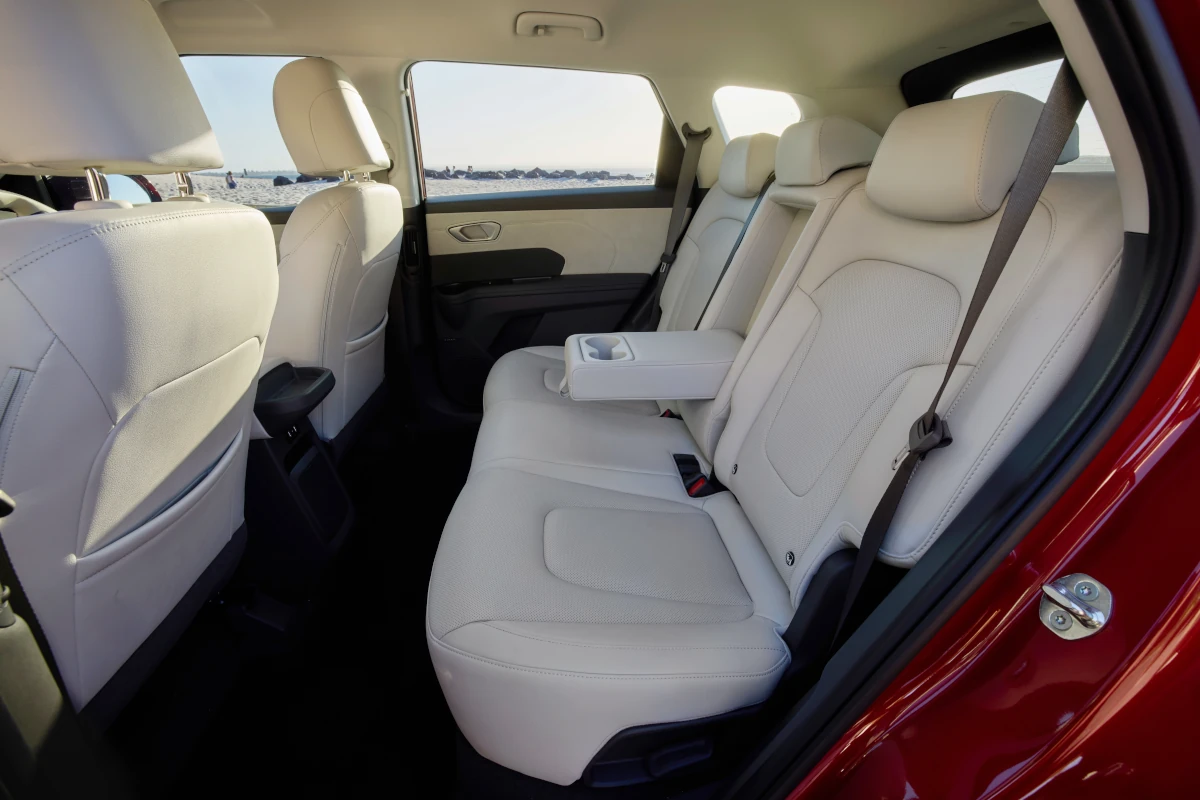
Even the tallest rear seat passengers should have no problems with space above their heads or in front of their knees, I am 175 cm tall and had tons of room left over. There is a flat floor in the back, reclining seats and air conditioning vents on the b-pillars to keep things comfortable back there too.
Something of note is the lack of a panoramic glass roof, which seems to be a rare thing in new cars these days. Rather than a feature lacking, it could potentially be a good thing if you are looking for a car without a glass roof because you find they are too bright or hot on sunny days.
Driving tuned for smoothness and comfort
Like most of Hyundai’s vehicles, the Elexio underwent a local ride and handling program where Hyundai Australia worked with overseas engineers to develop bespoke Australian suspension and steering tunes. The end result is geared towards passenger comfort and compliance, although it still feels composed and confident when pushed if necessary.
Our time driving the Elexio on the launch event was limited to a few hours all up, but covered most conditions including some Sydney traffic, highway stretches and windy B-roads that were littered with potholes and crumbling edges which proved no issue at all.
Acceleration in the Elexio is smooth, but lacked some oomph from a standstill or when trying to overtake quickly on shorter sections of straight road. Even with your foot planted, power feels restricted until you reach around 70 km/h, before easing off again.
Overall, Elexio satisfies the brief and feels more than capable of handling the family hauling duties with ease. If you are looking for something sportier that still has plenty of space and practicality, there is always the Hyundai Ioniq 5.
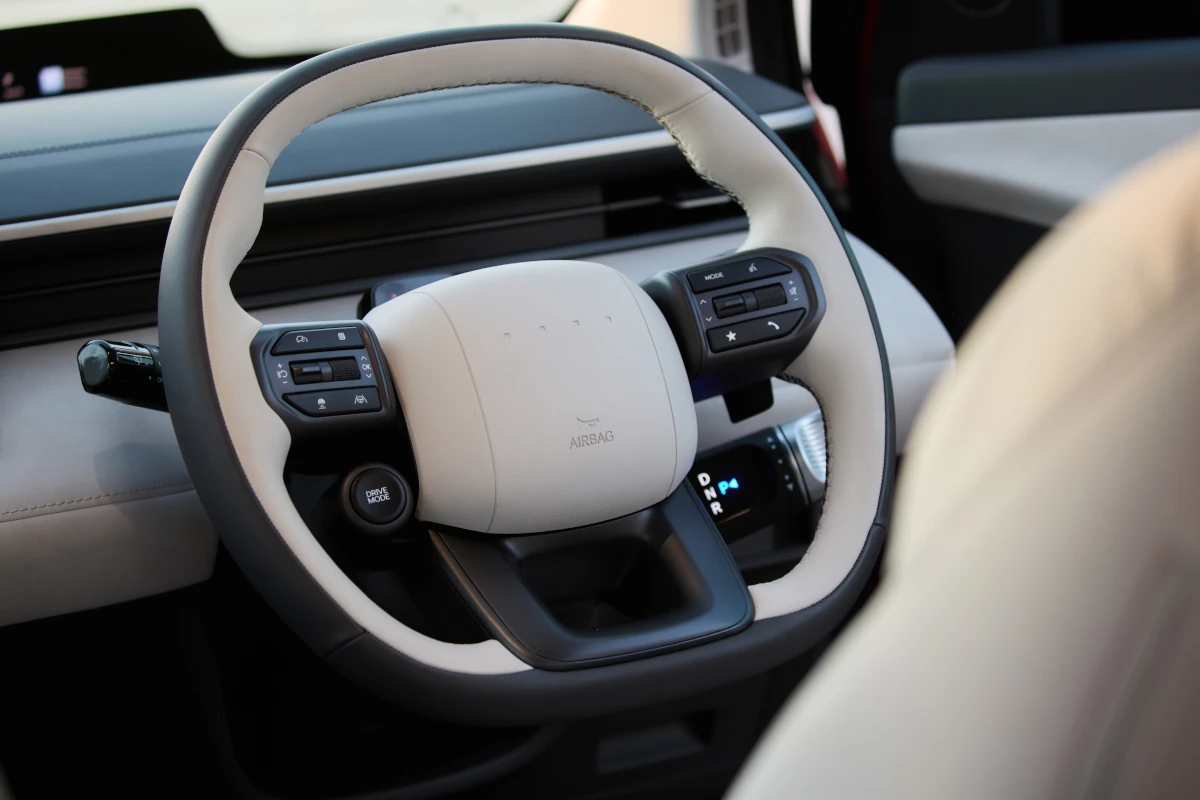
In terms of vehicle controls, the Elexio steering wheel has familiar buttons for cruise control and audio settings, with paddles for adjusting the regenerative braking. i-Pedal one pedal driving can be enabled by holding down the left-hand paddle. Four standard drive modes are accessed via the drive mode button – eco, normal, sport and snow.
On the brief highway stretches I tried Hyundai’s adaptive cruise and lane centering system, which worked as expected, more time with the system on a longer trip would be needed to fully assess it though.
ADAS on the Elexio does appear to suffer from some issues common to other Hyundai vehicles I have tested, for example the speed limit warning beeping constantly through school zones when they are not in force. Thankfully this can be stopped by long pressing on the steering wheel mute button.
Efficiency numbers for the Elexio were hard to gauge accurately given the driver swaps and driving patterns on the launch. However, I observed figures between 190 – 200 Wh/km on my sections, and an average of 179 Wh/km to cover 1586 km shown in one of the test vehicles. This would equate to roughly 490 km out of a full battery charge.
Conclusion
The Elexio is a solid new electric vehicle offering from Hyundai, with a spacious and comfortable cabin packed full of storage nooks and crannies that families will hopefully appreciate. It is also an easy car to jump in and drive, with a familiar set of controls once you get past the oddly placed touchscreen.
Does the Elexio do enough to tempt buyers away from the top-selling medium SUVs or cheaper Chinese competitors though? I think it does everything you’d expect for a vehicle in this price range, without standing out in any way or offering any killer features in particular to draw people in.
At the current price of $59,990 driveaway for the Elite variant, Elexio sits in the middle of the pack, reasonably well valued amongst the competition. When the introductory offer expires at the end of March and the price rises to over $67,500 on the road, it feels much less attractive and harder to justify the price premium for going with a legacy brand.
Hyundai has been providing hefty discounts across its EV range recently, along with some good deals around on new or dealer demonstrator vehicles. So if you are tempted by the Elexio, perhaps the best bet is to go and test drive one, then keep an eye out for a well priced example to come up.
Table of key specifications for Hyundai Elexio
The full specifications for Elexio can be found on Hyundai Australia’s website.
| Variant | Hyundai Elexio Elite | ||
| Price | $59,990 driveaway until March 31, 2026 $61,990 plus on-road costs thereafter |
||
| Paint colours and options | 5 exterior colours:
$295 for optional dove grey interior. |
||
| Battery size | 88.1 kWh | ||
| Battery chemistry and manufacturer | Lithium iron phosphate (LFP), BYD | ||
| Range | 546 km WLTP | ||
| Driven wheels | Front-wheel drive | ||
| Power / Torque | 160 kW / 310 Nm | ||
| Maximum charging speed | 10 kW AC, 122 kW DC | ||
| Charging time | 7 kW AC (0 – 100 %) – 13 hours 50 kW DC (10 – 80 %) – 72 minutes 150 kW DC (10 – 80 %) – 38 minutes |
||
| Bidirectional charging | Yes: V2L, internal socket in the boot | ||
| Exterior dimensions | Length: 4,615 mm Width: 1,875 mm Height: 1,695 mm Wheelbase: 2,750 mm Ground clearance: 160 mm |
||
| Kerb mass | 2,105 kg | ||
| Storage space | Frunk: N/A Boot, rear seats up: 506 L Boot rear seats folded: 1,540 L |
||
| Service interval | 24 months / 30,000 km | ||