Regional and metropolitan areas that lack electric vehicles charging facilities may soon get some relief, with the Australian Energy Market Commission releasing a draft rule that will allow networks to play the key role in supporting a $40 million Commonwealth scheme.
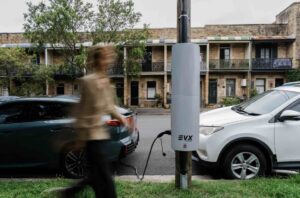
The rule change means that networks will identify sites, including regional blackspot charging and high-density kerbside areas in cities where customers have limited access to off-street charging, and be required to offer them first to commercial operators.
But the plan has been criticised by some in the industry because they say it may give networks an unfair advantage and may lock in higher energy costs for all drivers.
AEMC chair Anna Collyer told The Driven that a key “time-limited tweak” to the rules would enable the recovery of some of infrastructure costs related to the federal Accelerating EV Charging Program from electricity customers in the network,
That program is scheduled to end in June 2029.
EVs grabbed a record share of almost a quarter of the new car market in Australia last month. Tensions in the Middle East have kept petrol and diesel prices elevated amid ongoing supply concerns, a combination that may spur more consumers to go electric especially as more models become available.
Collyer said the take-up of more EVs will also help improve the appeal for commercial operators to install more chargers. The design of the federal program, though, was specifically aimed at not disrupting competition.
“The way the program operates is that the networks have to identify sites, and those sites have to first be offered to the commercial market,” she said. “If they don’t take them up, then it’s only then that the networks can do it as a last resort.”
As consumers saw they had more access to chargers, concerns about “range anxiety” would diminish, and so more would buy EVs. “Then you get the main benefit, which is the [carbon] emission reduction,” Collyer said.
Planning where to place chargers to maximise benefits has been a challenge. One recent study, led by Bjorn Sturmberg at the University of NSW, recommended councils be given a big say in where to locate kerbside chargers.
“Having access to parking is obviously a critical part of a charger being a valuable asset,” Collyer said. “We do expect to see coordination with councils so that the chargers are located in areas where people can park, and then use the assets to charge their car.”
The $40m Commonwealth will fund about 30% of the cost of eligible infrastructure, placing some 14,000 EV chargers where they are most needed, the AEMC said. Participating networks would be able to recover the balance of the cost (70%) from consumers.
That would add about $1 a year to a typical residential customer’s bill for five years.
“Having weighed all factors, the Commission is satisfied the program’s likely benefits outweigh its costs to consumers, given its targeted and time-limited design,” Collyer said.
Lessons learned from the trial program wouild also inform future Commission decisions on EV infrastructure, she added.
Bjorn Sturmberg, a senior UNSW research fellow, said it was appropriate for the AEMC to allow the temporary rule change to unblock the program, despite concerns about the privatisation of the most profitable sites and costs of unprofitable sites being pushed onto consumers.
“Imperfect as it is, the government’s program will make positive contributions by getting chargers installed in the near term, and collecting evidence to inform the next rounds of rule change processes and government policies,” Sturmberg said.
“I expect the learnings will reinforce how attention and resources need to focus more on urban planning processes and less on electricity sector processes,” he said.
Stewart Joyce, chief executive of the National Electrical and Communications Association, was among those highly critical of the move:
“Putting up electricity bills to pay for EV chargers shows staggering contempt for consumers battling in the midst of a cost-of-living crisis,” Joyce said in a statement.
“EVs are selling at a record rate and there is a thriving competitive market for installing chargers under a user-pays model. The main barrier is the networks,” Joyce said.
“With this rule change, the AEMC has shown it is on the side of monopoly networks, which are already making billions of dollars from sky-high electricity bills,” he said.
Stephanie Bashir, founder and principal of Nexa Advisory, says the AEMC’s draft decision “must be backed by substantive evidence that it is in the long-term interests of energy consumers”.
“So far, there is no clear evidence that the program will materially reduce emissions or increase EV uptake – and recent record EV sales undermine the claimed ‘chicken and egg’ problem,” Bashir said.
“There is no evidence that [Distribution Network Service Providers] can deliver charging infrastructure faster or cheaper.
“The risk is that every energy consumer will pay – whether they own an EV, need public charging or benefit from the program.
“Transport decarbonisation costs should not simply be shifted onto electricity bills,” Bashir said, adding that the AEMC, as the independent national rule maker, should require the federal energy department to produce supporting evidence for the change.
The AEMC will take submissions on the draft determination up until 5 November 2026, and it expects to make final determination by the end of the year.
Sign up for The Driven’s free daily newsletter and get the latest EV news and analysis delivered straight to your inbox.