There have been times where I’ve felt the culture war over battery electric vehicles has ended, and then you see new (or more commonly these days, recycled) mis- or disinformation popping up again.
I can forgive the accidental misinformation of people who leap into an EV and discover they needed to do some homework/prep for the change first.
This happened recently when an ABC reporter tried to use a DC charger without pre-loading and testing the App before their first-ever DC charge, as well as waiting for a 100% charge there rather than move on after the fastest charging has happened by 80%.
They blamed the EV for not working like a petrol car, rather than adapting their habits to take advantage of the freedom to refuel without standing around waiting. The Driven reported on it here: “Petrol tank mentality:” ABC’s 7.30 report on EV charging problems rated a fail.
It is, however, the fact-free, deliberate disinformation-type article that I feel the need to call out, especially when it comes from what the public generally treat as a “trusted” source – such as dedicated car site Drive.
In an article titled “The wrong Australians are buying EVs”, a series of EV cliches were rolled out as facts, long after they have been debunked in writing, You-Tube videos and lived experience by the ever-growing number of BEV buyers.
Sigh. Where did the author come up with the idea that EVs have such limited ranges that … “they only make sense when used in urban environments and inner-city conditions“? That is so 2012. BEV tech has moved a long way since then.
The fact is that whilst a few cheapies still offer low 200 km ranges (including what is currently Australia’s cheapest new car of any fuel type, the BYD Atto 1 at 220 km), the vast majority offer over 400 km and the longest are in 600 to 800 km driving range territory.
I find anything in the high 400s easily does any trip I throw at it – including a recent trip in my 2019 Kona electric from Melbourne to Sydney, Coffs Harbour and then back via the inland route using the New England and Newell highways.
The author then on goes on to say “… if you live in the inner city, chances are you won’t have off-street parking”. Whilst partially true, to paint the majority of inner-city dwellers as car-park free is disingenuous.
Many apartment and flat dwellers do have off-street parking, and there are charging solutions becoming available for these situations. The key issue so far has been so few apartment dwellers had BEVs that the rest of the flat/apartment owners weren’t ready to consider installing charging solutions.
That is changing rapidly and new documents like the Victorian Guide to installing charging in apartments are designed to help smooth that path.
For those left who genuinely don’t have off-street parking, the author then makes the claim that public charging is “less than stellar”, implying it is going to be ever-difficult to use or access.
Not true. To begin with, I’ll use the anecdotal example of the above-mentioned trip. I didn’t have to bother charging at my overnight stops (which I had to do on the same trip in 2019) as the public charging network was surprisingly accessible and easy to use, with one 5-minute wait at one charger in 3,400 km of driving.
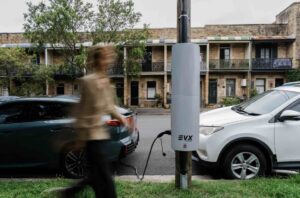
A second example is the roll-out of public AC charging. Still in its infancy, but these added to the growing network of local DC chargers mean there is a growing number of options for park-and-charge inner-city street charging.
Given the longer ranges of BEVs now, and the likelihood of inner-city dwellers doing shorter distances, one charge every couple of weeks should be all that is needed – and easily done without waiting or inconvenience by doing the weekly shopping or seeing a move whilst it charges.
As for the statement that came next: “For those in this and other outer-city suburbs, vast distances need to be covered; a hybrid might make more sense – even if most EVs can comfortably cover this distance and back”.
Well, I had a ‘WTF?’ moment. The author not only contradicted their entire ‘argument’ up to that point (that EVs were no good outside the inner city/no good there anyway) to accept most EVs could commute easily from outer suburbs … where they almost certainly could utilise off-street home charging.
To choose hybrid over EV then becomes a choice between paying for liquid fuel at our currently inflated prices for part of these longer journeys (most PHEVs for instance have electric-only WLTP driving ranges up to 50 – 60km or so) or electrical ‘fuel’ at off-peak rates for all of the journey. (The calculation is an over 90% saving on fuel costs of a BEV charged at home off-peak versus a petrol car).
For a PHEV, it might perhaps be closer to a third cheaper, but that assumes it is recharged every night and studies show that many PHEV owners don’t regularly recharge their batteries.
(Presumably because charging every night can easily become a chore, as compared to charging a full BEV once or twice a week). The obvious question also then arises: if you can do those trips in a BEV without using petrol or diesel at all, why wouldn’t you buy the BEV instead?
The author then rails against the Fringe Benefits Tax (FBT) exemption, saying that only the well-off can buy new BEVs and get the benefit of the exemption.
‘No shit Sherlock’ was my instant thought: generally, only the better-off and fleets buy new cars. The rest of us buy second-hand and let the rich and fleet owners take the depreciation hit.
The FBT exemption was a policy carefully designed to bring more second-hand BEVs to market quicker as leased cars are usually turned over for a new one at the end of the lease.
It also encourages fleet buyers in particular to consider buying BEVs over 4WD utes. It is worth noting here that, in part, the FBT exemption for BEVs corrects the loophole where commercial vehicles over 1t capacity have a form of FBT exemption.
(As a result of which, the loophole has been thoroughly abused – resulting in Australia’s over-abundance of large dual-cab utes being used as commuter vehicles instead of carrying tradie loads).
The author then runs into strife even on their limited research: the assertion is made that the FBT exemption is just one of many EV incentives in place ….and then fails to cite any. (There were such things some years ago, but they have all but disappeared now – only a few discounts on rego remain in a couple of states).
As a result, the author seized on the solar battery rebate as some sort of EV incentive. The only feature the two have in common though is they contain a battery. How the home battery incentive is an EV one fails me. After all, a home battery is perhaps a quarter to at most half the size of the average BEV battery.
If you recharged your car from the home battery, there would be nothing left to run the house cheaply overnight or on a wet and cloudy winter’s week. Basically, charging the car from a home battery is generally the last thing you want to do. Much better to recharge an EV on the ‘3 hrs of free power’ or a super off-peak electricity rate.
The author then wraps all their unsupported statements together to conclude: “All of this is to say that the people buying an EV – whether to take advantage of the various schemes on offer – are probably the ones that need an EV the least”. And “Long-distance commuting, country roads, and escaping the urban sprawl are arguably best left to other powertrains for now”.
Well as someone who has made multiple, totally unsubsidised BEV purchases in the past (including one new one) and has driven many long-distance, remote regional trips using the ever-growing and improving public charging network on those trips – all I can say is “DO YOUR BLOODY HOMEWORK” before writing such tripe.
Sign up for The Driven’s free daily newsletter and get the latest EV news and analysis delivered straight to your inbox.