
Note: See update at end of story:
Energy experts have reacted with frustration at an ABC 7.30 report on EV charging problems, which they say was poorly researched and gave a biased perspective of how long it takes to charge an electric car.
“Very disappointing,” said Andrew Stock, an energy expert and Climate Councillor about the item, which featured a reporter complaining that it took him one hour and 20 minutes to top up the EV he was driving – a 10 minute wait for a charger, 10 minutes to upload the app, and one hour of actual charging.
Stock, and others, wondered why the reporter bothered to charge in the first place, given there was a queue at the facility and the fact that he didn’t actually need to charge. If you are driving a petrol car and you see a big queue at a petrol station (and yes, that happens too), and you don’t need to fill up, then why would you stop and wait?
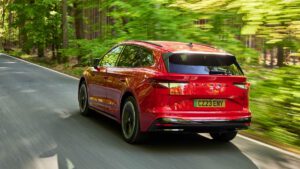
As the reporter himself observed, his battery still had a 46 per cent charge, and in the Polestar 2 he was driving at the time that was more than enough to make the return trip to Sydney. (He had started off with 76 per cent, and the return trip is mostly downhill, so would use a lot less than the 30 per cent he used to get to Sutton Forest in the Southern Highlands.
The Polestar 2 dashboard could have told him that, and could even suggest an available charger on the way if he really wanted to test it out. Instead, he chose to queue and wait and then – perhaps to underline the time it took – chose to charge the car to 100 per cent, which experienced EV drivers almost never do on long trips because it is slow and completely unnecessary.
The reporter then even complained that he could have done the same thing in a petrol car in just two minutes. It was too much for Stock, and others.
“He drove 160km from Sydney and used around 30% of the car’s battery capacity,” Stock wrote on LinkedIn. “Could have got back without any problem, but also could have added (say) 20-30% in a small fraction of the time it took to charge to 100%.
“Charging to 100% is poor practice for a road trip, resulting in excessive time on charge as the charge rate for the last 20% is ramped right back to protect battery (even on high rate superchargers). Far simpler and faster to charge to 80-85% and move on to next stop, also freeing up chargers for other drivers.”
Indeed, if the reporter had ventured across the road to the Tesla Supercharging station next to Heatherbrae pies, the queue – if any – would have been shorter because Tesla actively discourages EVs from charging to more than 80 per cent and hogging the charging bay. (That restriction on 80 pct can be over-ridden if it’s really needed, but rarely is).
Stock, and others, also noted that the reporter was completely unprepared and hadn’t downloaded any apps. Granted, EV fast charging should be easy and should not require them, or just a single universal one. But once downloaded, they are easy to use and take less time than waiting at a petrol station counter to pay the bill.
The ABC reporter’s failings were rookie errors, and it’s inevitable that drivers new to EVs can fall into the same traps. But they quickly figure it out – they download the apps, they ask the car to show where the free chargers are, and if charging is needed at all. A reporter doing their research would have known this, at least if the program’s intention was to sound informative.
As an example, Stock noted that he had drive from Adelaide to Melbourne and back over Easter and school holidays had experienced no issues accessing chargers on the way there on Easter Saturday or on the way back on Victoria holidays.
“Charging from 15%-85% in 3 stops took around 20-30 mins a time, enough for a short walk to stretch legs, coffee/lunch, and toilet,” Stock wrote. “Used apps to see charger availabilities and locations ahead of arrival. And the road monitoring tech in most current model EVs makes long road trips so much less demanding.”
That’s the usual experience for EV drivers. We drive regularly from Byron Bay to Sydney and back (750 kms each way), and stop twice for 20 minutes to charge, go to the loo and buy a coffee. It takes no more time to drive an EV that distance than it does a petrol or diesel car, if you adhere to the safety guidelines of “drive, revive, survive.”
It is also true that more chargers are needed in Australia, and that all charging sites should feature multiple bays, and the dud machines that plague some networks should be replaced.
The situation with the apps and the multi-facility swipe card needs to be resolved. In short, all EV charging bays should be like the ones provided by Tesla – fast, reliable and easy to use, and plenty of options.
But the issues were clouded because the ABC reporter didn’t understand the basics, and fell into the same trap as the tabloid bullies in Murdoch media. “It was bullshit,” exclaimed David Leitch, ITK principal and an EV driver, in the latest episode of the weekly Energy Insiders podcast that he hosts (and during an interview with another EV driver, the federal energy minister Chris Bowen).
Others agreed with Stock. “I was pretty surprised about this ABC piece too. It really was quite lacklustre – felt like a trip back to 2020,” wrote Peter Henley, an energy consultant with Claton Utz.
“Clearly ‘he’ has no idea, and still has the ‘ Petrol tank’ mentality. ‘Little and often’ is the mantra for EVs. And arrive refreshed, not brain dead,” added Peter Thomas, a grid engineer.
The “petrol tank” mentality is a common problem. EV charging, because so much can be done at home, requires a different approach.
“It’s not that hard! Even for an old bloke like me!” Stock concluded.
Update: Readers point out that the reporter filed an “analysis” derived from his 7.30 story on the ABC website. In that written piece the reporter recognises that he did not need to charge to return to Sydney, and that it was bad form, and a waste of time, to go more than 80 per cent.
Still, his conclusion is: “Driving an EV has its benefits, but the trade-off is clear: save money but lose time, unless you can charge at home, though that takes time too.”
Your iPhone take time to charge at home, but you don’t sit and look at it. Or do you?
Unbelievable.
Second uptake: John Birmingham has written a very humorous takedown of the ridiculous 7.30 reporter’s efforts. See: So you’ve decided to write a terrible EV piece