Australia’s August vehicle-sales data delivered a striking milestone. Battery-electric vehicles (BEVs) are now 25.6% of the 105,713 new-vehicle market (excluding heavy commercial vehicles), and BEVs are now Australia’s largest drivetrain category.
BEVs outsold petrol (25,824), diesel (23,608), conventional hybrids (18,662) and plug-in hybrids (10,591). BEV deliveries were about 170% above August 2025.
And yes, sure, BEVs did not outsell all vehicles with an internal-combustion engine – petrol, diesel, hybrid and plug-in hybrid vehicles collectively remained the majority of sales.
But the crocodile graph (Figure 1) conclusively shows that the old hierarchy is collapsing, while a technology once dismissed as ruining your weekend has now surged to be the largest single drivetrain category in the Australian market.
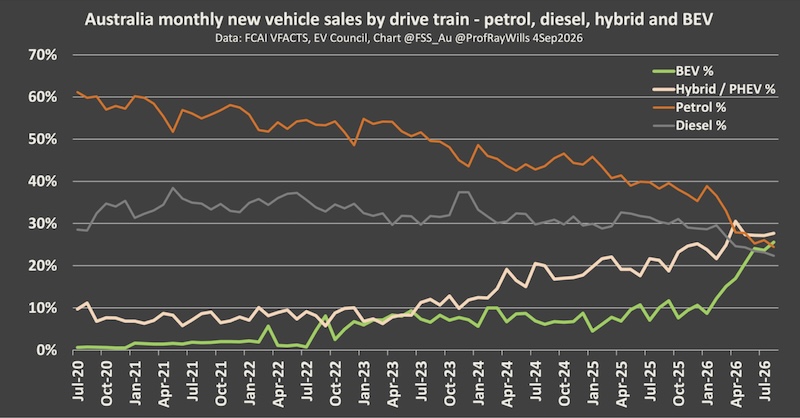
Figure 1. Australia new vehicle monthly sales by drive train – petrol, diesel, hybrids and BEV
The change since 2020 – when 60% of monthly sales in 2020 were petrol while BEVs were close to zero – is clear. Since then, the electrified share – BEVs, hybrids and plug-in hybrids – has risen steadily, with the stimulus of the US interference in global oil markets through attacks on Venezuela and particularly Iran impacting the Strait of Hormuz, and supercharging BEV sales.
In August, the combination of BEVs, hybrids and plug-in hybrids accounted for 51.8% of all new sales.
And yes, of course, Australian sales fluctuate with shipping arrivals, fleet orders, stock availability, registration practices and model updates. Monthly figures will move up and down, but the underlying market direction is unmistakable.
China has remade competition
The second crocodile graph is geographic. China’s share of Australian new-vehicle sales has risen from around 2% in 2019 to more than one-third in 2026 year-to-date (Figure 2). Over the same period, Japan’s share has fallen from around one-third to about 23%, Thailand’s from roughly 28% to around 18%, Korea’s to about 12%, and Germany’s to a low single-digit share.
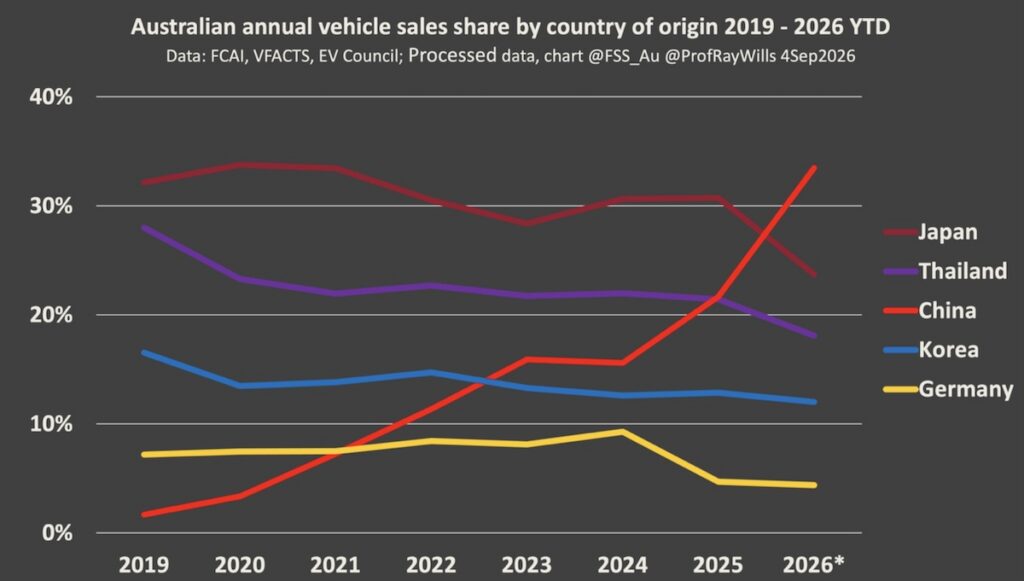
Figure 2. Australian annual vehicle sales share by country of origin 2019 – 2026 YTD
This is not a story of a single successful badge. It reflects the arrival of an automotive industrial system with extraordinary breadth: BYD, Geely, Zeekr, MG, GWM, Chery, Omoda Jaecoo, Xpeng, Leapmotor, GAC and others, plus Chinese-built models wearing long-established global brands.
A more useful unit of analysis is increasingly the corporate group, not the individual brand. The August market placed BYD and Denza at 8,492 deliveries; the Geely group—including Geely, Zeekr, Volvo, Polestar, Lotus and Farizon—at 7,395; Chery and Omoda Jaecoo at 6,441; and SAIC’s MG and LDV at 5,867. These indicative group totals reveal the depth of the competitive shift.
China is establishing multi-brand positions across mainstream, premium, SUV, commercial and battery-electric segments.
The disruption is increasingly driven by price, specifications, range, charging capability and model availability. Chinese manufacturers and Tesla are forcing established suppliers to justify prices and feature gaps that were once accepted as normal. In August, Tesla’s Model Y was Australia’s best-selling model, with 6,414 deliveries.
The grid crocodile mates with the sales crocodile
There is a bigger decarbonisation story.
The NEM generation reveals yet another crocodile – the fossil-fuel share of the grid has fallen from around 90% in 2011 to around 53.3% in August 2026, while renewables have increased from below 10% to about 46.9% (Figure 3).
There was a crossover briefly between November 2025 and January 2026, and month-to-month outcomes vary with seasonal impacts on solar, wind, hydro, demand and coal-generator availability. But the direction is clear: the electricity that powers the emerging electric fleet is itself becoming less carbon-intensive, and the permanent crossover is likely this summer.
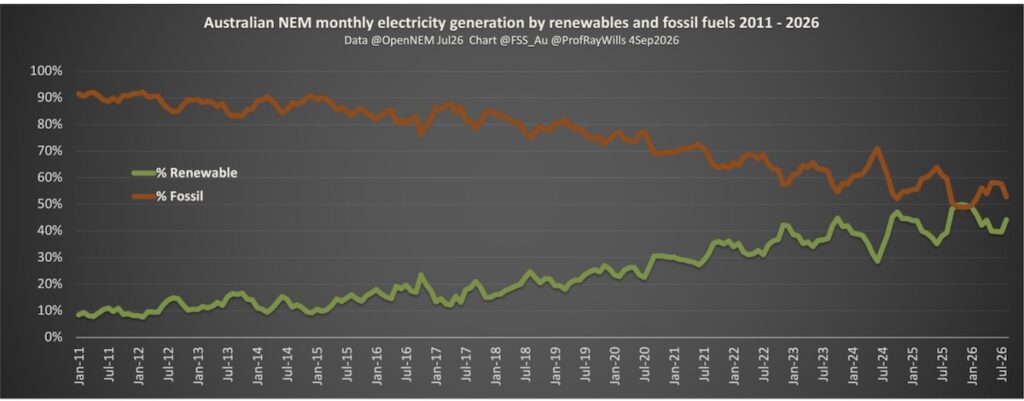
Figure 3. Australian NEM monthly electricity generation share by renewables and fossil fuels 2011 – 2026
And of course, grid decarbonisation brings a compounding advantage for electric transport.
BEVs reduce energy use immediately because electric drivetrains are inherently much more efficient than internal-combustion vehicles. EVs are three to five times more efficient than petrol cars, and government analysis finds BEVs generate substantially lower lifecycle emissions than comparable petrol vehicles even when charged from today’s grid.
But, unlike a petrol or diesel vehicle, an EV does not lock in its fuel emissions at the time it is sold. Its operational emissions fall progressively as fossil generation retires and renewables and storage are added to the system. Uncontestably, every existing EV becomes cleaner over time without its owner changing vehicles as the grid decarbonise.
Rooftop solar strengthens the connection.
Australia has more than 4.5 million rooftop solar installations, with over 30 GW of installed capacity up to July 2026. In the first half of 2026, rooftop PV is close to one-third of homes and contributed 12.9% of Australia’s electricity generation.
For households with solar and off-street parking, and businesses with roof-top solar and electric fleet, EV charging can increasingly occur during day from their own generation, or through controlled overnight charging when the grid is lower-emissions and cheaper.
This does not mean every EV is solar-charged, nor that all owners can charge at home. Renters, apartment residents and many regional drivers still need convenient, reliable public and workplace charging. And while Solar Sharer may still potentially bring savings to those residents, it hasn’t started well.
Nevertheless, it means fleet and electricity decarbonisation (Figure 4) are now mutually reinforcing systems rather than separate policy tasks.
And, as electrification of the fleet speeds up, oil displacement in Australia is accelerating.
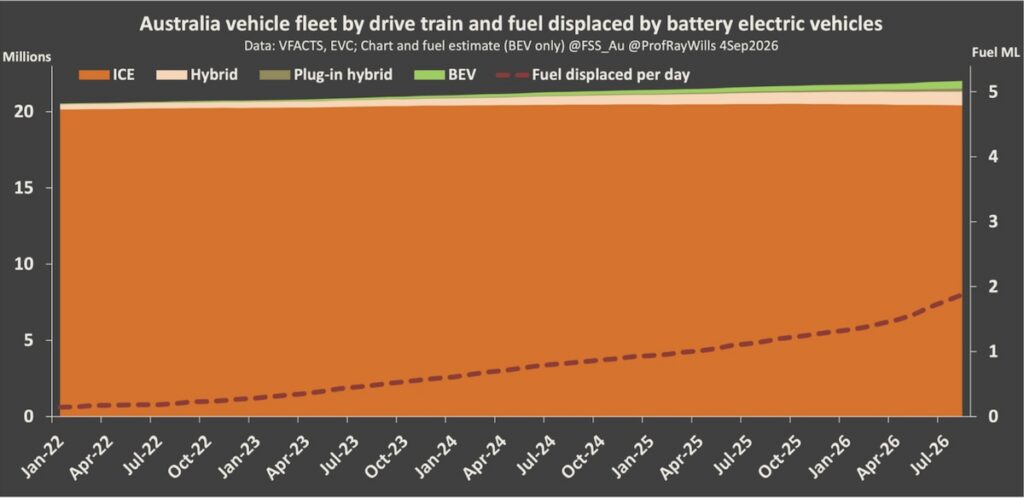
Figure 4. Australia vehicle fleet by drive train and estimated fuel displaced by battery electric vehicles – with the surge of BEVs since March reflected in the fuel displaced line
The destination is in sight
The policy and infrastructure agenda must now catch up with the market.
Commercial vehicles including trucks are a key next step. Tradies and business operators are looking for electric vans, utes, but that’s just a first step.
Heavy duty vehicles that are fit-for-purpose: payload, towing, long distances and demanding duty cycles on regional roads and farms and mine sites are more important.
While Australia’s August result does not mean combustion vehicles vanish tomorrow, the view that EVs would be peripheral while petrol and diesel retained the centre of the market is dead.
The crocodile jaws have closed on both transport and electricity: electric vehicles are taking sales from combustion vehicles, while renewable electricity is taking generation from all fossil fuels. The combined effect is a transport fleet that becomes cleaner twice – first through efficiency displacing oil consumption, and then through the continuing decarbonisation of the grid.