Australia’s new car market took another decisive step in April, and the message is now hard to miss: the centre of gravity is shifting away from internal combustion and towards electric cars.
And China is delivering that transition – more on that below.
The latest data shows battery electric vehicles jumping to nearly 17% of monthly new car sales in April, another sharp lift from the previous record set in March, while plug-in hybrids also surged.
On the numbers now visible in the market, the old petrol-and-diesel majority is shrinking fast. Pure ICE-only vehicles – petrol and diesel, excluding hybrids and plug-in hybrids – are now down to just 52.5% of new vehicle sales.
That is the real story in the April data. It is not simply that EVs had a strong month. It is that the combined rise of battery electrics, plug-in hybrids and conventional hybrids is steadily hollowing out the old market dominance of petrol and diesel.
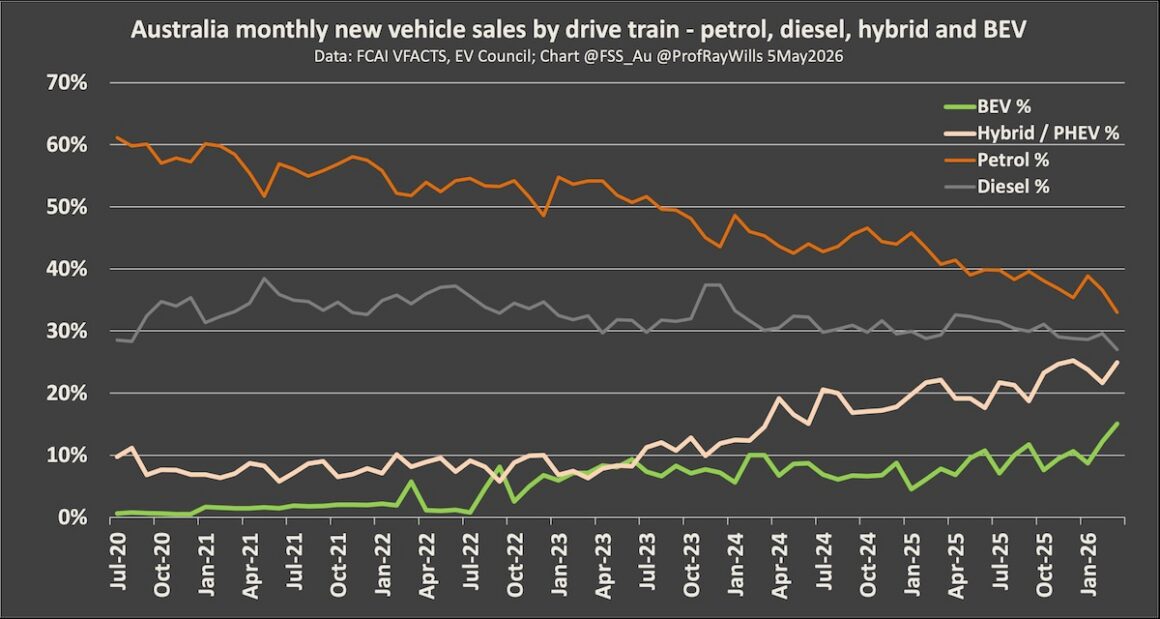
The drivetrain chart show this clearly. Petrol has been in long decline since the post-Covid rebound, diesel has flattened and then eased, while BEV share has climbed from almost nothing in 2020 to the high teens in April 2026.
Hybrids and plug-in hybrids have also continued to rise, meaning the share of the market with some level of electrification is now approaching half of all new vehicles sold.
That shift is also changing where Australia’s vehicles come from.
China is now firmly in the lead as the biggest source of new vehicles sold into Australia, with about 28% of the market on a year-to-date basis. Japan, which dominated the Australian market for decades, continues to lose share.
The April data reinforces China overtaking Japan on a monthly basis, and Japan’s share continuing to slide, and the longer trend now suggests that is no temporary blip but a clear structural change locked in the supply base.
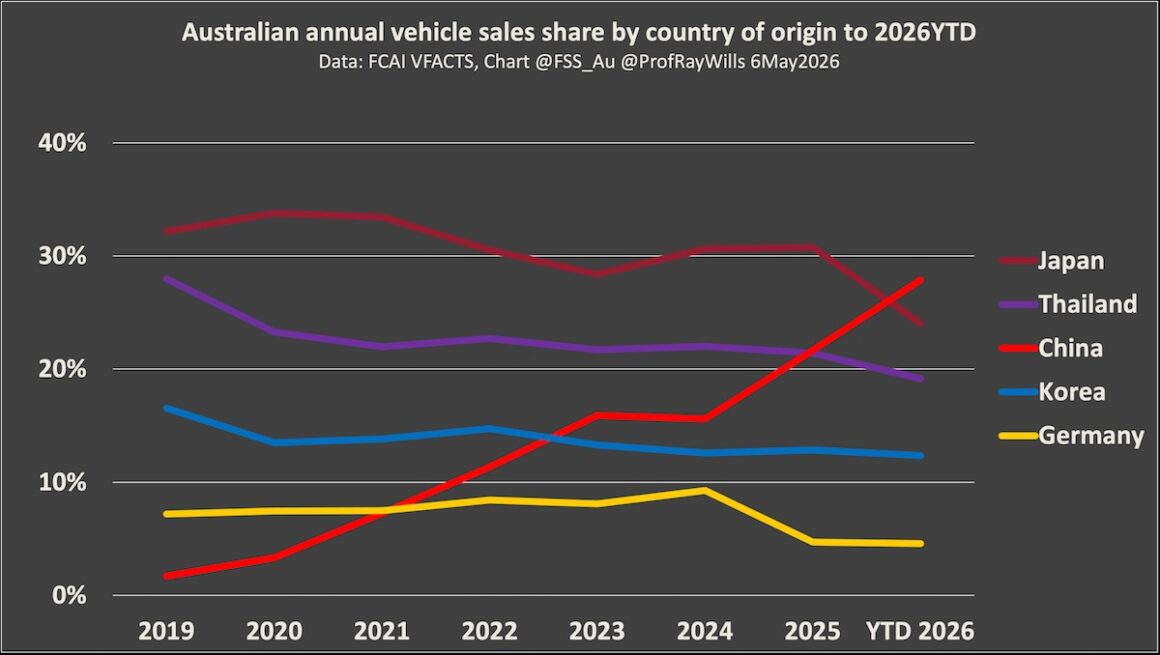
The significance of that goes beyond a country-of-origin league table. Australia is not just electrifying; it is electrifying mainly with vehicles built in China.
And that reflects the reality of the global market. China moved early and fast on solar, but now is moving even faster on batteries and EV platforms and manufacturing scale.
Meanwhile, Japanese automakers leaned more heavily into hybrids and delayed full battery EV rollouts. The result is now visible in Australian showrooms and in VFACTS tables alike.

April also matters because it comes one month before the traditional run-up to the June end-of-financial-year sales spike.
Historically, June has often delivered a temporary rebound in ICE sales as dealers clear stock and businesses bring purchases forward before 30 June. That was visible in the June 2023 and June 2025 bumps, even though the broader petrol and diesel trend kept heading down afterwards.
But 2026 may look different.
This year’s EOFY push will land in a market shaped by three forces at once: strong EV momentum, the first full year of the New Vehicle Efficiency Standard, and still-elevated fuel prices from the 4 week war on Iran.
That means June could still be a big month overall, but the composition of the spike may be very different from the old ICE-heavy EOFY pattern.
If fleets and business buyers move early to lock in deliveries, some of that demand is now likely to flow to hybrids, plug-in hybrids and BEVs (especially with full FBT exemption for EVs confirmed to stay for another year) rather than just diesel utes and petrol SUVs.
At the same time, carmakers will be increasingly aware that extra low-emissions volume helps under NVES, while pushing more high-emissions stock becomes harder to sustain – just like happened with Dieselgate.
So April may prove to be more than just another strong EV month. It may be the clearest sign yet that Australia’s market is crossing a threshold: China is now the lead supplier, one in six new vehicles is a battery EV, and ICE-only sales are falling towards half the market just as EOFY pressure begins to build.
See The Driven’s detailed EV sales data here: Australian electric vehicle sales by month in 2026; by model and by brand.
Sign up for The Driven’s free daily newsletter and get the latest EV news and analysis delivered straight to your inbox.