The electric vehicle industry has hailed a breakthrough year in EV sales in Australia, but warned the government needs to resist pressure from powerful legacy car makers to water down and weaken key policy measures.
The Electric Vehicle Council’s latest “State of EVs” report finds that sales of plug-in vehicles reached 25.8 per cent of the new car market in the first six months of this year, more than double the 12.1 per cent market share in the same period in 2025. It predicts the market share could jump further to 29 per cent by the end of the year.
The EVC combines both battery electric vehicles and plug-in hybrid cars in its data, but BEVs made up two thirds of the sales so far this year, including a record 24.1 per cent of new car sales in the month of August.
This is the lobby group’s 10th annual market health check. In the first, when EVs accounted for less than 0.2 per cent of new car sales, it predicted that reaching one quarter of new car sales would likely not happen until 2035. “We got there a decade early.” it says.
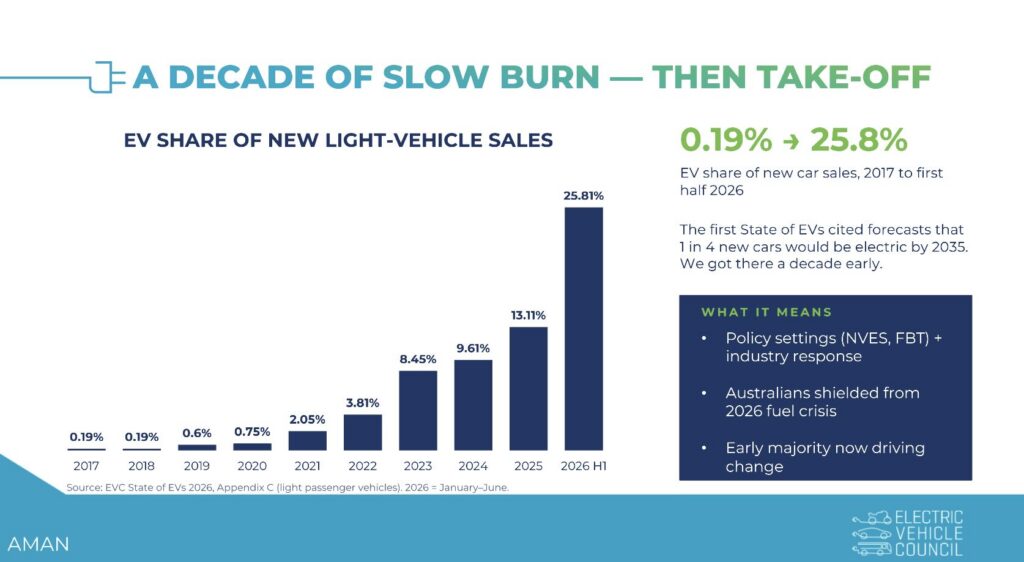
It notes that 2026 has been a breakthrough year, helped by the steep rise in petrol and diesel prices, a huge increase in the number of EV models on offer, cheaper EV models (with 15 now priced at $40,000 and below), and the impact of government policies such as the vehicle emissions standards and FBT exemptions.
More importantly, the EVC says that the market has shifted, and it is now “average Australians” rather than early adopters that are driving new purchases.
As an example it points to the biggest postcode for the uptake of EVs, which is around Tarneit in Melbourne’s west, about 30kms from the CBD.
“It’s certainly not glamorous as Sydney Harbour,” EVC’s head of policy Aman Gaur told a media briefing ahead of the report’s release. “It’s very much an average Australian suburb with, you know, people who have mortgages in the $600,000 to $700,000s, often have two income households.
“Both mum and dad are driving long distances to get to work. These are people who are very much suburban Australia, they rely on their cars, they do not have access to three forms of public transport outside their front door, and for them, the sensible economic choice is to get into an EV.”
Gaur says the used car market for EVs has also jumped by 150 per cent, which is important because most Australians still buy their cars second hand. “It means that the benefit of cheaper transport is being spread to more and more Australians,” he says.
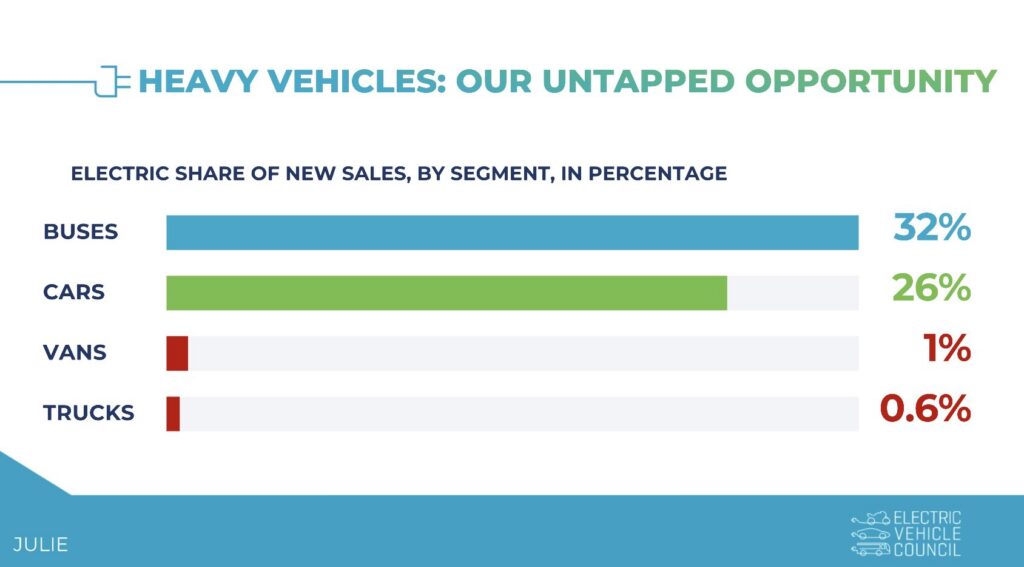
But the EVC warns that the transition still faces issues. There is barely any movement in the electric truck market, despite the emergence of new players such as New Energy Transport and Janus Electric, and despite a host of newly released electric vans. Electric truck and van sales represent less than 1 per cent of their respective markets.
“At a time when our economy’s reliance on expensive, imported diesel has been exposed, there is no financial support from any government to help small freight operators move off diesel and onto electric trucks,” the EVC says.
“In comparison, the UK offers up to $250,000 per electric truck and countries such as New Zealand, India and France offer more support to electrify.”
But the EVC is also concerned about the future of government policies for EVs, warning that the market will stagnate if the New Vehicle Emissions Standards is not reviewed and extended. The NVES is credited for forcing car makers to bring more EV models to the Australian market, but it is due to expire in 2029, and legacy car makers such as Toyota are lobbying for a slowdown.
“Unsurprisingly, Toyota are not supportive of moving forward with the emission standards,” Gaur says.
“I think it’s quite clear that OEMs who really have an opportunity to electrify are moving towards the standard. However, those who have previously pushed against it and tried to get Australians to stay on petrol hybrids are doing their best to ensure that the standards are not moved in line with our 2035 targets.”
Modelling by the Climate Change Authority shows that to reach the country’s emissions targets by 2035, Australia will need to have 5 million EVs on its roads. It currently has just 500,000.
“If they (the NVES) are not updated by the transport minister by the end of next year, they will stagnate at the 2029 levels. That will directly impact sales because we know that the thing that has driven the increase in supply (of EV models) has been the vehicle efficiency standards,” Gaur says.
“Quite apart from the emission standards, we know that we live in an environment now with high inflation, and that petrol and diesel are contributing to that inflation. So the worst policy outcome for Australians in this world is really in this sphere that they’re left driving petrol hybrid cars that leave them really hostage to overseas oil markets.”
The EVC is also worried about the “ideological reversion” of newly elected conservative governments in Queensland and the Northern Territory, particularly Queensland which has cancelled plans to transition to electric buses and ordered 630 new ones instead. It has also stopped funding EV charging and the transition of its own government fleet.
“Queensland and the Northern Territory are really trying to turn back the clock and moving to back to fossil fuels rather than trying to electrify their transport systems,” he says.
But the EVC also criticised the Western Australian, Tasmania and South Australia governments for not doing enough to support EVs, and gave Victoria “barely a pass mark.” NSW and ACT get green ticks for their policies, but NSW is also proposing to introduce its own “road tax” on EVs from July next year that the EVC is trying to stop.
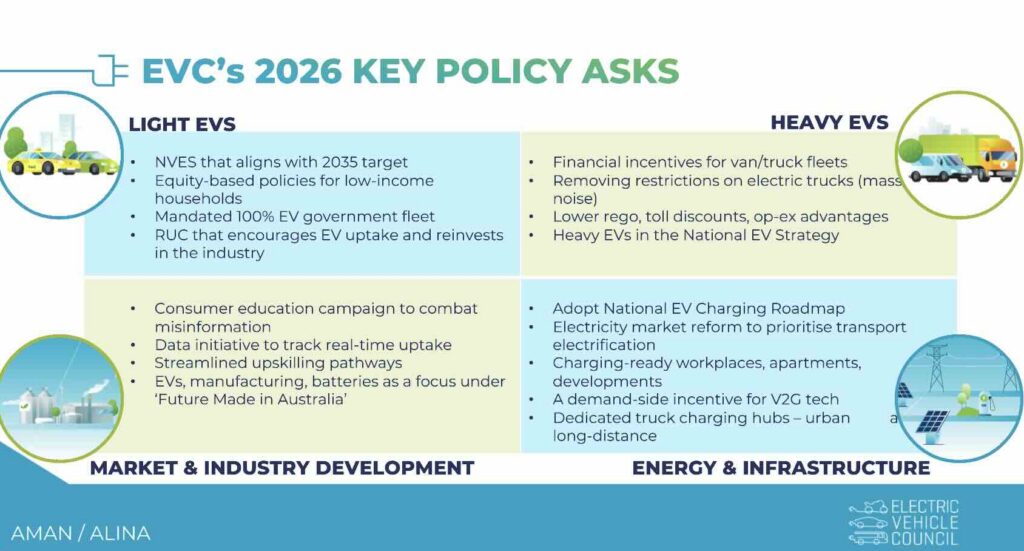
The EVC says it supports a federal road-user charge that does not deter EV adoption, and where revenue is reinvested into the EV ecosystem
It also recommends targeted equity-based policies to help economically disadvantaged Australians access the cost savings from EV adoption, financial incentives and regulatory reforms to accelerate electric truck and van uptake, a nationally coordinated charging roadmap and scaled infrastructure deployment and consistent national settings for vehicle-to-grid technology and right-to-charge rules.
And for a full rundown of all available EV models in Australia, please go to our Compare EVs page here.
You can find The Driven’s detailed EV sales data here: Australian electric vehicle sales by month in 2026; by model and by brand.
And you can sign up for The Driven’s free daily newsletter and get the latest EV news and analysis delivered straight to your inbox.