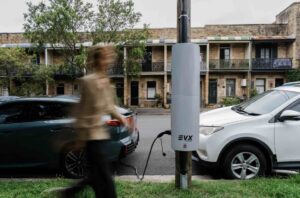
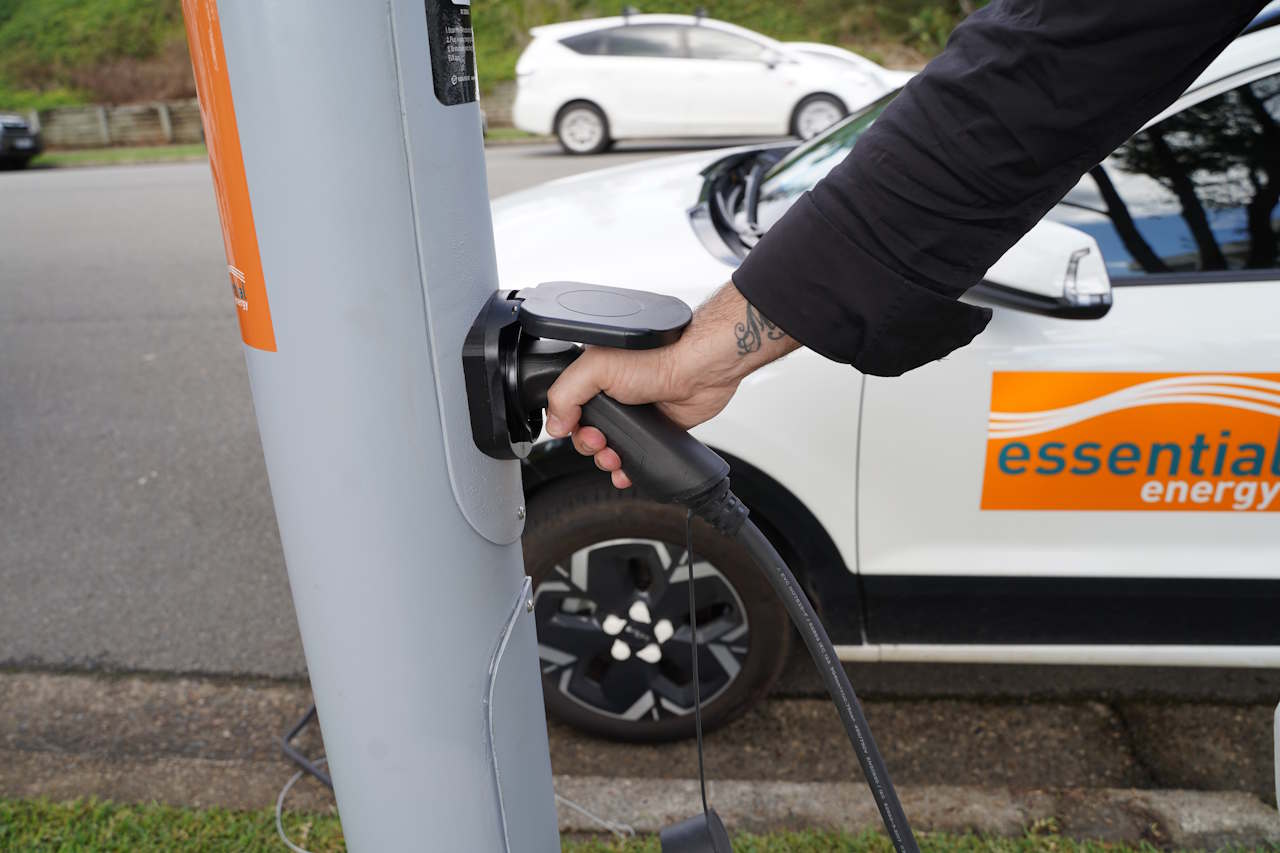
The Australian Energy Regulator has opened a consultation on whether to approve a ring-fencing waiver application from electricity distribution network owner and operator Essential Energy in its bid to install 300 kerbside electric vehicle (EV) chargers on streetlights and distribution poles.
Essential Energy unveiled its plans to install streetlight-mounted EV chargers across regional, rural, and remote areas of New South Wales earlier this year, as part of a trial which would also make a further 1,000 poles available for private operators to install their own equipment.
The so-called ‘Plug and Play’ EV charging trial, which is partly funded by the Australian Renewable Energy Agency’s (ARENA) Driving the Nation Program, will utilise Essential Energy’s existing infrastructure and relationships with councils and communities to de-risk the creation of public charging in otherwise expensive locales.
Chargers would be housed in a recessed charging port within composite streetlight and distribution poles.
Essential Energy owns one of Australia’s largest electricity distribution networks stretching across NSW and parts of southern Queensland.
The company said at the time of its announcement that it is open for the initial network of 300 7-kilowatt (kW) white-labelled EV chargers to be used by private charge point operators, and that it was preparing a ring-fencing waiver application to the Australian Energy Regulator (AER) to facilitate the program.
If Essential Energy is successful in securing a waiver, it would pave the way for it to lease the new charging infrastructure within the poles to charge point operators.
Essential Energy’s role would be limited to owning, installing, maintaining, and leasing the infrastructure, while retail charging services such as pricing, billing, and customer engagement would be provided by charge point operators.
Ring-fencing rules are designed to prevent distortion in competitive markets by preventing regulated monopolies such as distributed network service providers (DNSPs) from owning and operating assets that compete with private companies.
Many charge point operators and EV advocates are fighting the waivers, arguing that they amount to a distortion of the market and will add to their regulatory base. In turn, the networks argue they are based placed to facilitate the additions, and say the additions to their regulatory asset base are minimal and should amount to just a few dollars a year.
Rob Amphlett Lewis, group executive of distribution at Australia’s biggest DNSP, Ausgrid, told Renew Economy’s Solar Insiders Podcast earlier this year recognised the potential conflicts, but asked simply that DNSP’s be given a chance: “Just give us a shot, let us have a crack, and if we don’t succeed, fine.”
Victorian network operator CitiPower, Powercor and United Energy (CPU) secured their own high-contested waiver late last year to launch a kerbside EV charger trial.
But there remains strong resistance to modifications to ring-fencing rules, as highlighted in March by a rule change request submitted to the Australian Energy Market Commission (AEMC) from a coalition of consumer and industry bodies calling for a crackdown on networks being given waivers from consumer protection rules.
Essential Energy submitted its ring-fencing waiver application with the AER in April, which in turn has led to the AER opening a consultation seeking input from stakeholders “on the opportunities and risks of a DNSP owning and leasing EV charging infrastructure in regional NSW.”
The ring-fencing waiver applies only to the installation and operation of the 300 pole-mounted EV chargers and not to the upgrades planned to a further 1,000 poles to make them charger-ready for third-party EV charger deployment.
Written submissions will be accepted through to Tuesday 14 July 2026, with a public stakeholder workshop to be held online on Tuesday 23 June as part of the public consultation process. Submissions and requests to make a submission via alternative methods should be emailed to [email protected].
Sign up for The Driven’s free daily newsletter and get the latest EV news and analysis delivered straight to your inbox.