Hyundai’s newest electric SUV arrives in Australia with an unusually blunt strategic message: If you can’t beat the Chinese EV makers, build one in China.
The Elexio is the first Hyundai electric vehicle sold in Australia to be built in China, through Beijing Hyundai, the company’s joint venture with BAIC. It appears Hyundai is now “fighting China with China.”
That makes the Elexio more interesting than it might look at first glance. This is not another quirky Ioniq-branded halo car, nor a smaller urban EV like the Inster. It is Hyundai’s attempt to land a practical, long-range, family-sized electric SUV right in the most competitive part of the Australian market: the high-$50,000 to low-$60,000 bracket.
And that is both its opportunity and its problem. I had the Elexio as my daily drive for a week to see where it sits against the two Hyundai EVs I already own (Inster & Ioniq 5), and some of the other electric SUVs I’ve been driving lately.
The Elexio range starts with the base model at $57,990 drive-away, while the better-equipped Elexio Elite comes in at $59,990 drive-away. Both use the same basic drivetrain: an 88.1kWh LFP battery, a single front motor producing 160kW and 310Nm, and front-wheel drive. Hyundai quotes 562km WLTP range for the base model and 546km WLTP for the Elite.
The difference is largely down to wheels and equipment. The base model rides on 18-inch wheels, while the Elite gets 20-inch wheels, which look better but shave a small amount from the claimed range.
For an extra $2,000, the Elite adds some genuinely useful comfort gear: heated and ventilated front seats, a heated steering wheel, two wireless phone chargers instead of one, and a power tailgate. The base car makes do with a manual tailgate, which feels a little odd for something nudging $58,000 drive-away.
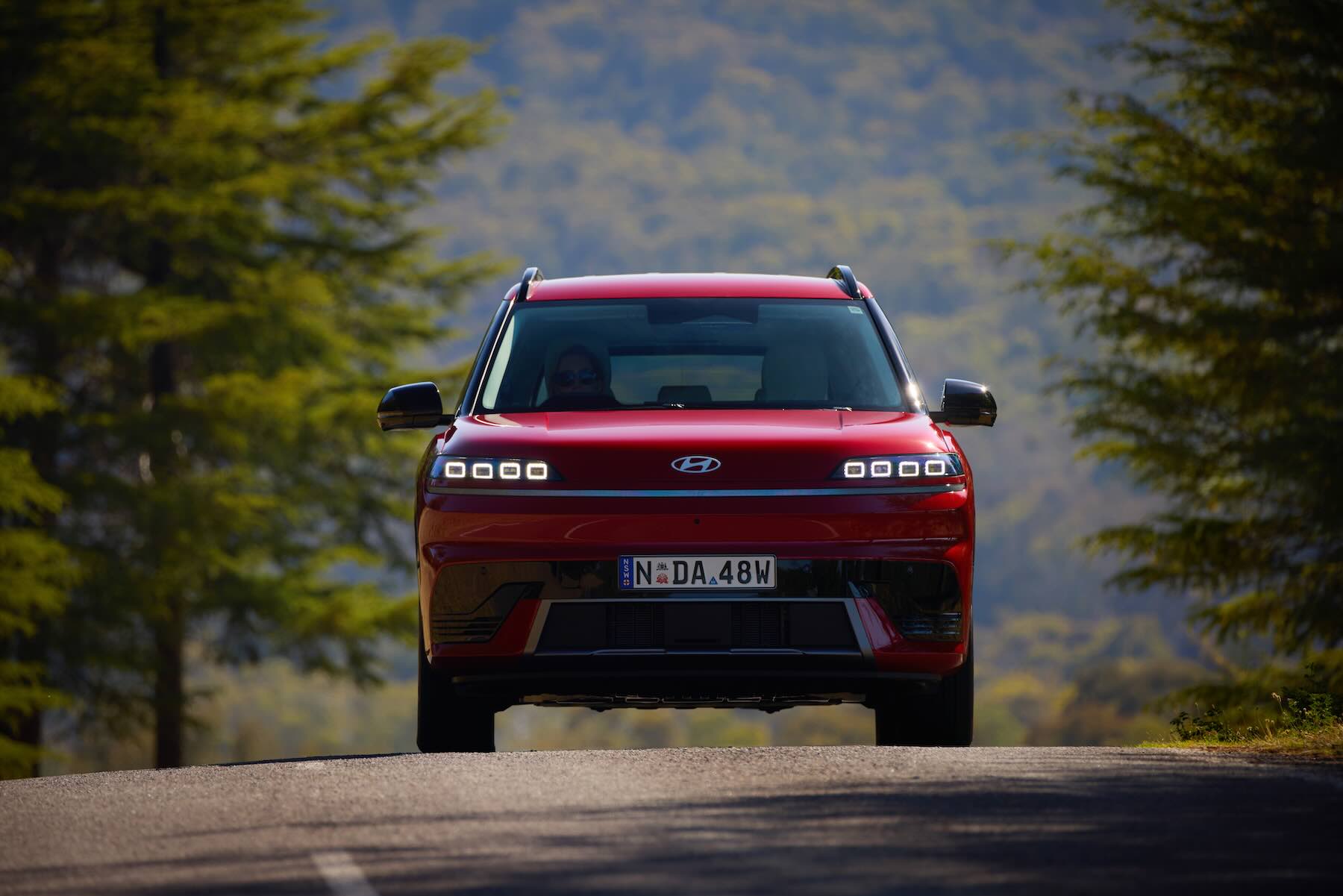
Visually, the Elexio is a slightly odd Hyundai. There are still hints of the brand’s pixel-lighting design language, but it does not have the retro-futuristic confidence of the Ioniq 5 or the playful weirdness of the Inster. It is handsome enough, but not especially memorable. It’s a good-looking car in my opinion, but not one that necessarily stands out.
Inside, things get more interesting, and more divisive.
The dashboard is dominated by a very wide 27-inch screen that stretches across the centre and toward the passenger side. It almost feels like Hyundai moved the steering wheel to the right-hand side, but forgot to bring the screen with it.
Otherwise the interior is modern, clean, with a minimalist feel which you often find in cars coming out of China, but it does not feel like a typical Hyundai. The menus, software layout and general user interface are very different from the familiar systems found in Hyundai’s other Australian models.
Whether that is good or bad probably depends on how much you like the screen-heavy, button-light approach that has become common in Chinese EVs.
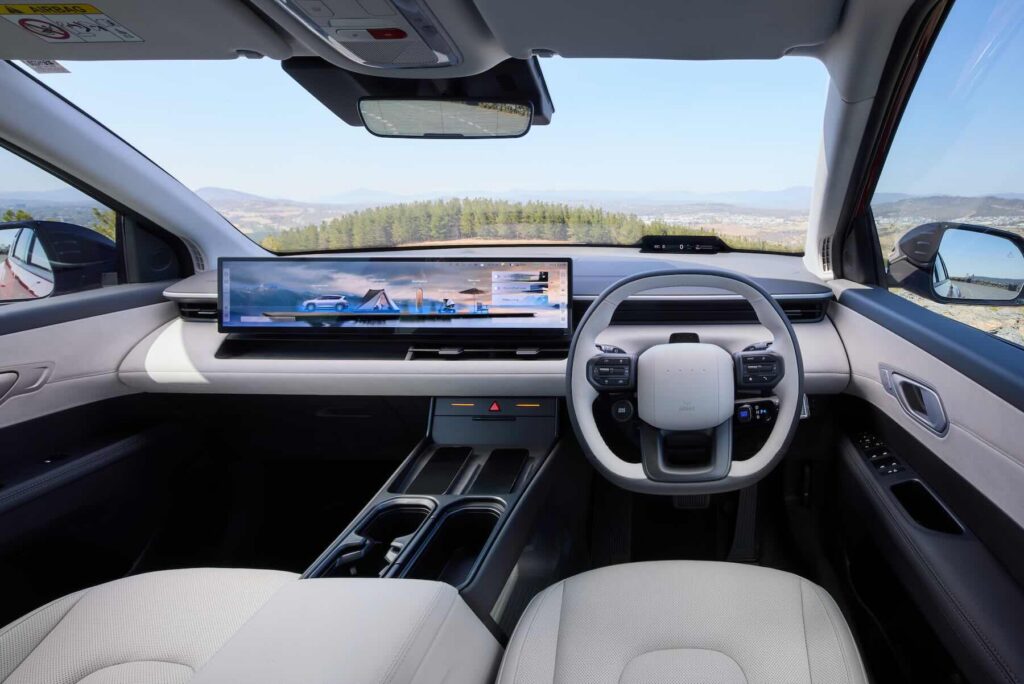
The issue is not that the screen is bad. It is that the driver only really gets half of it. There is no traditional instrument cluster in front of the steering wheel, so key information is handled by the head-up display and the left half of the main screen.
Meanwhile, the passenger gets a lot of real estate. That might be handy on a road trip, but it does leave the driver interface feeling slightly compromised.
The head-up display itself is mostly good. It sits lower down, with a black background that makes it crisp and easy to read. It shows useful information such as speed, range, navigation and media.
But there are two catches: it can be hard to read with polarised sunglasses (which is also typical of many HUDs you find in vehicles), and it doesn’t show some basic information like indicator or lighting icons, which meant I found myself having to glance back to the centre screen more often than I’d have liked.
The lack of physical buttons is another very un-Hyundai touch. Apart from the hazard light button, most functions are handled through the infotainment system.
Climate control is screen-only, which may annoy anyone who thinks changing the temperature should be done at the touch of a physical, permanent button. For those that like to use voice commands, the Elexio does make up for the lack in physical buttons with some decent voice command options.
Cabin quality, though, is hard to fault. The materials feel decent, the seats are comfortable, and there is a practical centre console with multiple cup holders, storage space and several USB-C ports. Oddly, there is no ambient lighting, which now feels like a strange omission in an EV market where cabins in even budget models often light up.
The Elexio makes a stronger case in the back seat. It is bigger than the Kona Electric, giving it some extra distinction as an alternative to the existing Kona range.
Rear legroom is good, there is more than enough space for child seats, and rear passengers get door cup holders, centre storage and extra USB-C ports. As a practical family EV, this is where the Elexio starts to make more sense.
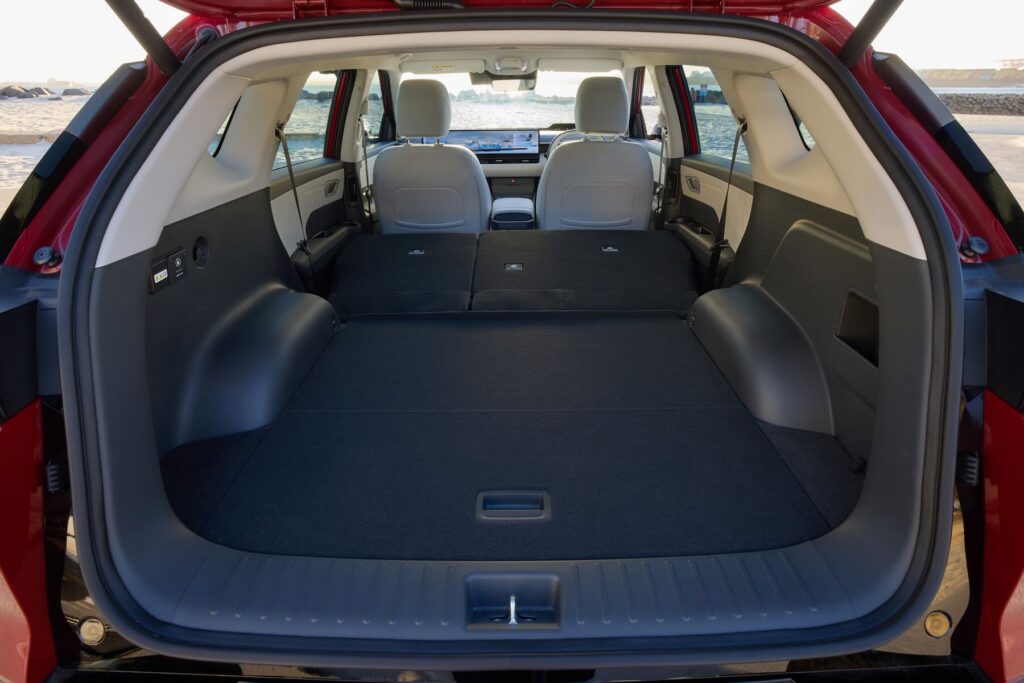
Boot space is also useful. Hyundai quotes 506 litres with the rear seats up and about 1,540 litres with them folded. There is some underfloor storage, enough for cables and small items, but not a huge amount of extra depth. There is also no frunk unlike the Kona and Ioniq 5 & 9 models.
Charging is solid. The port is on the front driver’s side, which is not ideal for every charging setup, especially kerbside chargers, but probably not a deal-breaker. DC fast charging peaks at a strong 150kW, with Hyundai quoting a 10 to 80 per cent charge time of 38 minutes. AC charging peaks at a respectable albeit unambitious 11kW.
On the road, the Elexio is good rather than dazzling. The Elite’s 20-inch wheels make the ride a little firmer, and compared with softer Chinese electric SUVs like the Geely EX5, the Hyundai lets you feel more of the road. That is not necessarily a bad thing. Some drivers will prefer the firmer, more controlled feel, while others may prefer something softer and more cloud-like.
The i-Pedal regenerative braking system was a bit of a surprise. Compared with the Inster for example, which has a strong one-pedal driving feel, the Elexio’s i-Pedal is significantly weaker.
That may reflect the car’s Chinese-market development, where one-pedal driving appears to be less of a priority. For Hyundai owners used to stronger regen behaviour, it may feel like a step backwards.
There are also some interface quirks. Wireless Apple CarPlay and Android Auto are standard, but when Apple CarPlay is running, it blocks the blind-spot camera display, with a message saying blind spot is not available while using Apple CarPlay. That is annoying, especially because the blind-spot camera itself is one of Hyundai’s better safety features.
Even the pedestrian warning sound is different. The Elexio’s AVAS, which is the low-speed EV warning sound, does not sound like other Hyundai vehicles. It has a different, unfamiliar tone, which again reinforces the sense that this car comes from a different branch of the Hyundai family tree.
So where does that leave the Elexio? The short answer is that it is a good car. The harder question is whether good is enough.
Two years ago, an electric family SUV with more than 500km of WLTP range, a big LFP battery, 150kW DC charging, useful interior space and a sub-$60,000 drive-away price would have looked like a standout offer. Today, that same car has to fight the Tesla Model Y, BYD Sealion 7, Kia EV5, Zeekr 7X, Renault Scenic E-Tech, XPeng G6 and several others. The market has moved brutally fast.
That is the Elexio’s central challenge. It does most things right. It is spacious, practical, comfortable, well equipped and arguably quite sensibly priced. But it also has a screen layout that will divide buyers, software that feels less familiar than other Hyundais, weaker-than-expected i-Pedal behaviour, and a design that does not quite have the visual punch of Hyundai’s best EVs.
It is not a bad car. Far from it. For some it could present as a very rational buy. But in 2026, rational may be not enough to guarantee attention.
Sign up for The Driven’s free daily newsletter and get the latest EV news and analysis delivered straight to your inbox.
ELEXIO Specifications (Feb 2026)