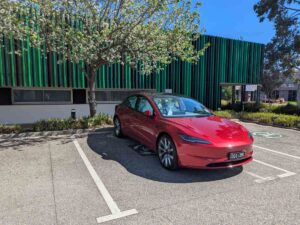

A huge uptake of Tesla’s newly released Model Y L six-seater EV has helped the company post its best ever sales for July, following on from a record June when EVs took nearly one quarter of the new car market in Australia.
According to data released by the Electric Vehicle Council on Tuesday, Tesla recorded sales of 4,778 in July – traditionally a slow month because it comes at the start of a quarter. More than half of these were Model Y L EVs, the first time the company has separated the six-seater version from other Model Y sales.
The Model Y became the best selling vehicle of any type in Australia in June – and reportedly the highest monthly sales since the Holden Commodore more than two decades ago – helping the plug in EV and hybrid market take a near 50 per cent share of the new car market for the first six months of the year.
The new July numbers for Tesla represent a five-fold jump from its sales of July last year, when it delivered just 917 vehicles. The Model Y, including the Y L, totalled 4,644, and was the standout performer.
The Tesla Model 3 had just 134 deliveries, down 63 per cent from the same month a year ago, while Polestar also declined, with a total of 143 for the month, down 37 per cent from 240 last July. Its best selling car was the Polestar 2, with 77.
Still, the EVC, which reports Tesla and Polestar sales separately from the other dealers included in the FCAI’s VFacts data (to be released on Wednesday) said year-to-date sales for Tesla and Polestar have risen to 29,711 – an 80.4% increase over the 16,466 sales recorded for the same period in 2025.
“July sales suggest June was no one-off,” EVC chief executive Julie Delvechhio said. “Lower running costs, fewer petrol price shocks, more choice — Australians are increasingly choosing electric.”
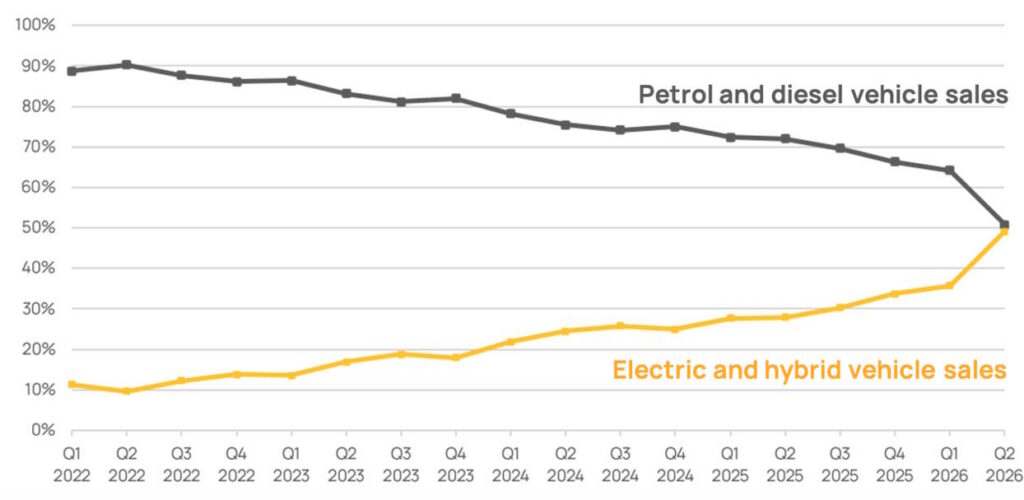
Earlier, the Australian Automobile Association reported that 49.16 per cent of new car sales in the second quarter of 2026 were electrified, consisting of BEVs, plug-in hybrid electric vehicles (PHEVs), or hybrids.
Importantly, total quarterly light vehicle sales hit an all-time high in the second quarter of 330,111, with the increasing number of electrified vehicle sales more than accounting for the decline in internal combustion engine (ICE) vehicle sales.
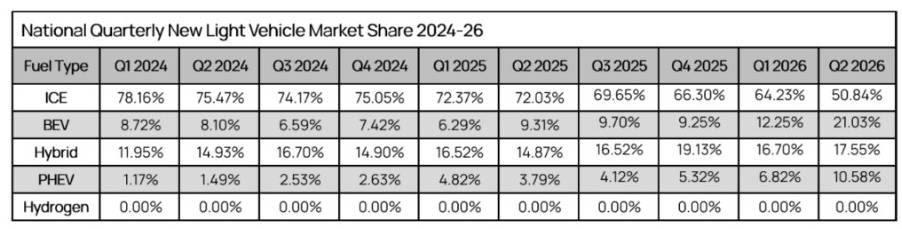
Both BEVs and PHEVs saw a record quarter, taking home a market share of 21.03 and 10.48 per cent, respectively, up from 12.25 and 16.7 per cent in the previous quarter, and 9.31 and 3.79 per cent in the same quarter a year earlier.
In terms of actual vehicle sales, a total of 69,414 BEVs were sold in the second quarter, over double that recorded in the first quarter of 2026 and up 137 per cent compared to the second quarter of 2025. PHEV sales reached 34,937 in the second quarter of 2026, up 82 per cent from the first quarter and up 193.5 per cent from the second quarter of 2025.
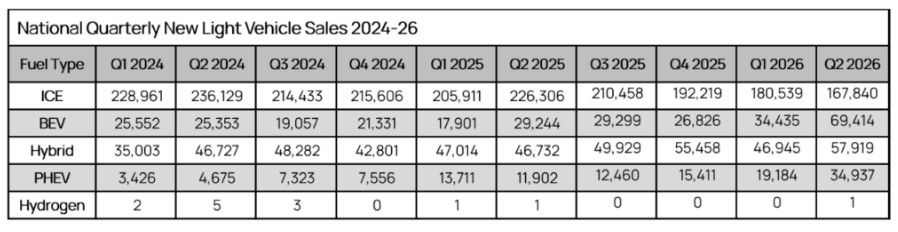
All this, despite quarterly hybrid sales hitting an all-time high of 57,919 and accounting for their second-highest share on record at 17.55 per cent.
Conversely, and serving to well and truly demonstrate the cliff-face ICE vehicles are currently tumbling over, ICE sales accounted for only 50.84 per cent of all new vehicles in the second quarter, down from a share of 64.23 in the first quarter and a 72.03 per cent share in the second quarter of 2025.
This represents not only ICE’s lowest-ever market share but also its biggest-ever quarterly drop. Put another way, since the EV Index began in 2022, the market share for ICE vehicles has fallen from almost 9 in 10 new cars sold to about 5 in 10.
See Australian electric vehicle sales by month in 2026 – by model and by brand