Credit: Bridie Schmidt
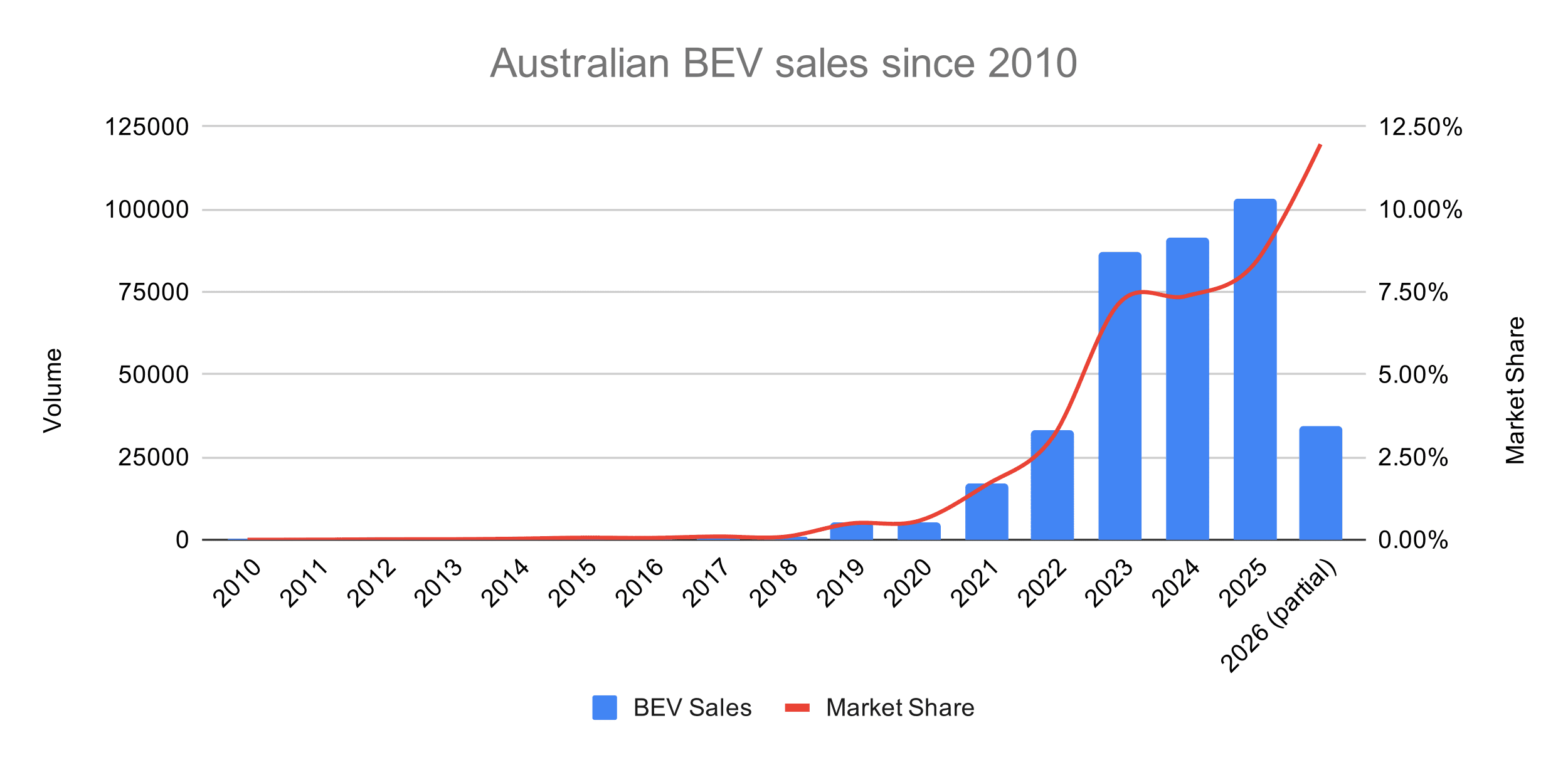
An analysis of Australian battery electric vehicle (BEV) sales each year since 2010 indicate that we are already on track to reach 80 per cent market penetration by 2030.
This may sound surprising, but BEV sales have been growing exponentially since they first went on sale here in the early 2010s.
The milestone of more than 100 sales was surpassed in 2012, made up of the Mitsubishi i-MiEV and first generation Nissan Leaf. Five years later in 2017, we passed 1,000 vehicles, and just 4 years after that there were 17,243 EVs sold in 2021. Four years later again in 2025, that figure reached 103,269.
Full details of BEV sales each year are included in the table below.
| Year | BEV Sales | Total Vehicle Sales | Market Share |
| 2010 | 10 | 1035574 | 0.00% |
| 2011 | 49 | 1008437 | 0.00% |
| 2012 | 173 | 1112032 | 0.02% |
| 2013 | 191 | 1136227 | 0.02% |
| 2014 | 370 | 1113224 | 0.03% |
| 2015 | 759 | 1155408 | 0.07% |
| 2016 | 668 | 1178133 | 0.06% |
| 2017 | 1208 | 1189116 | 0.10% |
| 2018 | 1054 | 1153111 | 0.09% |
| 2019 | 5264 | 1062867 | 0.50% |
| 2020 | 5215 | 916968 | 0.57% |
| 2021 | 17243 | 1049831 | 1.64% |
| 2022 | 33410 | 1081429 | 3.09% |
| 2023 | 87217 | 1216780 | 7.17% |
| 2024 | 91293 | 1237288 | 7.38% |
| 2025 | 103269 | 1241037 | 8.32% |
| 2026 (partial) | 34382 | 287168 | 11.97% |
If we extend the same consistent trend that has been occurring for the past 15 years, essentially growing sales by a factor of 10 every 4 or 5 years, there will be over a million EVs sold in the year 2029 or perhaps 2030. Allowing for some growth of total vehicle sales, this would represent somewhere between 75 to 80 per cent of the new car market.
Exponential growth is extremely hard for the human mind to grasp, our brains are naturally wired to expect linear growth. However, history has repeatedly shown that new technologies are adopted quickly and often follow the well-known ‘S’-shaped adoption curve.
Even experienced motoring journalists, whose job is to understand the car market, often underestimate how quickly things can change. For example, during the media launch of the Hyundai Elexio in February this year, I was shocked to hear one of the other journalists from a major Australian publication say he was sick of talking about EVs.
“I understand that manufacturers backed into the corner with NVES and government expectations and you have to do what you have to do, but it’s an awful lot of focus for what is 8 per cent of the market. I’m just saying I’m sick of talking about what is 8 per cent of the market, I might as well talk about supercar sales to be honest with you.”
Granted, this launch occurred just before the Iran war started and interest in electric vehicles surged, but the sales data was already there if you bothered looking into it. 8 per cent will turn into 80 per cent in just a handful of years, I would love to replay that quote and see what the same journalist thinks then.
Plotting the data on a graph reveals a few more interesting insights. The early data almost blends into the X-axis as those early years are dwarfed by sales in recent years. Growth has not been smooth either, there are several obvious jumps that occurred, helping to trick the human mind into missing the overall longer term trend.
The first visible jump in 2019 occurred when the Tesla Model 3 launched in Australia. Tesla did not officially report their sales figures back then, but it is safe to assume the vast majority of 5,264 electric vehicles sold that year were Model 3s, including my own.
Tesla then launched the Model Y here during the middle of 2022 with first deliveries taking place in August, accounting for another large bump in sales. Model Y went on to cement its place as the number 1 selling electric vehicle in the country, a title it still holds to this day despite fierce competition from BYD and other Chinese newcomers.
With the recent surge in EV interest, 2026 is going to be another one of these large jumps. Data for the first quarter is already showing 100 per cent growth, or double the number of sales compared to the first quarter of 2025. If this holds for the remainder of the year, we are likely to reach over 200,000 sales and finish around 15 – 16 per cent of the new car market.
Tim has 20 years experience in the IT industry including 14 years as a network engineer and site reliability engineer at Google Australia. He is an EV and renewable energy enthusiast who is most passionate about helping people understand and adopt these technologies.
The best thing about having an EV on a driving holiday in New Zealand is…
Drivers have been warned to be "deeply sceptical" of automakers' claims after several popular hybrid…
Musk announces delay on release of Roadster, Optimus robot and FSD, and says that new…
Polestar hopes release of four new EV models in coming years will help reverse its…
New electric vehicle (EV) registrations grew by 51 per cent in March across Europe, accounting…
Tesla's new variant with range boost spotted in Approval documentation, paving path for sale.