Recent world events and the resulting rise in liquid fuel prices has undoubtedly shifted the conversation around energy security and accelerated the electric vehicle transition. Sales data for March revealed the best month ever for Australia, with 14.5 per cent of new cars sold being battery electric.
If you also include the 8,215 plug-in hybrid electric vehicles as the Electric Vehicle Council usually does in their reporting, a total of 24,054 cars with a plug were sold in March. This accounts for an impressive 22.1 per cent of all vehicles. It will be interesting to see how different manufacturers keep up with rising demand in the months ahead.
The increase in EV demand globally has seen Tesla sales recover somewhat in the first quarter of 2026, good enough to take the number 1 global spot back from BYD. Global sales of battery electric BYD vehicles dropped by 25 per cent in the first quarter to 310,389, well below Tesla’s figure of 358,023 over the same period.
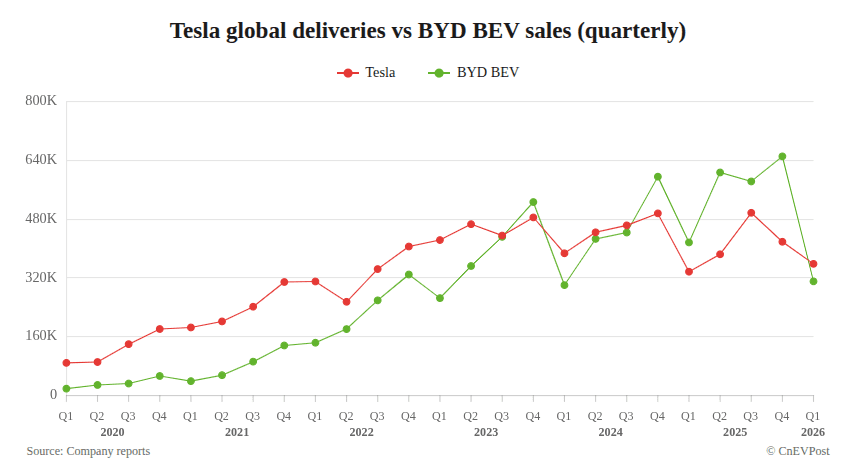
As you can see in the chart from CnEVPost reproduced above, sales of both Tesla and BYD are down from the highs of 2025 though, and the consistent upward trend that both brands experienced between 2020 and 2024 seems to be changing shape as competition from other brands heats up.
Focusing on Australian sales data, the battle for number 1 between Tesla and BYD would appear to be largely over for now with BYD sitting comfortably on top, unless Tesla comes out with something unexpected or BYD falters.
Apart from a small win for Tesla in February, BYD easily outsold Tesla during the first quarter of 2026, with a total of 9,954 vehicles vs 7,260. BYD’s newest models like the Atto 2 and Atto 1 are selling well, and are in 4th and 10th place year to date. Only the Seal and Dolphin are outside the top 10, in 12th and 13th place for now.
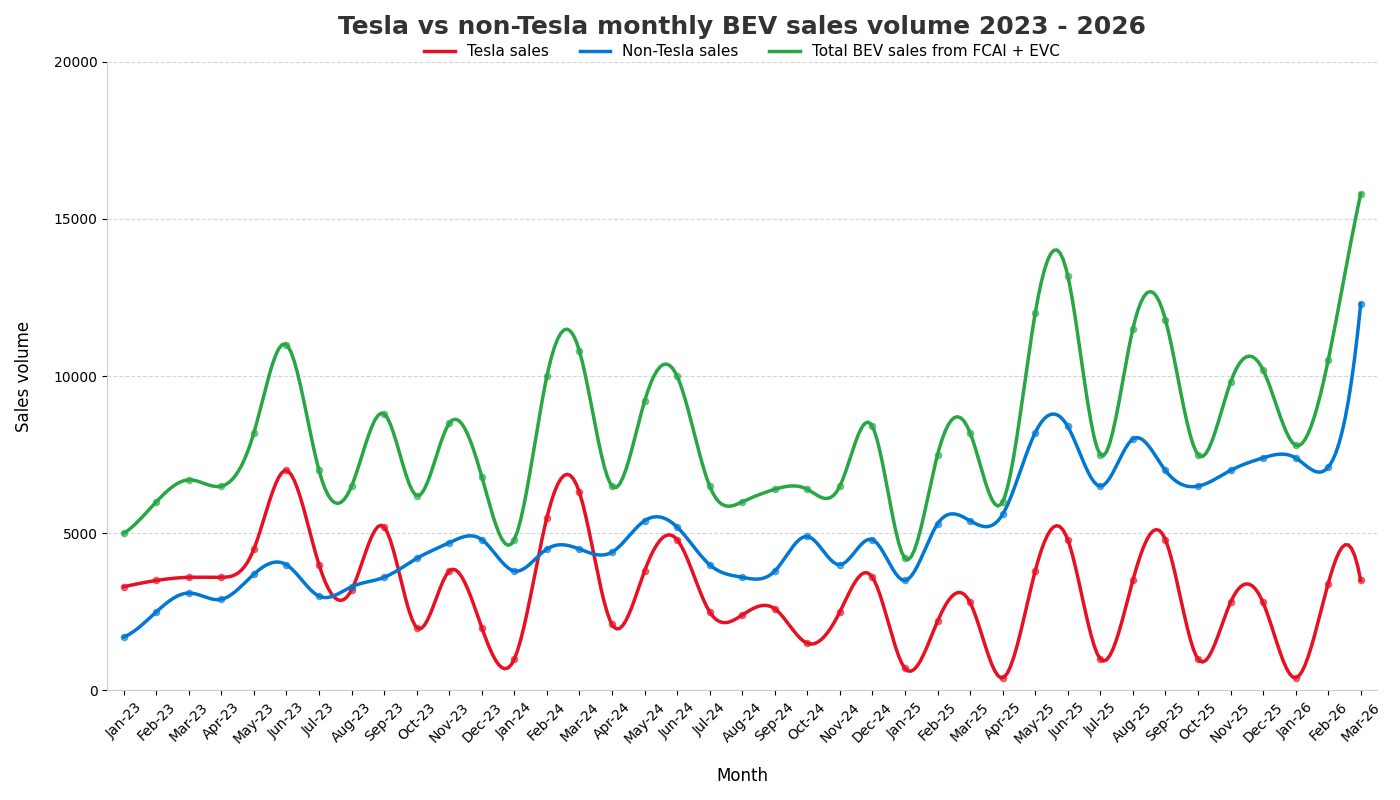
Looking at Tesla vs non-Tesla trends, the recent surge in EV interest has clearly been taken up by other brands with Tesla sales relatively flat over the past 2 years if you draw a trend line through the spiky month by month data that the chart above is generated from.
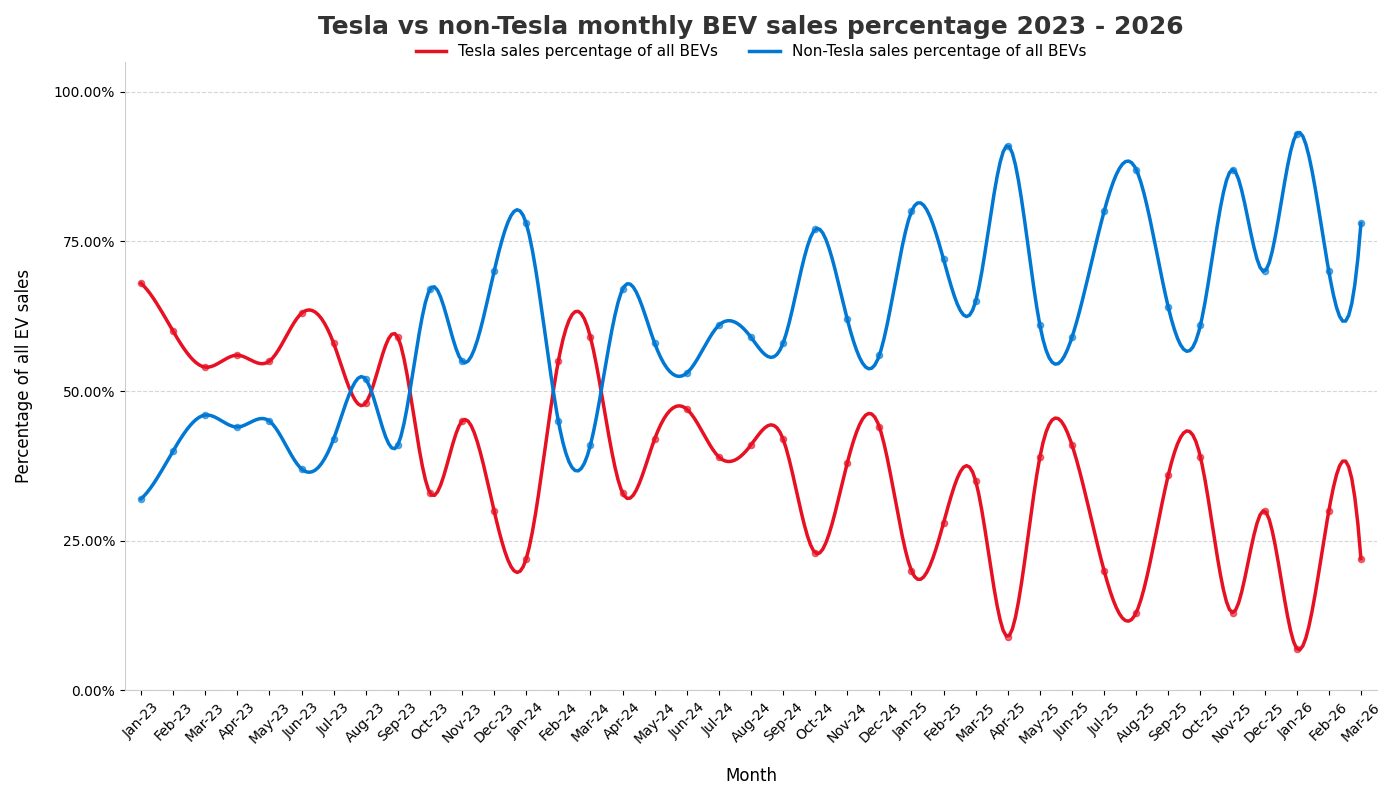
Given Tesla sales are flat in an expanding market, the percentage of Tesla sales is therefore continuing its decline from being the majority until the later part of 2023. Using combined figures from Q1 2026, Tesla vehicles accounted for 21 per cent of the Australian EV market.
New Chinese brands and some established automakers on the rise
While BYD and Tesla have been duking it out for the top spot, a lot has been happening from number 3 onwards over the last few years. To get a better understanding of the situation I took the top 10 brands from 2024 to 2026 and created the table below, also showing the movement compared to previous years.
| Position | 2024 | 2025 | 2026 |
| 1 | Tesla | Tesla (-) | BYD (▲) |
| 2 | BYD | BYD (-) | Tesla (▼) |
| 3 | MG | Kia (▲) | Kia (-) |
| 4 | BMW | MG (▼) | MG (-) |
| 5 | Volvo | BMW (▼) | Zeekr (▲) |
| 6 | Kia | Geely (▲) | Geely (-) |
| 7 | Mercedes-Benz | Mercedes-Benz (-) | Omoda Jaecoo (▲) |
| 8 | Hyundai | Volvo (▼) | Hyundai (▲) |
| 9 | Polestar | Polestar (-) | Toyota (▲) |
| 10 | GWM | Volkswagen (▲) | Volkswagen (-) |
Several interesting observations came out of this exercise. Kia is well behind BYD and Tesla in 3rd place, but has grown their sales significantly since entering the top 5 in 2025. With a varied EV lineup covering all segments including the soon to be released PV5 electric van, Kia looks set to remain in the top 3.
Hyundai dropped down to 13th in 2025, but is now back to number 8 in 2026 where they finished 2024. Hyundai has a similar lineup to Kia but have traditionally not done as well as their sister brand from South Korea.
German brands Mercedes-Benz and BMW both suffered falls, but their actual numbers tell somewhat different stories. Mercedes-Benz slightly increased their sales by 10 per cent between 2024 and 2025, although they appear to be falling in 2026 based on only 526 sales in the first quarter vs a total of 3,045 in 2025.
BMW sales have been declining steadily since 2024 when they finished the year with 7,787, down to 5,187 in 2025. So far in 2026 they have sold just 670 vehicles, but this number will be higher once they provide March figures for iX1 and iX2 that we are currently missing. BMW is also pinning hopes on the new generation iX3 and its ‘Neue Klasse’ platform.

European brands Volvo and Polestar were consistently in the top 10 until this year, now relegated to 14th and 15th place. Similar to Mercedes-Benz and BMW, Polestar increased their sales in 2025 but is lagging so far in 2026 whereas Volvo has been declining year over year.
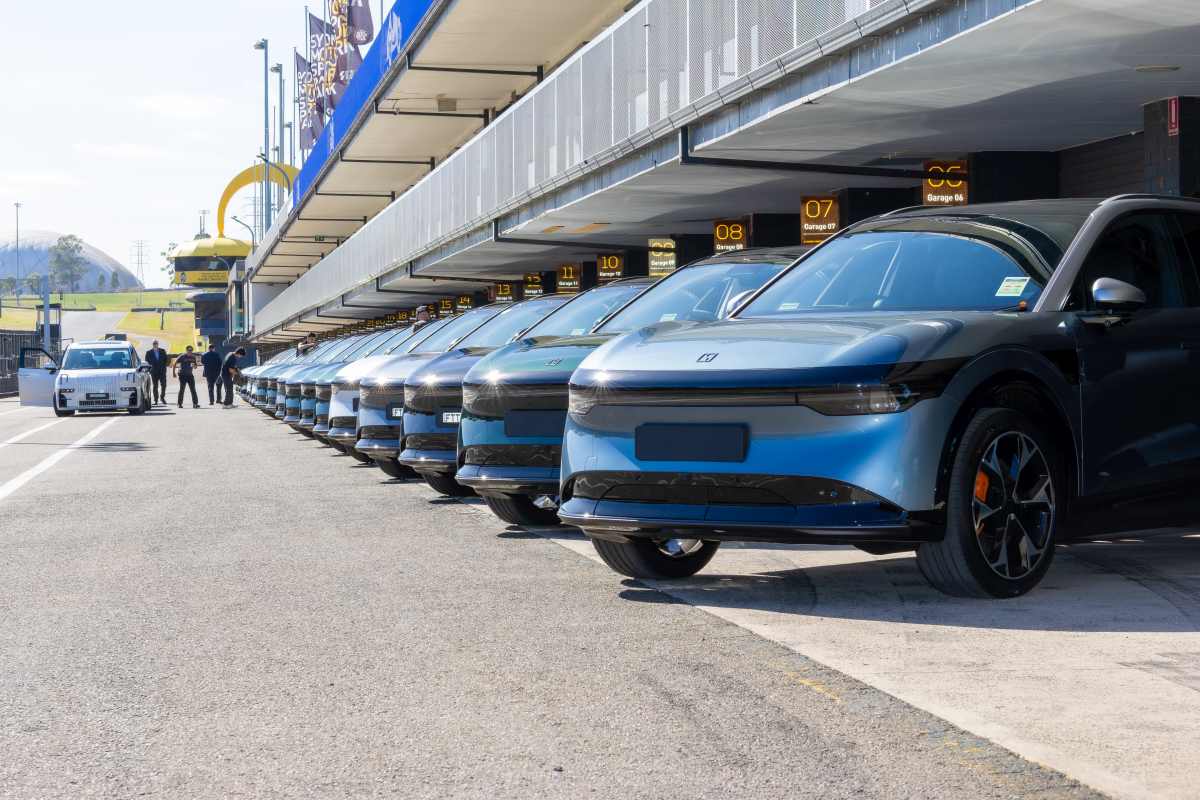
Some of the new Chinese brands are standout performers, responsible for pushing the aforementioned European brands out of the top 10. Geely came out of nowhere to take 6th place in 2025 and Zeekr is also doing particularly well, with their Zeekr 7X accounting for 94 per cent of sales so far this year.
Omoda Jaecoo has also come out of nowhere with competitive introductory pricing on their J5 placing it 7th on the charts, an impressive achievement with just one model on sale. If they can expand their lineup and repeat this success with future models they will cement their place near the top.
Volkswagen barely registered any sales in 2024, as the ID.Buzz only appeared on the market in November and December of that year. However, they have consolidated their position in 10th place since then, with the ID.4 and ID.5 SUVs joining the iconic van.
Toyota has made a surprise appearance in number 9 this year, after finishing 2025 in 16th place. Perhaps the loyal base of Toyota customers will help propel the brand further up the charts, as we firmly enter the early majority stage of EV adoption and some of those buyers choose to stick with brands they already know.
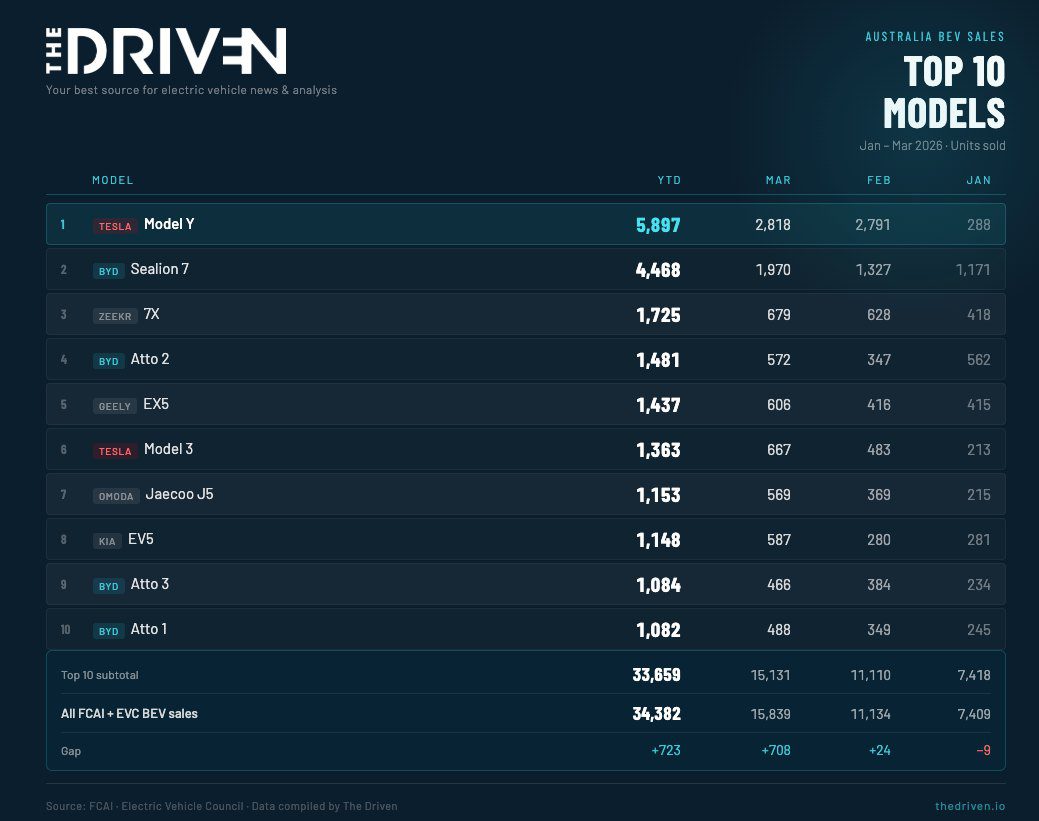
See The Driven’s monthly EV sales data for 2026, as well as previous years: 2024, and 2025.