People who know me won’t be surprised to hear I love a good debate. Give me a topic and I’m happy to verbally tussle. But, whatever the topic, any debate needs to be based on facts.
It’s why, somewhat wearily, I’m responding to Ed Lynch-Bell’s commentary in The Driven. While some don’t agree with networks rolling out charging infrastructure that many EV drivers are looking for, readers deserve the full story before making up their minds.
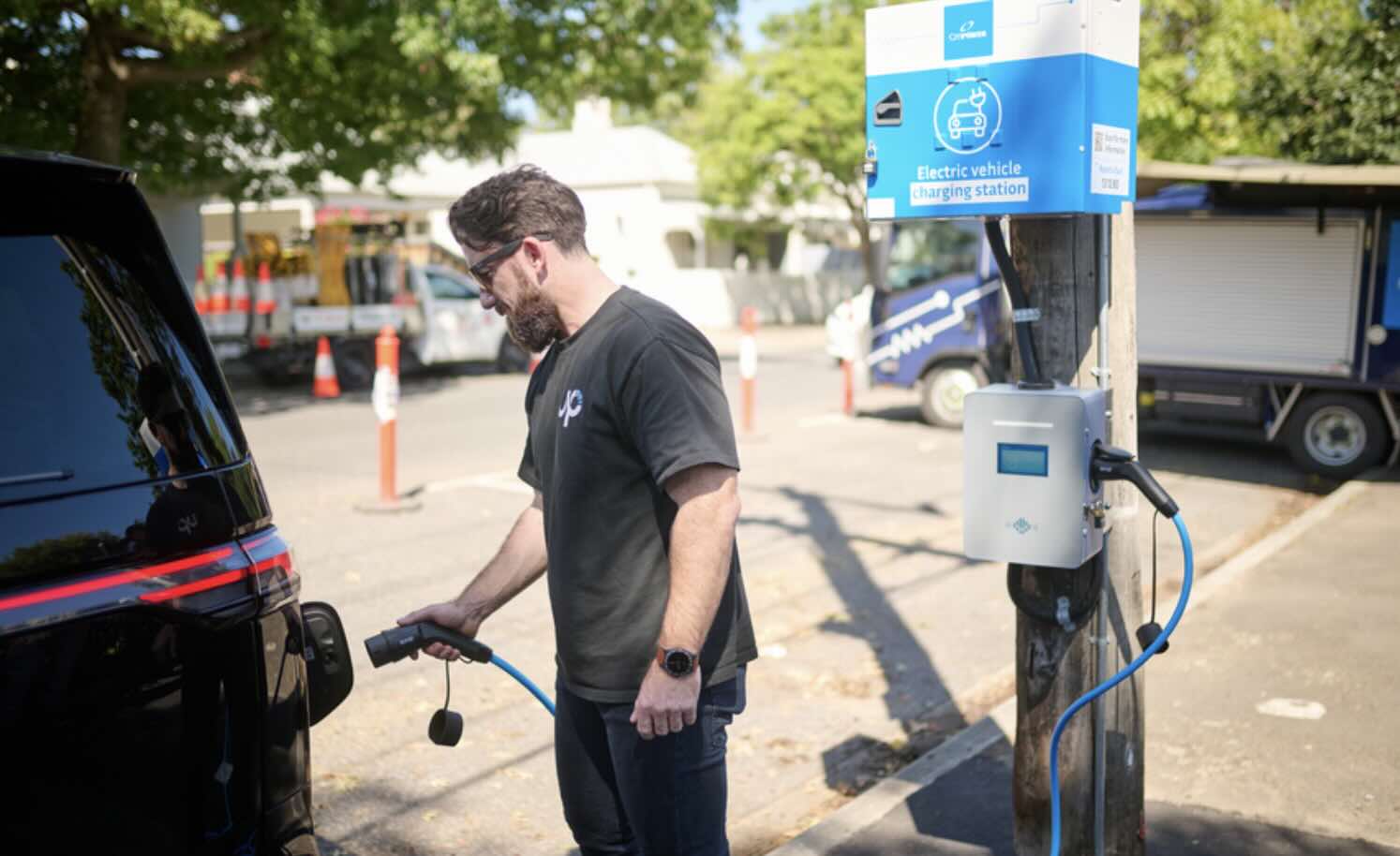
In particular, I want to clarify some points made about CitiPower’s connections process and our limited trial of 100 pole-mounted EV chargers we’ve started installing.
Firstly, the EV charger at Collingwood described as waiting for CitiPower to “flick a switch” has, in fact, been switched on for months. I visited the site last Thursday, took some photos and you can even see the lights on the charger are on and visible behind this sign. The charger is waiting for Exploren to complete commissioning.

The nearby community battery was also turned on by CitiPower as soon as the battery developer was ready for us to do so. Again, months ago. While the reason for this battery’s delay is a matter for that developer, I can confirm there was certainly no delay with us connecting it to the network.
There’s also some concern with us mentioning that our first eight pole-mounted 22kW AC chargers has significantly expanded charger numbers in Melbourne, when there are DC kerbside chargers in existence. Yes, of course, DC chargers do exist and we connect them too. But they’re very different things to what we’re installing as part of our trial and the fact is, the number of AC pole-mounted kerbside chargers in Victoria is still small but hopefully growing.
These aren’t isolated misunderstandings. They reflect broader claims we’ve been asked to address formally, including at the recent Victorian Parliament’s Inquiry into Electricity Supply for Electric Vehicles. That’s why I want to use this opportunity to clear up the public record once more.
I’ll admit I find myself returning to this topic more often than I’d like. Despite many conversations with critics aimed at addressing misinformation, claims about data, connection timeframes, access fees, locations and what our trial is designed to achieve continue to circulate.
- We publish the same network data on our public website as every other distribution business in Australia. No more, no less. Anyone can log-on and explore that here.
- We don’t refuse locations. We flag constraints and offer solutions, either a site upgrade or a more suitable alternative nearby. Of course, we conduct thorough checks to make sure a connection won’t undermine power supplies to surrounding customers.
- High speed chargers can draw as much power as a large apartment building. Applicants pay for complex upgrades so those costs aren’t passed on to customers who may never own an EV.
- Our pole access rates are comparable to other Australian networks. Where comparisons to NSW have been made, they’ve cited heavily discounted negotiated rates, not standard fees. We’ve also granted exemptions and discounts to charge point operators entering the Victorian market.
- Our networks support bi-directional chargers and we’ve made connection as straightforward as rooftop solar, with step-by-step guidance issued to thousands of registered electrical contractors since mid-2025 and published on our website.
- Our chargers are being operated by third party e-mobility service providers, not by us. Our purpose is not to compete with the private sector, but to generate evidence on charging behaviour, network impacts and site selection. Our trial has been welcomed by many local councils, communities and, importantly, EV drivers.
At the end of the day, our business is to connect people to the network. That’s what we do, and we do it every day.
Dan Bye is Head of Customer Connections and Requests at CitiPower, Powercor and United Energy.