
“Never let a crisis go to waste”, as the saying goes, and the Energy Networks Association is using the Iran crisis to attempt to put its hands further into the pockets of hard-working Australians.
Once again the regulated monopolies, both private and publicly owned, are attempting to prevent a competitive commercial EV charging ecosystem from developing by charging every single electricity consumer for hanging EV chargers on power poles.
The debate is well known in EV circles but deserves repeating as more Australians become interested in EV ownership. The electricity networks, which are either partially or wholly publicly owned or are privatised owners of public assets, have a regulated monopoly on the transmission and distribution of all electricity in Australia.
Sling a cable over the garden fence if your neighbour’s power goes out to help them out and you are violating the monopoly that has been granted to them.
In return for this monopoly position, the electricity networks are allowed to make a specified return on the capital they invest in maintaining and upgrading the grid. Anything they invest gets collected through the electricity bills of homes and businesses across the country. The way that they increase their profits is by advocating with government to invest more capital and charge more to electricity consumers.
Whilst it is important to maintain and grow the grid to meet the changing needs of Australians, we need to stop the endless cycle of gold-plating that has pushed up power bills even as wholesale electricity prices fall thanks to the uptake of renewables.
The electricity networks and their peak body spend a lot of money on lobbying governments, the Australian Energy Regulator, and the Australian Energy Market Commission because they set the rules for how electricity networks can spend and earn money.
Advocating for energy networks to own pole-mounted chargers is a particularly egregious example of this. Putting EV chargers on the kerb, whether on power poles or otherwise, is a great idea, and companies such as ENX, Chargepost, and many others have sprung up to serve the needs of EV drivers.
They have, however, faced difficulties growing their businesses because of the challenges faced in getting access to power infrastructure.
Not only do they face the issue faced by all EV charging companies in finding available power and going through the excruciatingly slow and costly connection application processes set by the 14 Australian DNSPs, but they face an additional hurdle in the facility access fee, the annual charge levied by energy networks for hanging chargers on poles.
This can vary from $1,000 in some areas to over $3,000 in others. The tiny number of pole-mounted EV chargers in Melbourne will tell you that the privatised DNSPs in Victoria demand the highest facility access fees.
A 7kW EV charger can sell a maximum of 61,320kWh a year if it were connected continuously. 10-15% utilisation is much more normal, so 9,138kWh. EVX can charge a maximum of $0.60/kWh using a credit card reader, less through the app and lower off-peak. At absolute best, if everyone taps a credit card, they are making $5,518.80 including GST, $5,017.19 once the tax is paid.
They have to pay $1,000 a year to access the pole. They then have to pay the network again. Using Ausgrid and their Small Business Time of Use Tariff as an example, they have to pay $1.95 a day in network access charge, $0.10 a day in metering charge. Of course, once you start using power you have to pay more.
So before they have even sold a kWh, EVX have to pay $749.14 in charges on top of the $1,000 facility access fee resulting in 34% of revenue going to the energy network without having sold a single kWh.
Energy networks make the argument that they should own charging infrastructure and add the costs of that infrastructure onto every single electricity bill in the country. Whether you own an EV or not, they want you to pay for chargers.
Whether you charge at home or rely on public charging, they want every Australian to pay for it. The basis of this argument is that the competitive market cannot provide kerbside charging. This argument is based on a cost regime that is designed and imposed by energy networks.
There are plenty of ways to make kerbside charging profitable. In the UK, distribution network operators are not permitted to charge facility access fees to charging networks who want to hang things on poles. Councils have to publish maps of where charging is needed, and you see a vibrant kerbside ecosystem of both DC and AC chargers across British cities and towns.
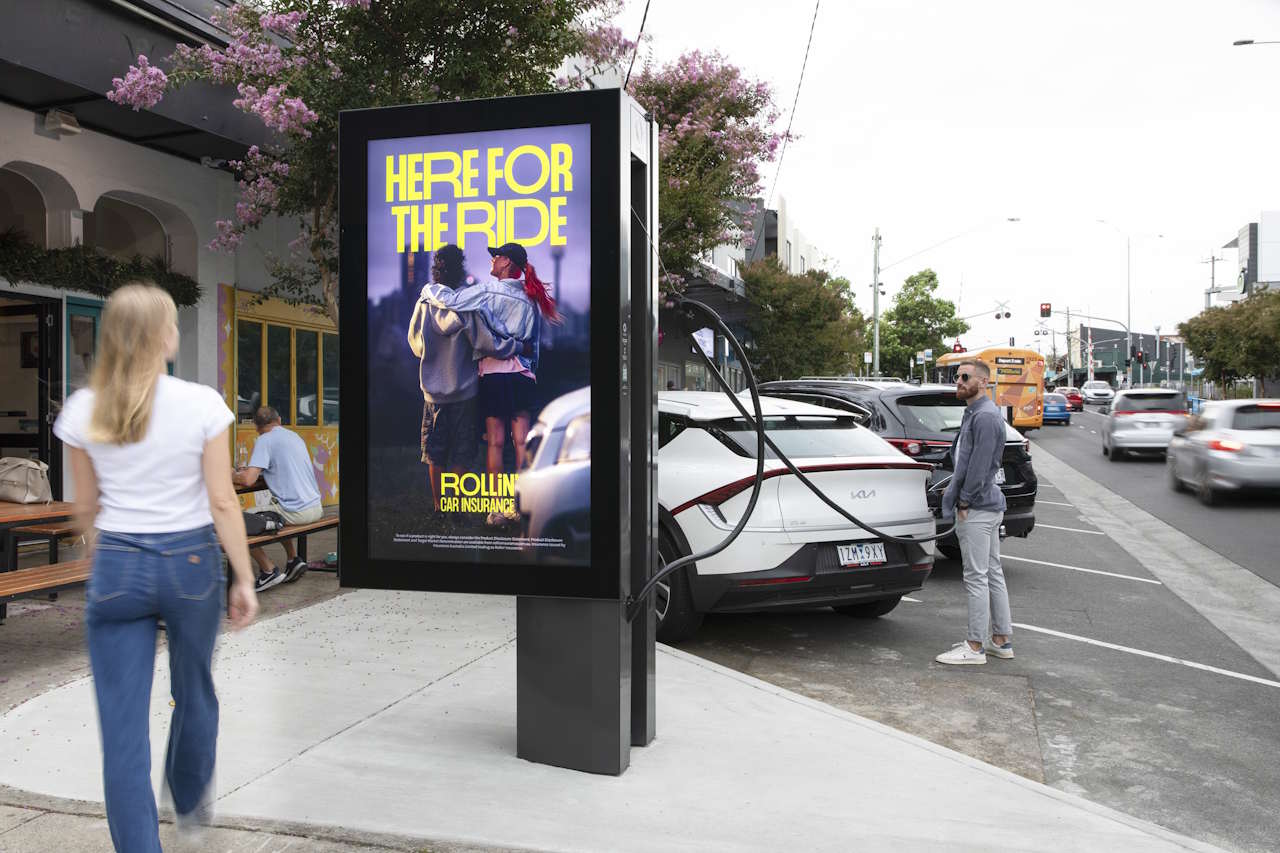
Here in Australia, Jolt have provided large amounts of public DC charging on the kerbside by changing charging economics by putting billboards on chargers (see photo above).
Last year, NHK showed a 50kW DC pole-mounted charger that makes pole-mounted kerbside a much more attractive commercial proposition by increasing the revenue potential of each charging spot simply by increasing the speed of charging.
A competitive market can grow if not stifled by the energy networks and their anti-competitive practices and a desire to violate the very sensible ring-fencing regulations designed to protect electricity consumers from just this kind of overreach.
The energy networks are attempting to set the agenda without making a good case for it and with a very poor understanding of what is going on on their kerbs.
In a recent LinkedIn post by my EV Meetup co-host, Ross De Rango, about the new Boroondara pole-mounted EV chargers being constantly blocked by petrol cars, the CitiPower press office popped up in the comments to defend their work.
They claimed that the eight pole-mounted AC chargers they had installed had ‘quadrupled the number of kerbside EV chargers in Victoria’. This led to a bit of head-scratching, because I know that Evie Networks installed a fair few DC chargers on the kerb in regional towns as part of the Charging the Regions programme, as did a number of local councils.
I also can point to the first kerbside charger in the state, outside the Daylesford town hall, installed by Hepburn Wind. I can also point to the most recent one, an Exploren unit outside Collingwood Leisure Centre near my home in the City of Yarra.
I take my son swimming here every Saturday, and this beautiful new Ocular charger has been sitting unpowered and unused for months. As is fairly typical, this important community asset is waiting for CitiPower to come and turn the power on.
Despite thousands being paid to CitiPower for connection applications and for engineering works, this charger sits idle and not earning revenue for Exploren or CitiPower because it is waiting for someone from the energy network, CitiPower, to come and flick a switch.
