Last month, Tesla produced its first steering wheel- and pedal-free two-seat robotaxi, the Cybercab, at its Texas factory, a key milestone in the company’s autonomy ambitions.
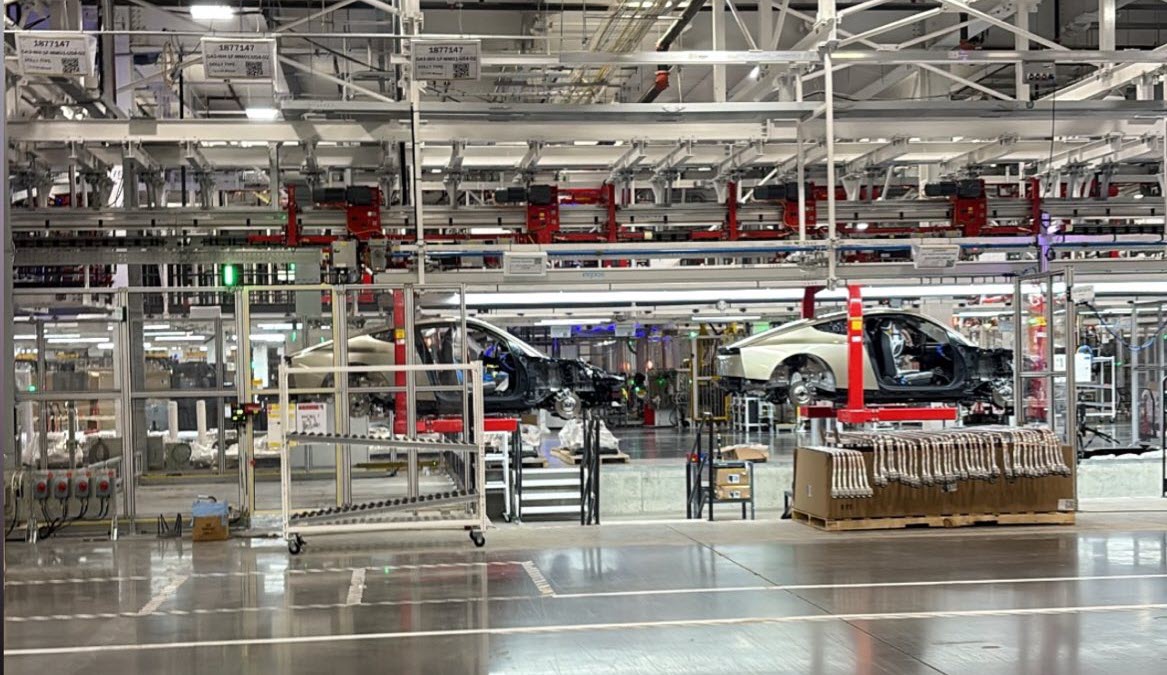
The image, shared by user Aynirealtor on X, shows two gold Cybercab robotaxis on a production line inside the Texas factory.
A photo shared by Aynirealtor on X shows two Gold Cybercab robotaxis on a production line within the Texas factory. Both vehicles appear to be missing doors and front panels, likely to be fitted later in the production process. The seats are already installed, with much of the interior assembled at this stage.
Interestingly, the lead vehicle appears to have a steering wheel, suggesting it may be a validation or testing unit. Similar removable steering wheels have previously been spotted on other evaluation vehicles.
Production versions are not expected to include a steering wheel, as the Cybercab is designed exclusively as a robotaxi rather than a driver-operated vehicle.
https://twitter.com/aynirealtor/status/2034799767356686576?s=20
Tesla first unveiled the Cybercab at its “We, Robot” event in late 2024, where hundreds of fully autonomous test rides were conducted on closed roads at Warner Bros. studios in California, using both the Cybercab and Model Y robotaxis.
Since then, various sightings of the golden model have been reported in the US, and a roadshow also took place in Europe to let people see it in person.
The Cybercab is expected to cost around $A45,000 as a self-driving robotaxi. It offers reasonable boot space and fewer interior components than Tesla’s other passenger-car products.
A Tesla engineer has previously said the Cybercab could have around 50% fewer parts than a Model 3. This will help the company scale much more quickly than the highly specialised vehicles used by its autonomous driving competitors, such as Waymo in the US.
With increasing public sightings and now a glimpse inside the factory, Tesla appears to be edging closer to mass production, potentially just weeks away based on earlier guidance. As with Tesla’s broader autonomy plans, timelines remain ambitious, with full regulatory approval and real-world deployment still key hurdles.