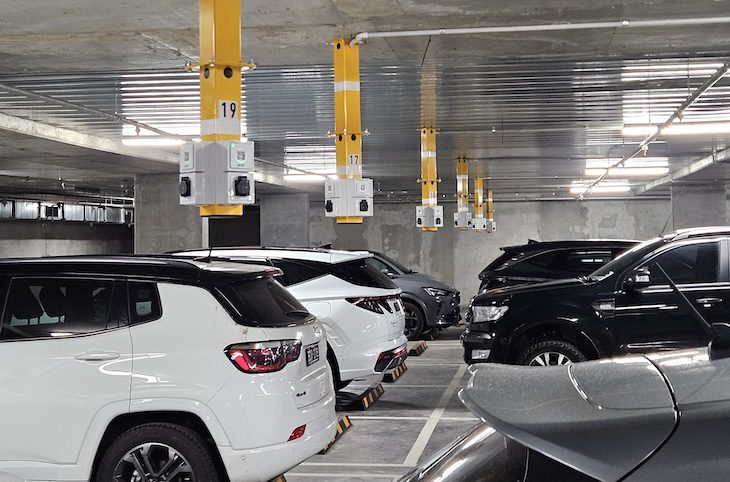
A Melbourne apartment complex has just been kitted out with 251 electric vehicle (EV) charging points – and it has not yet caught fire.
The project is a sign that strata committees and body corporates are finally beginning to change their attitude on retrofitting EV charge points into older buildings, following a fear campaign led by some state fire services over the last two years.
Wylie Chak, the founder of Nox Energy which installed the chargers, says attitudes have “100 per cent” moved past that now. “The conversation that we’re having this year compared to last year is completely different,” he told The Driven.
“People… are needing EV charging in their strata. So the conversation, it’s easier and easier. Our sales cycle in 2025 was six months. [In] 2026, [it’s] six weeks.”
Nox has just finished installing what it says is the largest number of EV chargers in an apartment building in the southern hemisphere, at a cost of $300,000.
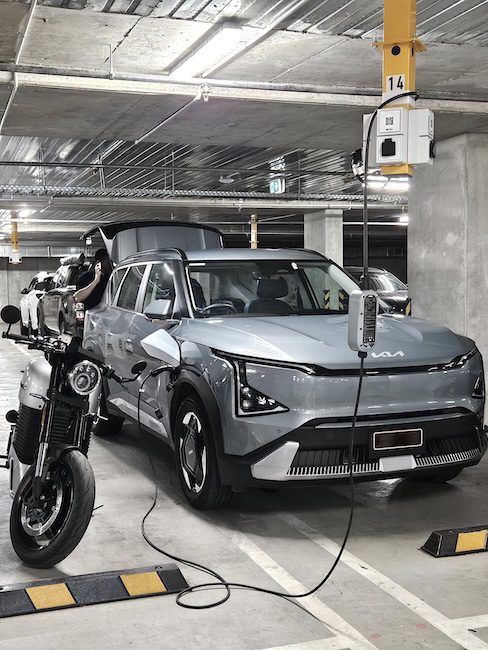
With petrol prices rocketing, Chak is not the only person who believes strata and body corporates will come under more pressure to relent on installing EV chargers.
Australians are likely to be “waiting on the line for a while” if they call up this week asking to buy an EV, said federal energy minister Chris Bowen at the charger launch on Tuesday,
“The reason ARENA has funded this program is not for 250 charges, per se. It’s to show it can be done. It’s the demonstration effect to say, look, yeah, it’s hard. It’s not too hard. See, the building has not caught on fire. Insurance is still fine. Everything is fine. It can be done,” he said at the Sierra apartment building in the Melbourne suburb of Hawthorn yesterday.
“That’s quite the selling point for prospective tenants and buyers here.
“In this environment where I’m spending most of my waking hours this fortnight on fuel security, I can tell you no international geopolitical crisis will impact on the distribution of the sun in Australia or the wind blowing.”
Indeed, a new piece of analysis by international think tank Ember says EVs avoided the consumption of 1.7 million barrels per day of oil globally in 2025, nearly matching the 2.4 million barrels exported by Iran through the Strait of Hormuz.
EV charging policy expert Ross De Rango expects the challenges in the Middle East to generate a sharp uptick in EV interest, and says even now the question of whether an EV can be charged is beginning to drive home purchasing choices.
No new substations, everyone pays their way
This particular project is just one of 2000 charge points that Nox has been granted $1.5 million to install by the Australian Renewable Energy Agency (ARENA).
Nox has so far installed 460 charge points of that total, and chak says these are speeding up on existing high demand from Melbourne, and rising demand from inner city Sydney.
The Sierra building, however, is the pinnacle of that ARENA project so far and it solves many of the problems that apartment managers are facing.
It has 251 Level 1, or ‘trickle-charging’ plugs that either replace regular power points in the walls, or hang from bollards in the ceiling of the multi level basement car park, and a commercial fast charger.
Every car park now has access to its own charge point. These points handle the billing, so each EV owner pays their own way, but importantly also manages the demand.
What this means is if every person in the building plugged in their EV at the same time, the software gives a number of cars up to a certain threshold 10 minutes of charge before switching over to the next batch — so the apartment complex does not need to pay for a new substation or other infrastructure to handle mass EV demand at the same time.
Chak says it took three months to handle the physical parts of the installation, but four months of negotiations with the body corporate committee.
Still not on fire
The system is also synced with the fire alarms in the building, so they shut off all charging if there is a fire anywhere in the building.
“It actually improves the fire safety profile of the building,” Chak says.
Chak says the fire issue is fading as people become more educated about what EV charging really means inside apartments.
“People can’t say ‘EVs are now fire bombs’ anymore. No one is saying this or asking these kinds of questions anymore,” he says.
Car insurer NRMA nods to data that shows 13 EV fires between 2021 and 2026, compared to 11,582 internal combustion fires, of which three were charging at the time but the cause of the fire was unrelated to charging.
“We’ve dealt with hundreds of stratas, and when they looked into the insurance, having EV charge points inside a building will not necessarily increase your fire premium, your insurance premium, and it actually does not increase the fire safety risk if you have the right solution installed by certified installers,” Chak says.
De Rango, now the director of Vehicle Charging Solutions Australia, says insurance companies are increasing comfortable with road registered EVs – as opposed to unregistered scooters or bikes – inside apartments – and correctly installed charging equipment.
“IAG (whose brands include NRMA, CGU, RACQ) consider that ‘There’s virtually zero fire risk if an undamaged EV is charged correctly’,” de Rango told The Driven.
“Sadly, fire services continue to maintain an anti-EV posture, despite the evidence.
“FRNSW continues to hold the position that EVs and their charging apparatus should be treated as a ‘special hazard’ in buildings, despite the CEO of the Australian Building Codes Board publicly stating that this was not appropriate two years ago.