
German automotive giant Volkswagen Group missed its 2025 European Union (EU) fleet CO2 emissions compliance targets despite marked improvements, but will avoid any immediate penalties due to the EU’s flexible compliance mechanism.
Volkswagen, which encompasses car brands such as Audi, Bentley, Porsche, Škoda, published its Annual Report & Full Year Results 2025 this week, revealing a strengthening financial performance in line with the previous year, despite increasing challenges such as US tariffs.
Even in the face of the challenges which hamstrung Volkswagen’s sales revenue and vehicle delivery, the group saw a 32 per cent increase in the number of battery electric vehicles (BEVs) delivered in 2025, reaching nearly 1 million.
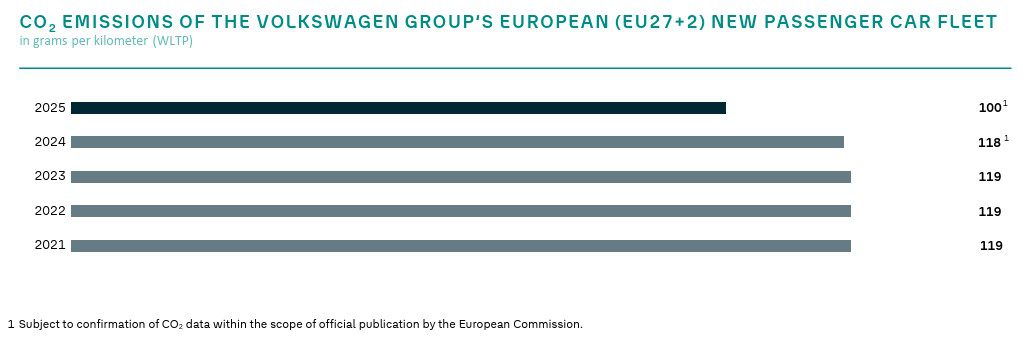
Buried on page 135 of the 673-page report is Volkswagen’s new passenger fleet CO2 emissions data for the 27 EU member states plus Norway and Iceland (EU27+2). According to the statutory basis for calculation, Volkswagen’s passenger fleet emitted an average of 100 grams of CO2 per kilometre (g C02/km).
At 100g CO2/km, Volkswagen fell just short of the tightened 2025 targets implemented by the European Commission, the EU’s main executive body, which required a 15 per cent reduction in CO2 compared with 2021, which corresponded to a CO2 target of 95g CO2/km for Volkswagen’s new passenger car fleet, and shy of the industry-average weight-based fleet target of 93.6g CO2/km.
2025 was a marked decrease on previous years, down from 118g CO2/km in 2024 and 119g CO2/km for the prior three years, but still short of where the group is required to be by law.
Volkswagen Group won’t be penalised for failing to meet its targets, however, due to the flexibility granted carmakers by the European Commission’s three-year compensation mechanism which allows carmakers to underperform, as long as they make up for it in subsequent years.
“The Volkswagen Group’s goal is to achieve the CO2 fleet limits in EU27+2 in each year over the three-year period from 2025 to 2027 primarily through its own efforts,” Volkswagen said in its Annual Report, but warned that “the persistently challenging and volatile market environment, particularly in the field of e-mobility, [means] achieving the targets remains a major challenge.”
As highlighted by Matthias Schmidt from the eponymous Schmidt Automotive Research, Volkswagen is hoping an “accelerated BEV push” in 2026 will lead to a “further reduction in CO2 fleet emissions” thanks to the roll-out of the Electric Urban Car Family from the company’s core brands which will be offered with lithium iron phosphate (LFP) batteries, helping to “lower costs, improve BEV margins, and reduce provisions being put aside to meet the targets.”