
In 2024, our colleagues Carolina Poupinha and Jan Dornoff published The Bigger, the Better?, a cheekily titled deep-dive into the real-world environmental and economic implications of oversizing batteries in electric passenger cars.
They found that while doubling an electric car’s battery size can significantly reduce the number of required stops on occasional long-distance trips, it also increases average energy consumption, greenhouse gas emissions, and total cost of ownership (TCO).
So, the verdict is clear: bigger is not always better … at least when it comes to electric car batteries. But does the same hold true when it comes to electric trucks?
Underutilized batteries … oversized costs?
Range anxiety is an important consideration for owners of heavy truck fleets, for whom reliable vehicle performance is essential to business survival. Higher driving range means less downtime—the number one enemy in the freight business—and more operational flexibility.
Diesel trucks offer high driving ranges and short refueling times, meaning that range and downtime have traditionally not been of major concern for fleet owners.
For electric truck fleets, things are a bit more complicated: the higher costs of energy storage limit how much battery capacity can be installed in battery electric trucks (BETs). Because of this, BETs typically have a lower driving range, requiring fleets to carefully plan their freight operations.
As BETs are increasingly being used in day-to-day operations, fleets are learning how to size batteries to balance range and TCO. Advertised ranges often reflect typical use cases, such as for urban delivery, and may not be representative of real-world performance for specific fleets.
Our recent study with the European Clean Trucking Alliance showed that actual ranges can even exceed advertised values due to variations in routes and payloads between use cases. Luckily, manufacturers provide tools that accurately predict a BET’s real-world range for each fleet—an essential step in the procurement process.
Yet fleets still tend to oversize their batteries for two main reasons. First, they have a habit of sizing batteries based on the worst-case scenario: the few days per month when the driven distance—and therefore energy consumption—is much higher than average.
This approach prioritizes flexibility over cost efficiency. Second, uncertainty around long-term battery degradation encourages oversizing, with some operators planning for a decline in end-of-life BET range beyond even conservative estimates.
Designing for these extremes means that the battery—the most expensive component in an electric truck—is underutilized on most days. Our study found an average battery depth of discharge of 44%, meaning that over half of the battery’s capacity is not used most of the time. This has detrimental impacts on TCO: fleets are, in effect, overpaying for batteries they don’t need.
Can smaller batteries go the distance?
We conducted a case study to evaluate whether using a smaller, cheaper battery sized to typical daily needs could reduce TCO without causing major operational drawbacks, even when accounting for battery degradation over time. For this analysis, we used data from our recent report of a 40-tonne tractor-trailer used for regional distribution that operates 5 days per week. The truck averages 350 km per day; on a worst-case scenario day, it drives up to 510 km.
Using 1 month’s worth of data, we assessed three different battery sizes (in terms of nominal capacity): the default battery size used by the fleet as well as batteries downsized by ~25% and ~30%. We kept the truck’s energy consumption constant across all three scenarios, assuming that any energy savings from a smaller battery pack would be offset by carrying more payload.
To test the feasibility of the different battery sizes, we made a few assumptions based on our real-world freight operations study. We assumed that the truck charged overnight at the depot and started each day with a full battery.
We also assumed that any additional energy needs that could not be met from overnight charging required opportunity charging during the workday—that is, topping up the battery at the depot, customer’s premises, or public charging locations—at a suitable charging capacity (350 kW).
Our aim was to see whether BETs with downsized batteries needed extra charging time beyond the charging opportunities built into the driver’s regular working day. Drivers are required to take a 45-minute break with every 4 hours of driving, and we assumed 30 of these minutes were available for charging.
Assuming an average driving speed of 60 km/h, this equates to about 6 hours of driving on the average day and 9 hours on high-mileage, worst-case scenario days. This resulted in a baseline built-in charging time of 30 minutes on the average day and 60 minutes on a worst-case scenario day.
Figure 1 illustrates the total opportunity charging time required to complete daily routes on an average day and a worst-case scenario day, comparing it with the minimum time available for charging during mandatory breaks. Whenever charging took longer than the available break time, trucks incurred a time penalty from the longer dwell time.
Figure 1. Required opportunity charging time with different battery sizes for the average (top) and maximum (bottom) daily distance traveled
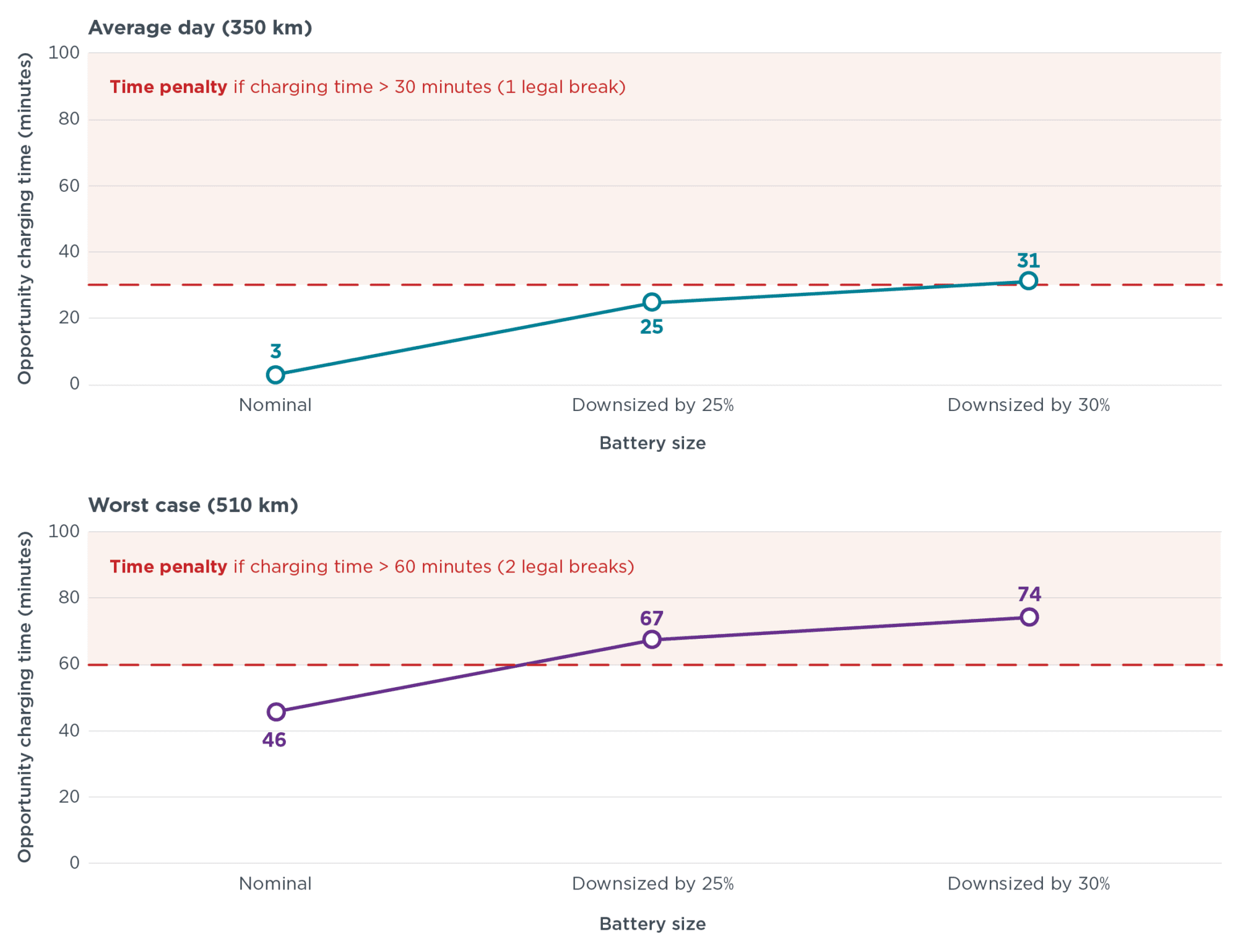
Note: The red horizontal lines correspond to the time available for charging during the driver’s required break time, and the red area indicates a time penalty.
With the original battery size, the truck was able to complete all delivery routes using opportunity charging within the required break time. With the battery downsized by 25%, there was no time penalty on the average day, although there was a 7-minute penalty on worst-case scenario days. With the battery downsized by 30%, there were time penalties of 1 minute on the average day and 14 minutes on the worst-case scenario day.
Assuming that additional dwell times of less than 15 minutes can be accommodated without leading to significant cost penalties, minor route replanning would likely be enough to maintain operational efficiency. And in exchange for this minor route replanning, fleets have a lot to gain in terms of TCO. As shown in Figure 2, battery downsizing lowers the vehicle’s upfront cost, resulting in a TCO up to 9% cheaper than the baseline. Even when accounting for higher opportunity charging costs, battery downsizing still yielded savings of 5%–6% over the default battery. Additionally, smaller batteries reduce upfront costs—a key barrier to BET uptake for fleet owners with limited capital.
Figure 2. Impact of battery downsizing on 5-year total cost of ownership
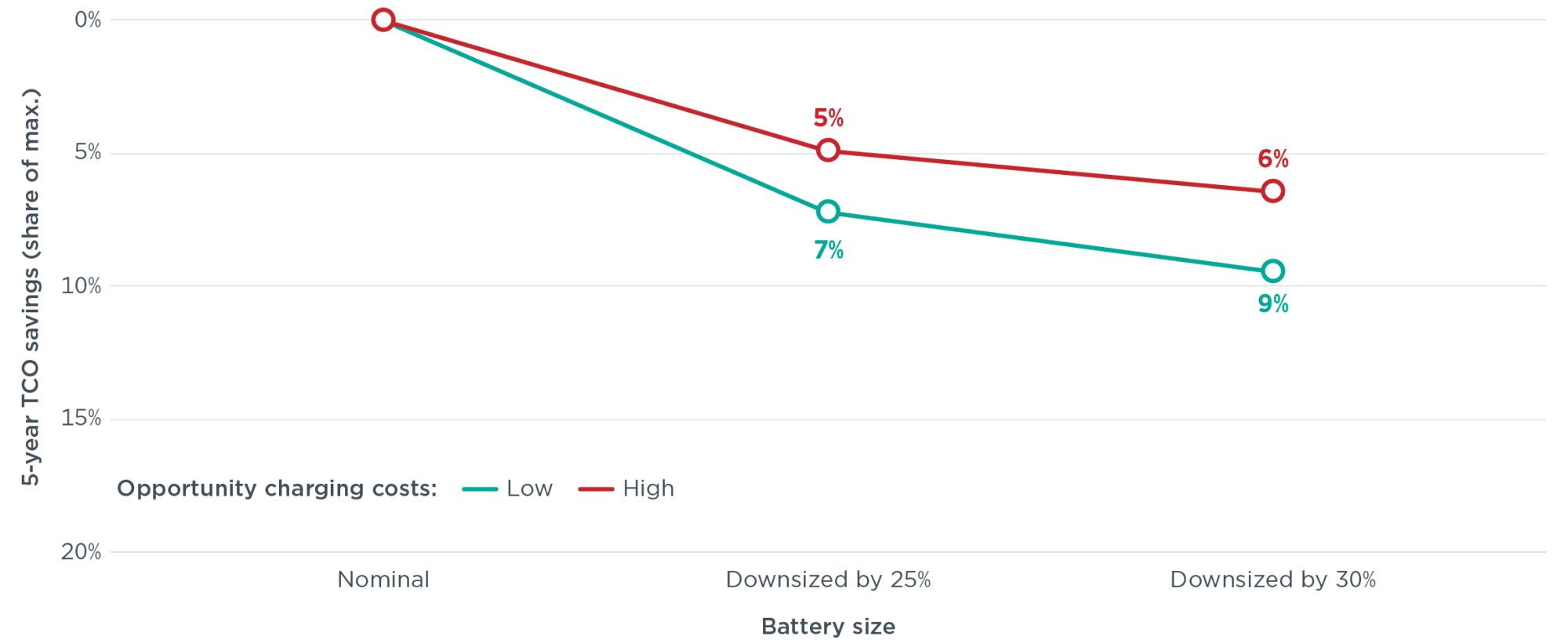
Note: We do not include cost penalties associated with additional charging time. We consider two electricity price cases for opportunity charging: (1) the same price as overnight depot charging (€0.274/kWh), assuming opportunity charging happens at the depot with the same electricity supply contract; and (2) a higher price (€0.40/kWh) aligning with current market prices for public truck charging.
En route to TCO savings: BET battery health and resale value
For trucks with the default battery capacity, route coverage without time penalties remained high even when accounting for degradation, dropping from 95% to 70%. For trucks with downsized batteries, the resulting time penalties were still quite limited, increasing from a maximum of 14 minutes to 31 minutes at the most.
What do these time penalties actually mean for BET operational efficiency? The answer largely depends on fleet management. A recent analysis led by Fraunhofer ISI showed that fleet-level route replanning—specifically, integrating both route and charging optimization across a mixed diesel–electric fleet—can achieve higher electrification rates and cut costs more effectively than simply swapping diesel trucks with BETs without further operational adjustments.
Another critical aspect is the resale value of electric trucks. In the absence of historic BET resale data, financing companies don’t have a clear sense of the severity of end-of-life battery degradation. As a result, they conservatively assume that BETs have no residual value. This could be another factor driving fleets to oversize batteries, as fleet owners aim to increase the resale value of their BETs. An improved understanding of how fast batteries degrade in real-world operations will not only improve estimates on the residual value of BETs, allowing fleet operators to size batteries based on actual needs rather than resale concerns; it will also enable more optimal battery design and utilization, both of which will reduce the TCO.
Bigger is always better … or is it?
So, what’s the verdict? As with passenger cars, bigger is not always better when it comes to electric truck batteries, and fleet owners stand to gain a lot in terms of TCO savings if they opt for batteries sized to better match normal freight activities.
As fleet owners integrate the lessons learned from BET pilots, they will develop a better understanding of real-world ranges and battery degradation, which will facilitate optimal battery sizing and adapted fleet planning and scheduling. In addition, the current trend toward cheaper, more energy-dense batteries, along with the uptake of high-speed charging, will offer BETs more flexibility without necessarily compromising high utilization and TCO.
The takeaway? The future of electric trucking will be led by fleets that choose smarter sizing over bigger batteries.
Pierre-Louis Ragon and Albert Alonso-Villar are researchers with the International Council for Clean Transportation.