

For years, one of the stock arguments against electric cars has been that they are for the wealthy. That they are merely expensive toys for early adopters, far removed from the realities of normal car buyers.
That may once have been true. But over the past 12 to 18 months in Australia, that line has become increasingly difficult to sustain. And not even a month into 2026, the arrival of cars like the BYD Atto 1 looks set to push that argument well into retirement.
Starting at $23,990 before on-roads, the Atto 1 is cheaper than a Toyota Corolla – one of the first cars you think of when thinking about entry level vehicles in Australia. The Atto 1 isn’t a premium SUV or a tech showcase. It’s a basic, small hatchback that sits right in the heart of the market, where people actually shop.
Press cars for the Atto 1 have yet to be made available, but I decided to take one out for a half hour test drive from the local BYD dealership, just to get some first impressions on a car that represents a major shift in the EV pricing debate.
With such limited time behind the wheel, it’s far too early to make any firm judgements. But in that brief drive, the Atto 1 didn’t feel obviously flimsy, unpleasant, or like something designed by an accountant rather than an engineer.
Being a front-wheel drive, it carries a slight nose-heavy feel on the road, but it’s also calm and predictable, which is what you’d expect from a small, affordable hatchback.
Choosing FWD here makes sense: it’s cheaper to build, more space-efficient, and generally helps with efficiency. That said, I still tend to prefer rear-wheel-drive cars for their better balance and sharper response through corners.
At first glance I couldn’t help but think that it looks like a toy Lamborghini Urus, but I was relieved to find that it doesn’t feel like a toy once inside. The interior doesn’t look like it was assembled from leftover plastic bins either. It’s modern, clean and recognisably BYD, borrowing a lot from the Dolphin and Atto 3, just scaled down and simplified.
That’s all well and good, but it’s also what you’d expect from a car launched in 2026, even a cheap one. The bar is no longer whether it has electric windows, but instead whether it feels like something you could comfortably drive every day.
On the road in suburban traffic, the Atto 1 behaves like most small EVs. It’s quiet and easy to drive, pulling away cleanly from the lights. None of that is remarkable in 2026, it’s simply what electric cars do well.
The base model Atto 1 offers a remarkable price, but it does also lack some basic features that I think should come standard in any modern car.
Things like wireless phone charging, rain-sensing wipers, power-folding side mirrors, lights on the vanity mirrors, front parking sensors, power-adjustable seats. Blind spot indicators are also missing, and somewhat confusingly they are also omitted from the premium model.
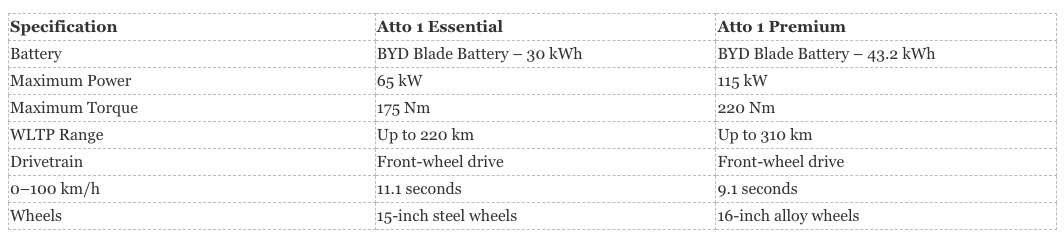
With a quoted range of just 220 kilometres, the base model would be hard to recommend for anything beyond city duties. The premium’s larger 43kWh battery offers a more reassuring 330kms of claimed range. 1 seconds will get you from 0-100km/h in the base, and about 9 seconds for the premium. But let’s be honest, you’re not buying this car for its sporting credentials.
Whether the Atto 1 turns out to be a great car or a merely adequate one will require much longer testing. For now, all the Atto 1 has really proven is that a very cheap electric car can feel normal. In a market where people have been told for years that EVs are only for the wealthy, that might be its most disruptive feature of all.

Sam is Chief Operating Officer for Renew Economy and EV Media. Sam has been working with Renew Economy and One Step Off The Grid since 2014 and with The Driven since its inception in 2017. Sam is also the host of The Driven Podcast.