The following comments are based on our experience of living, parking and charging for four to six weeks every year in Newtown in Sydney’s inner west.
Kerbside and pole charging is currently a contentious issue, with the owners of the poles and wires (the DNSPs) seeking permission from the regulator to install chargers as part of their regulated asset base, and the charge point operators (CPOs) opposing this as anti-competitive.
The DNSPs argue that EV adoption is being held up by the lack of charging infrastructure and that widespread adoption of kerbside pole chargers would be a rapid solution, while the CPOs argue that a competitive environment will result in more efficient utilisation and better placement of chargers.
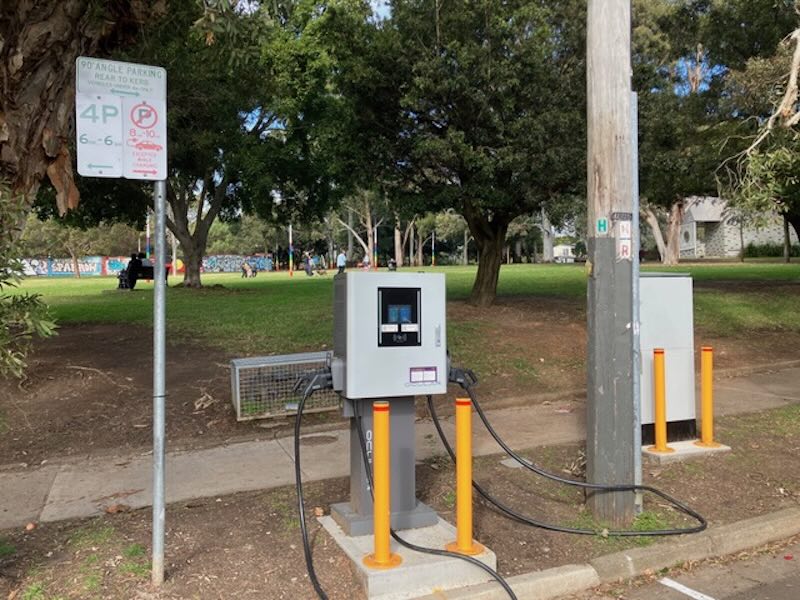
The number of kerbside chargers around inner Sydney has expanded rapidly over the past year, with three 22kW BYO type 2 cable points and two 50kW DC CCS2 points within a five minute walk from our house. My observation is that they are all relatively under-utilised and often vacant, or blocked by fossil cars, which is at odds with the assertions of the DNSPs.
This is consistent with the vehicle usage pattern for inner west dwellers where people mostly take public transport and use their car for specific tasks, travelling perhaps 50 km per week.
I know this does not describe all patterns, but it is a predominant pattern. It is easier to go to a local multi-bay super fast charger every couple of weeks or so (the “petrol station model”) rather than chancing it with a space at the pole chargers which are often blocked by fossil cars.
That gives enough charge to do the weekly drives to sport for kids, shopping etc without having to compete for parking. I know this because it is exactly what we do and what our Sydney family plan to do when they upgrade to an EV.
A compounding problem is the variable parking regulations at each EV kerbside charging space. Some allow any car with a local area permit to park for an unlimited time, blocking the space for EVs.
Others are dedicated EV charging spaces with a 4 hour limit between 6pm and 6am, preventing overnight trickle charging, but with no limit on daytime parking for anyone wanting to park an EV or fossil vehicle.
The best option would be an exclusive EV bay restricted to actively charging EVs with a time limit between 0800 and 2200 and no limit outside those times.
Interestingly, this two berth bay almost always has a free space unless ICEd. Whew! This is all before dealing with the problems of fossil cars ICEing the chargers, trip hazards and the requirement for rear-to-kerb parking potentially restricting access to charge ports.
Given that these chargers are installed to solve the charging problems for local residents without off street parking, it makes sense to restrict their use exclusively to those with local parking permits.
In addition, every charging bay needs to be designated exclusively for EVs being actively charged. The number and location of these bays would be best worked out by the LGAs with local community involvement to reduce the controversy around ring fencing some parking bays.
Parking restrictions should be lifted to allow overnight charging at slower AC chargers, say between 1800-0800. Daytime limits could still be applied, with the key being that cars not actively charging attract a fine.
An obvious solution to EVs hogging the chargers is to ensure that all charging stations enable idle fees, ensuring that those who overstay, particularly at DC stations, are penalised. There is rarely a reason why an EV might want to linger more than an hour at a 50kW charger. However, this does not catch the fossil cars.
Then we get to the chargers themselves, which do not allow credit card payment and rely on downloading yet another app for each provider. The better ones allow RFID token use, but we are still a long way from the single RFID token for all chargers supplied by the Norwegian EV Association. Basically, it should be at least as easy as paying for fuel. Try harder, please.
Based on this, it appears to me that kerbside charging is not an essential element for the uptake of EVs in Australia, and that the number of bays is likely to be a relatively small proportion of available parking. It would be better rolled out based on local demand using data from LGAs rather than DNSPs.
The numbers clearly may change if our power grids adapt to utilise the massive storage potential of multiple EV batteries, but this is still a way off. In the meantime, I hope these suggestions will suit most EV drivers and their local communities. I’d be glad to hear the opinions of local EV drivers.
Want the latest EV news delivered straight to your inbox? Subscribe to our free daily newsletter