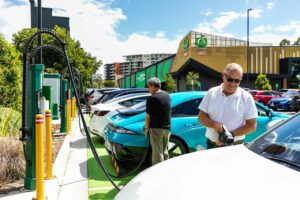
One of the teething problems of the public DC charging network is they have been treated a bit like the planting of street trees. Do a bit of prep, poke it in the ground with a quick watering and nature will do the rest.
In the rush to get them in, it certainly feels like the idea of what is to happen after it is turned on has not been thought of!
The result has been broken chargers collecting cobwebs waiting for parts … or even waiting for it to be noticed that they are out of order. I remember well the example of a charger in the Melbourne suburb of Hawthorn being out of action for years due to no-one wanting to take responsibility for maintenance once it had been installed.
Unfortunately, DC chargers are less like street trees and more like fuel bowsers. They need to be inspected and tested regularly, along with unexpected maintenance issues flagged and attended to quickly. They should also be easy to access/pay for and have transparent pricing structures (also like fuel stations).
Sadly, few of these things are true for Australian chargers. Whilst I have had great experiences with one major network having a helpful and knowledgeable call line – I have also had another newer (fuel-station based) one send me to an obviously overseas call centre that had no idea of what was happening.
To my increasing frustration, they kept going back to their script and running through the basics of plugging/replugging and using the App, despite their own App showing the network was down all over NSW!
(To give them some leeway, their network was only a few months old and they may have sorted the issues– but I haven’t tried theirs again either. The experience was rather off-putting).
It is therefore instructive to look at what is happening in more mature EV markets as a sign of what will be coming here … eventually. The UK market is therefore a good one to look to for future trends for several reasons:
- They are an English speaking, right-hand drive country;
- Our legal system is closely related to theirs. This means what types of legislation and standards are created and adopted here often mirror what happens there, and
- They are well ahead of us in EV adoption, meaning they will have experienced similar issues, but be ahead of us in dealing with them. (One in four new cars sold in the UK now are plug-in EVs – most of them full BEV).
The UK has recently released draft legislation designed to improve the consumer experience at public charge points. To quote the impact statement released with it:
“Currently, many drivers who switch to an EV report issues and frustrations with recharging their vehicle on the public charging network.”
To achieve this, the draft legislation addresses the following five points:
Minimum payment methods: requiring a contactless credit card option to be fitted to all new chargers over 8kW, and retrofitted to chargers over 50kW.
Payment roaming: requires the ability to use multiple charger networks via any one of the Apps – i.e. you won’t need multiple Apps, RFID cards or the like once this comes into force.
Price transparency: pence per kilowatt hour (p/kWh) to become the standard metric for a unit of electricity. This is also to be clearly displayed without the need to download an App or enter into some form of contract with the provider. The eventual outcome of this one is expected to be the displaying of the price per kWh in the same was as a price per litre is currently displayed out the front of fuel stations around the world.
Reliability: this one is a biggie – public charge points must meet 99% reliability on 50kW+ charge points and a 24/7 helpline to be available for all public charge points.
Open data: Require charge point data, such as location, availability, etc., to be shared openly and use a mandated data standard. This would allow Apps (such as PlugShare) to access real-time data on charger availability and make it far easier for EV drivers to make informed decisions about which chargers to use (or avoid) on a trip.
All-up, these would go a long way towards achieving the stated goal in the regulatory statement of developing “a network of charging infrastructure for electric vehicles (EVs) that the public can use simply and trust. A public charging network of high quality will make switching to EVs as seamless as possible and encourage EV uptake.”
The UK legislation is currently in draft form (found here) although it is expected to be adopted and take effect later this year.
Once it comes into force, there will be a grace period for charge station operators to implement the requirements, with enforcement to begin sometime in 2024.
Hopefully the ‘powers that be’ will notice the need to smooth the EV transition here before such problems escalate by enacting similar minimum requirements soon.