
German luxury automaker Mercedes-Benz will use batteries with silicon anodes with 20% greater energy density than today’s lithium-ion cells in its upcoming electric G-Class.
Developed by Sila Nanotechnologies, the batteries are expected to achieve 40% greater energy density in the future.
Sila Nanotechnologies was founded by two ex-Tesla engineers and a Georgia University materials science professor as a start-up named Georgia Tech.
Having incorporated under the new name in 2011, the company has developed a next-generation silicon anode chemistry for lithium-ion batteries. It says it has “shattered” the energy limit ceiling of current lithium-ion battery chemistry.
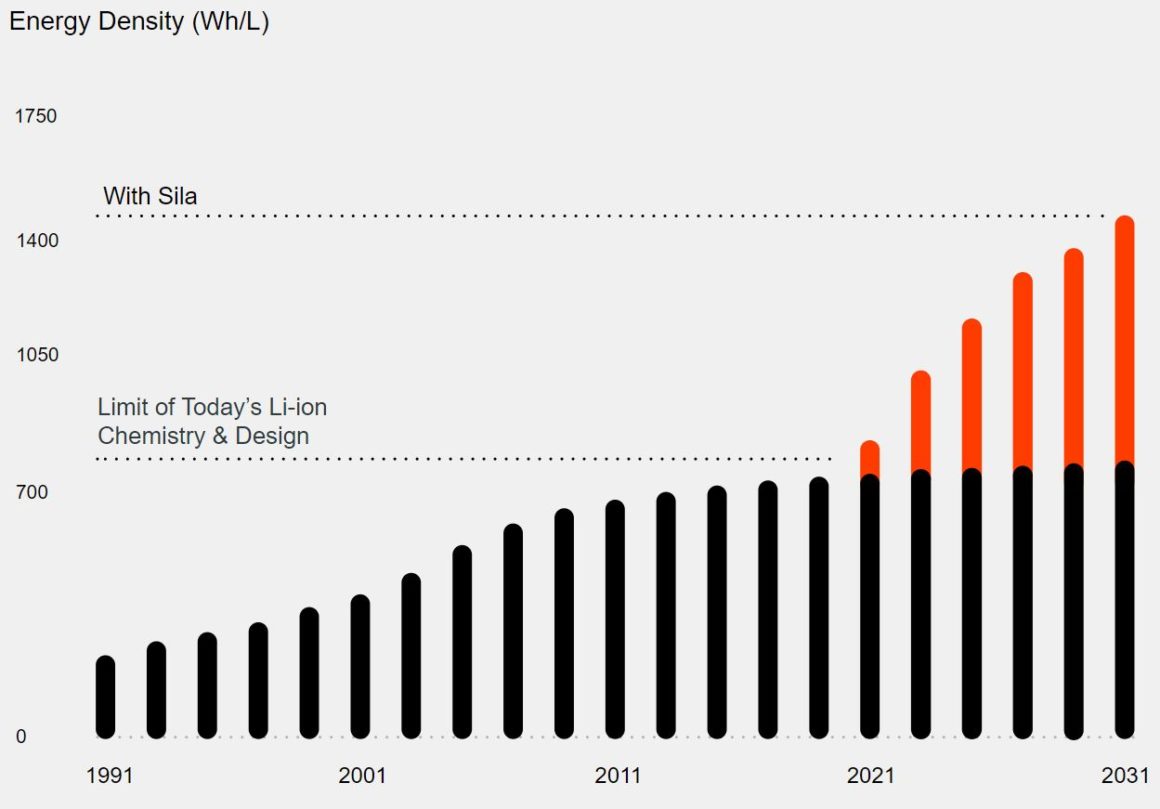
Current lithium-ion batteries “have reached their energy limit—a plateau defined by the chemistry of today’s graphite anodes,” says Sila on its website.
But Sila’s next-generation silicon anode chemistry boosts energy density by 20%. And, it is expected to be able to boost energy density by up to 40% in the future.
More importantly, Sila’s new battery technology can serve as either a full or partial graphite replacement. It can immediately fit into existing battery manufacturing processes. This means that battery supply lines do not need to be retrofitted for a new type of technology.
This all leads to the announcement from Mercedes-Benz and Sila. The German automaker will batteries with Sila’s silicon anode chemistry as an optional extra in the upcoming electric G-Class.
The supply agreement follows a 2019 investment Mercedes-Benz made in Sila, and forms the natural next step in their partnership.
Game-changing battery tech
Markus Schäfer, member of the board at Mercedes-Benz Group AG, and CTO for development and procurement, describes Sila’s battery technology as a “true game-changer”.
Sila has, he says, “been proving their ability to not only deliver scientific innovation at the highest level, but also their ability to manufacture high quality material.
“We’re glad that in Sila we have a leading partner who will help us power our future generation of electric luxury vehicles with their highly innovative anode technology.”
Sila Nanotechnologies started life as a Georgia Tech start-up before incorporating under its new name in 2011. It was founded by a trio of engineers: Gleb Yushin, Gene Berdichevsky, and Alex Jacobs.
While Yushin was involved through his position as Professor of Materials Science at Georgia Institute of Technology, both Berdichevsky and Jacobs spent time at Tesla.
Berdichevsky was the seventh employee at Tesla Motors and served as principal engineer on the Roadster battery and Jacobs designed and developed battery packs, including those used in the Roadster and Daimler’s Smart Fortwo electric drive.
“We’re focused on delivering materials that are cost-efficient and capable of delivering on the promise of electric vehicles, working to ensure longer range energy, improved charge times, and lowering battery cost per kWh,” said Gene Berdichevsky, now CEO of Sila.
“To realize the potential of next-generation materials, scale-up is a pivotal part of execution and we’ve been building towards automotive quality standards and scale since our start.”
Sila will make the anodes to be supplied to Mercedes-Benz using 100% renewable energy at its new Washington State facility in the US.
This also makes Mercedes-Benz the factory’s first publicly announced automotive customer. Current expectations are that the first electric G-Classes will be equipped with the new battery technology option by the middle of the decade.