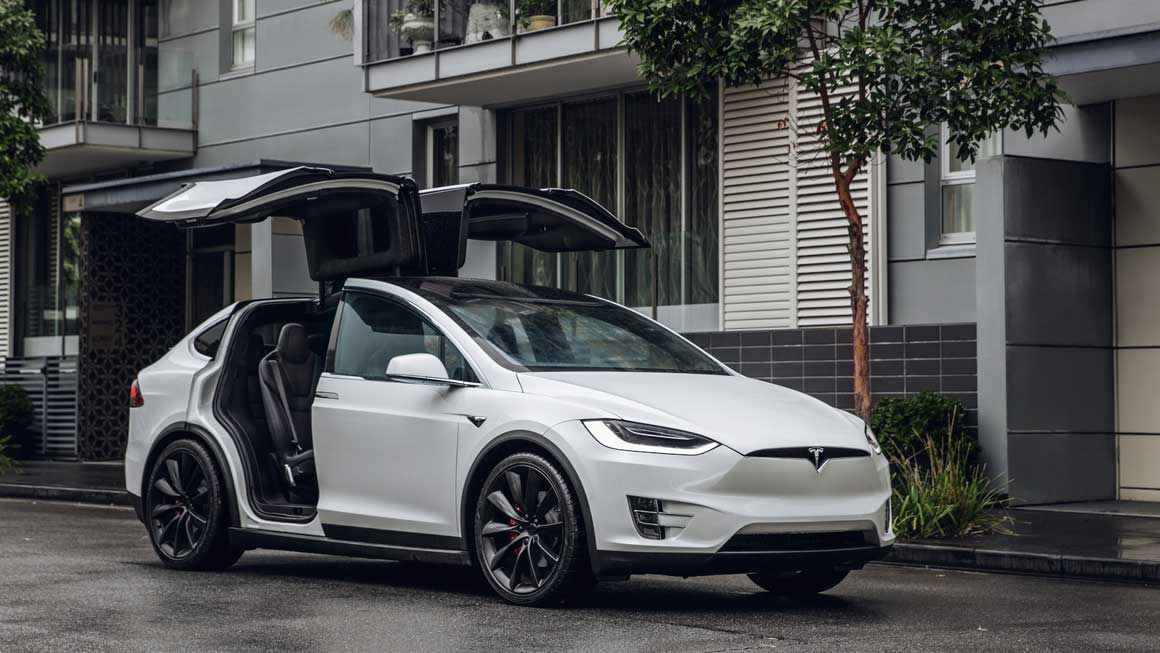
Elon Musk has led the world in the transition to electric vehicles through Tesla, and in space transport with SpaceX. Surely he is interested in the half way point – flying cars? After all, he’s already made one EV with gull wings – the Model X (See picture above).
It’s been a subject of intense speculation, particularly around Silicon Valley, which seems obsessed with “virtual take off vehicles” and “urban air mobility” as the next big thing.
But so far the signals from Musk have been mixed at best. “Obviously, I like flying things,” Musk told Bloomberg’s Max Chafkin a few years ago. “But it’s difficult to imagine the flying car becoming a scalable solution.”
Yet, when talking about the updated Tesla Roadster, Musk has been keen to point out that it will be able to “fly”, even if only briefly, thanks to new thrusters courtesy of SpaceX technology.
Some analysts suspect Musk is being deliberately coy. The Roadster’s thrusters are just one example of how the skills and knowledge between Tesla – both its EV and battery storage divisions – and SpaceX can be transferred.
“The potential skills transferability and network adjacencies are too strong to ignore,” Morgan Stanley analysts say in a new report. “In our view, the chance that Tesla does not ultimately offer products and services to the eVTOL/UAM market is remote.”
The Morgan Stanley analysts say the only reason that Tesla is not often mentioned in the flying car narrative is that Musk himself doesn’t talk about it much, and when he does, he and his team dismissive, focusing instead on space, tunnels (the Boring company), and three dimensional transport.
“So, that’s it then… We’ll have Teslas on our roads, underground in tunnels… on Mars. But not in Earth’s skies? Well… we’re not convinced,” the analysts said.
Morgan Stanley believes that the global market in flying cars would be $US9 trillion by 2050, and it says the market could be worth between $100 and $1,000 a share for Tesla – assuming it enters the market.