
South Korean carmaker Hyundai has unveiled the Prophecy, an electric coupé-like concept with a long wheel base that the company believes will become “a new standard for the EV segment” as it readies itself to invest €50 billion ($A84.5 billion) into future mobility technology.
Unveiled in a live-streamed event – arranged in lieu of the 2020 Geneva Auto Show, which was cancelled due to the coronavirus – the Prophecy is a manifestation of Hyundai’s “optimistic futurism”.
Hyundai has a plan to bring 44 electrified vehicles to market by 2025, 23 of which will be 100% electric – a plan that no doubt spurred by the success of the Tesla Model 3.
With a smooth nose, cat-like headlights and panoramic roof, the Prophecy concept certainly looks the closest we’ve seen to the styling of the Tesla Model 3.
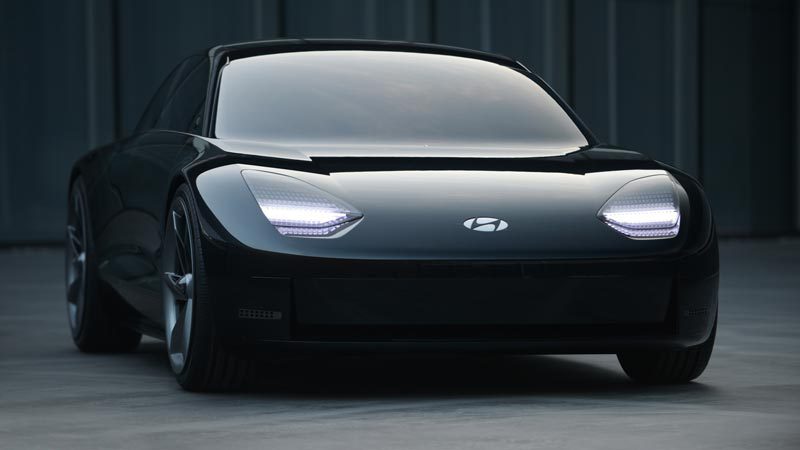
“We have brought to life yet another icon that establishes a new standard for the EV segment as well as pushing Hyundai’s design vision to even broader horizons,” said SangYup Lee, head of Hyundai’s global design centre.
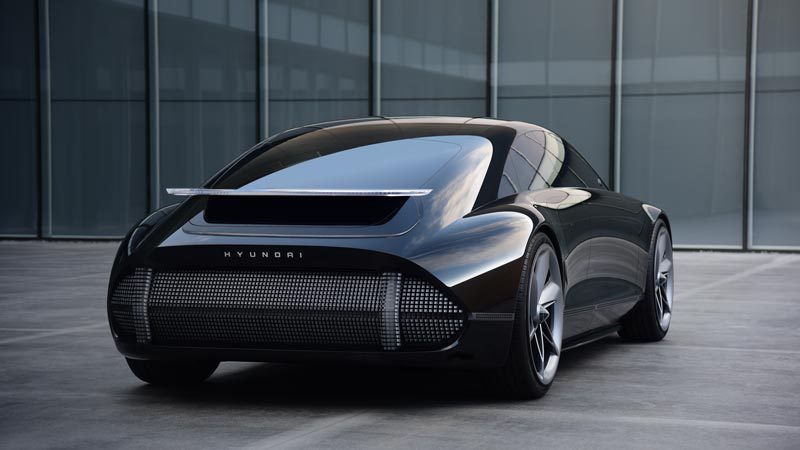
From the side however, the Prophecy is something else. A generous wheelbase with a truncated rear end and a spoiler reminiscent of Italian design house Zagato stand out both literally and figuratively, contributing to the aerodynamics of the car along with the asymmetrical rims.

And on the interior, the Prophecy makes a complete departure from any likeness to the Model 3.
Inside, a startling tartan upholstery seeks to present a “lifestyle space,” as opposed to a standard automotive interior, while two joysticks replace the steering wheel, in a move geared towards autonomous driving.

There’s not a lot of details about the vehicle’s specifications, such as driving range or battery capacity, except to say that Hyundai has included a generous air intake below the bumper to assist with cooling the ample battery (we hope this is not the only battery thermal management it plans on including).
Nevertheless, it would certainly be interesting to see the Prophecy graduate from concept to production vehicle, if it can inherit the nimble responsiveness – and price tag – of the Hyundai Ioniq. If Hyundai can achieve this, and bring it to market in Australia, it would be sure to turn heads.