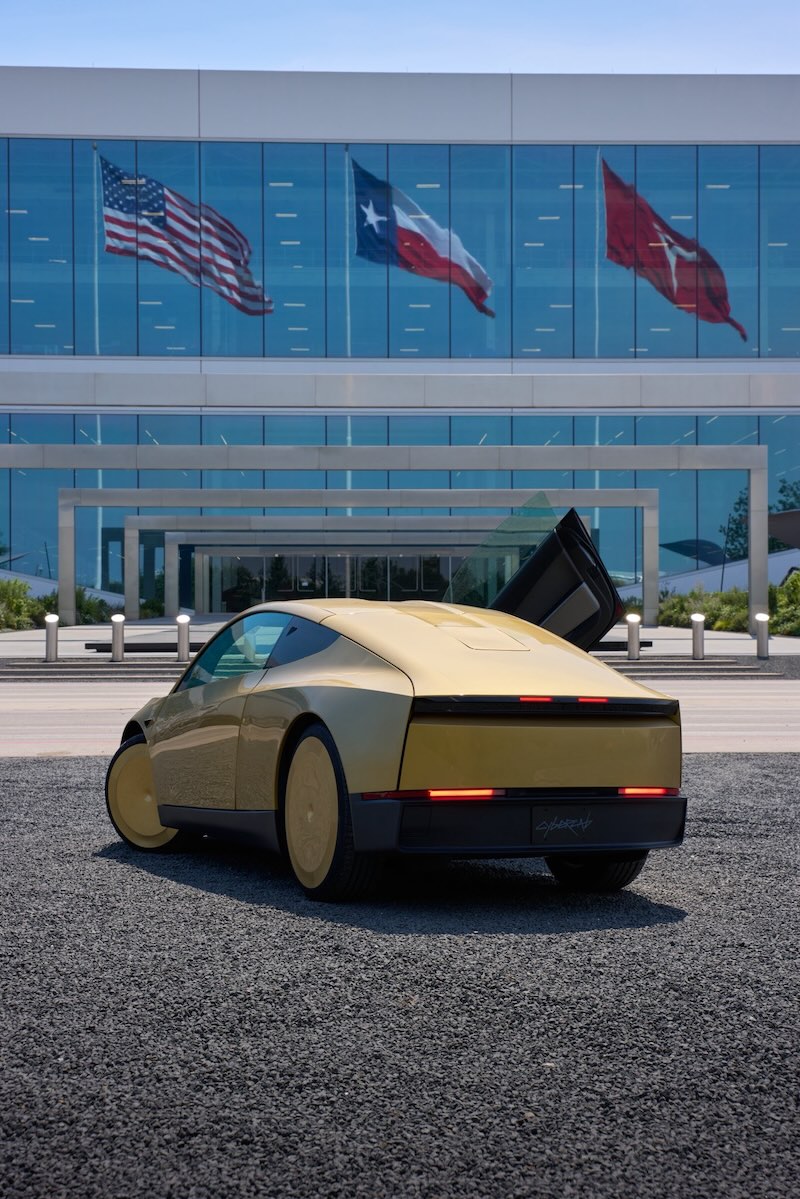
Tesla’s two-seater Robotaxi, the Cybercab, has been in production for a few months with deployments in multiple cities across the US.
Now, the company has shared that it will be coming equipped with Starlink Mini and newer models will feature Starlink hardware for fast internet connectivity for the car and the riders of the service.
The hardware itself sits flush where the back windscreen may normally be and with the exterior is also painted in the signature gold colour of the Cybercab. In a post on X, the company shared: “First Cybercab with Starlink integration”.
Off the back of this, Tesla CEO Elon Musk shared a few use cases for this tech integration in the Cybercab: “You will be able to watch live sports in 4k or movies or games or productivity!”
Starlink is a satellite internet service created by SpaceX which provides high-speed internet to homes, businesses, and travellers globally, including many living in regional and remote areas.
In recent years, large airline services, shipping companies and the RV industry have taken up the technology to provide internet services where it was near impossible to get a reliable connection a few years ago.
Tesla first showed the Cybercab at the company’s “We, Robot” event in late 2024. The event included hundreds of demos of the Cybercab and Model Y Robotaxis on closed roads at Warner Bros. studios in California.
Following that, plenty of sightings of the golden model have been made, with most either at Tesla’s test track near Fremont, California, on the roads, at Tesla showrooms in the US and even Europe.
The Cybercab is expected to cost around $A45,000 as a self-driving robotaxi, with plenty of rear space and fewer interior parts than its other passenger-car products. Production of the unique two-seater vehicle started in April 2026.
Recently, key specs of the model were revealed through EPA approval documentation in the US, showing that Tesla’s lightest model, with the smallest battery, will deliver an impressive 600+ km of range.
That’s thanks to the Cybercab having a kerb weight of 1,412 kg and is powered by a 48 kWh battery pack which feeds the front motor.
Previously, a lead Tesla engineer said the Robotaxi is expected to have 50% fewer parts than Tesla’s Model 3 electric sedan, reducing weight by over 400 kg compared to the sedan.
With new integration of Starlink in all future Cybercab models, it could create another fairly compelling reason for more digitally connected users to try out the Cybercab as the rollout continues to expand in the US, with international markets to follow.