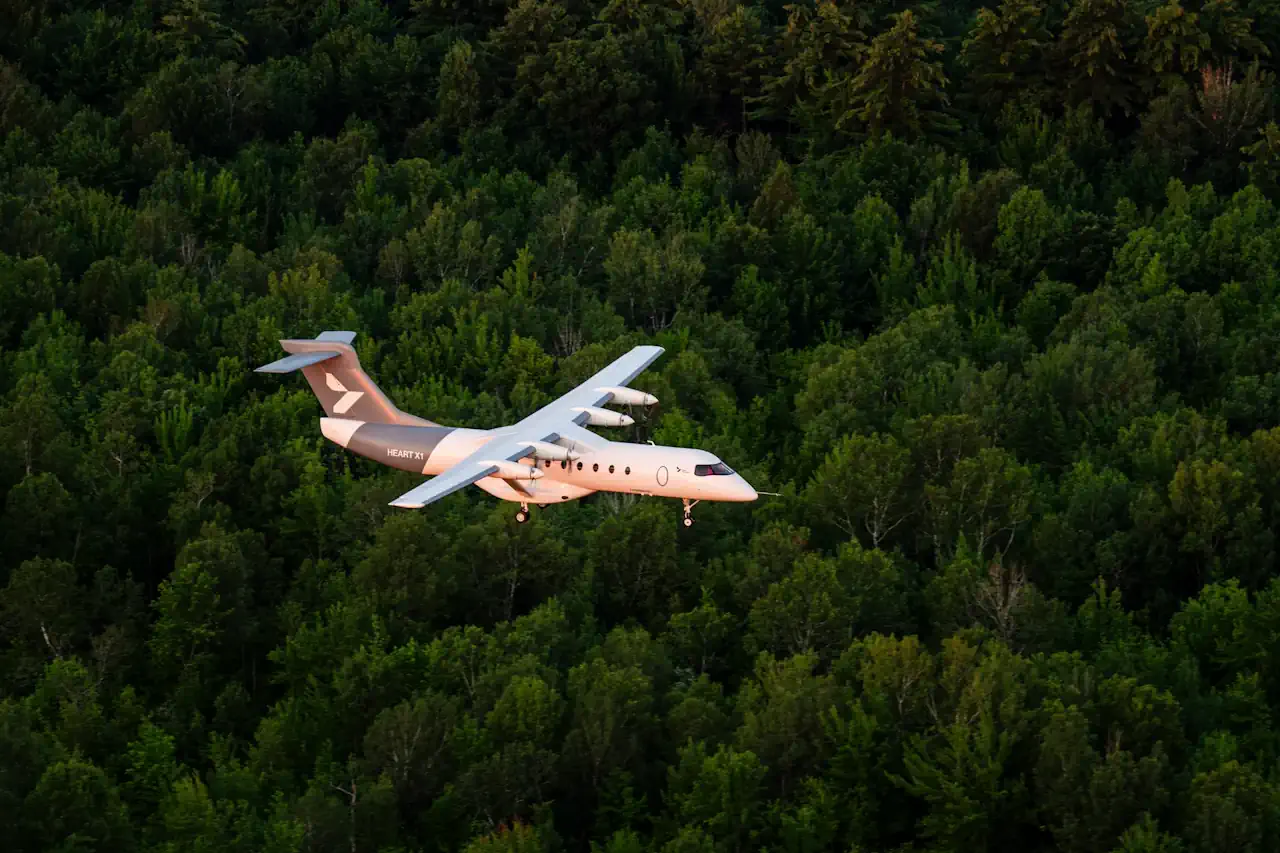
The world’s largest battery-electric aircraft has completed its first flight out of an airport in upstate New York in a journey that lasted 27 minutes.
American aviation and aerospace company Heart Aerospace says its X1 demonstrator aircraft completed its first flight last Wednesday, August 12,, out of the company’s flight-test base at Plattsburgh International Airport, a regional commercial airport serving a community of 20,000 people in upstate New York.
The 27-minute flight saw the X1 reach an altitude of 1,100 feet, during which its propulsion system delivered over one megawatt of power. But given that the flight was powered entirely by the plane’s onboard battery systems, the X1 used about $US5 worth of electricity – equivalent to around $A7, or a venti cappuccino from Starbucks.
“With the first flight of X1, Heart Aerospace has demonstrated electric flight at the scale of a commercial airliner,” said Anders Forslund, founder and CEO of Heart Aerospace.
“Electric commercial aircraft have the potential to fundamentally reshape airline economics and, ultimately, lower the cost of air travel for passengers.
“This is at the heart of our vision for abundant air travel, with electrification enabling more affordable, frequent, and cleaner air service to and from airports closer to home.”
Measuring 76 feet (23 metres) nose to tail and spanning 106 feet (32 metres), Heart’s X1 also weighs more than 25,000 pounds at take-off, making it the largest battery-electric aircraft to ever be flown.
The X1 is a full-scale demonstrator representative of Heart’s ES-30 production aircraft and is designed to validate key technologies, aerodynamics, and flight performance.
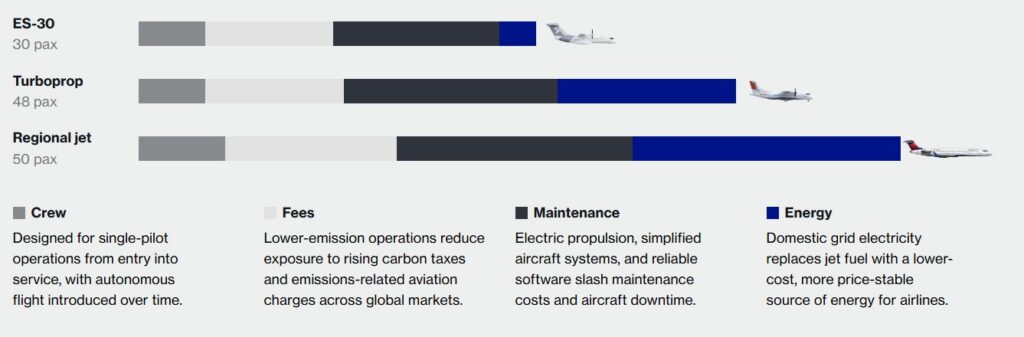
Heart currently expects the ES-30 to enter service by 2031 and reduce aircraft operating costs by over 40 per cent compared to legacy regional aircraft, driven by lower energy costs, reduced maintenance, and greater aircraft uptime and reliability.
The ES-30 is a conventional fixed-wing, 30-seat hybrid-electric regional airliner, and has already attracted customer commitments from major air carriers including United Airlines, Air Canada, and JSX.
It will be capable of operating in all-electric mode or in hybrid operation. It is expected to boast an all-electric range of 200 kilometres and a hybrid range of 800 kilometres, with charging times of around 30 minutes.
The first pre-production ES-30 is currently in development at Heart’s pilot manufacturing plant in Los Angeles and is expected to begin flight testing in 2028.