Witricity's tech in action with a Hyundai Kona EV at the Geneva Auto Show in 2018. Supplied.
When is a plug-in electric car not a plug-in electric car?
Yes, the answer is as simple as you might think: when there is no longer any need to plug it in.
And that reality – a dream, some may say, for EV drivers – could now be one step closer thanks to wireless charging technology developed by telecoms company Qualcomm and acquired by wireless charging tech company Witricity.
Wireless charging is nothing new – Witricity has been developing the technology since it was founded to commercialise MIT research in 2007, and has since been used to charge smartphones, tablets and even medical devices.
A collaboration in 2012 saw Witricity join forces with German carmaker Audi and in 2013 the company demonstrated the technology using Mitsubishi’s concept CA-MiEV to triple its range.
A prototype of the technology was showcased at the Geneva Auto Show in 2018, and more recently Honda has collaborated with Witricity to demonstrate the use of wireless charging tech as part of a vehicle-to-grid (V2G) solution at CES2019.
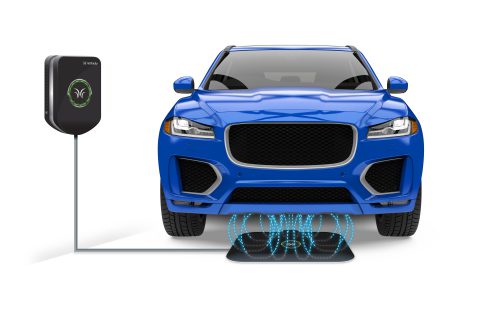
Put simply, the tech allows an EV driver to simply drive their car over a wireless “pad” which uses magnetic induction technology to charge the car battery without the need for a cable.
Now, the deal with Qualcomm (which will remain a minor shareholder) gives Witricity access to 1,500 patents and patent applications that it says will allow it to streamline development to deliver a seamless, efficient EV charging experience.
“WiTricity’s wireless charging technology is key to the future of mobility which is clearly electric, and increasingly shared and autonomous,” Witricity chief Alex Gruzen said in a statement.
“EV drivers and fleets demand a simple, effortless charging experience.
“Bringing the Qualcomm Halo technology into the WiTricity portfolio will simplify global interoperability and significantly accelerate commercialization. This is an exciting day for WiTricity, for automakers, for prospective EV buyers, and ultimately for any company deploying fleets of autonomous vehicles.”
Witricity’s vision is to charge the world’s EV fleet – which is tipped to increase to 120 million vehicles by 2030 according to Witricity – using its wireless tech.
With a potential $US50 billion ($A70 billion) to be invested in EV charging infrastructure in the years to come, Witricity advisor and former VP of Wireless Charging at Qualcomm Steve Pazol says that the opportunity exists to not only “support the shared vision of a more efficient, safer and cleaner urban mobility, but also to transform the automotive experience”.
Bridie Schmidt is associate editor for The Driven, sister site of Renew Economy. She has been writing about electric vehicles since 2018, and has a keen interest in the role that zero-emissions transport has to play in sustainability. She has participated in podcasts such as Download This Show with Marc Fennell and Shirtloads of Science with Karl Kruszelnicki and is co-organiser of the Northern Rivers Electric Vehicle Forum. Bridie also owns a Tesla Model Y and has it available for hire on evee.com.au.
Kia has announced pricing for its first electric van in Australia, coming in below competitor…
An annual fee for driving electric vehicles could put the brakes on their record sales…
Mazda is finally stepping properly into the EV space, and we got an early look…
Australia enjoyed record EV sales in March, but how long will it last? The answer…
More expensive DC chargers may be the most economic option for kerbside charging. Their higher…
Electric van maker says it has introduced an innovative new feature aimed at those who…