
Tesla’s Semi electric truck, which recently entered high-volume commercial production, will have full self-driving (FSD) working by early 2027, according to the company’s CEO, Elon Musk.
At the company’s earnings call this week, Musk announced that the company’s FSD software suite will be working on the Semi: “We expect to get self-driving working on the Tesla Semi probably around the end of this year or early next year.”
He further explained that the company’s main focus is to get FSD working on its two main models, the Model 3 and Model Y, as well as its dedicated Robotaxi.
“I just don’t want it to be a distraction from the march of nines of safety for self-driving on the Model 3/Y and Cybercab,” he said.
“It will definitely be working next year.”
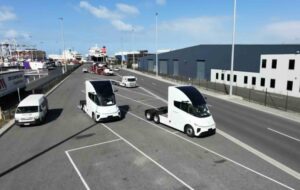
In recent months, images of a Tesla Semi with additional beams and a sensor suite attached to it, driving on public roads in California have been spotted, highlighting the autonomous driving/FSD testing.
The last sighting showed that the Semi being tested did not have a trailer attached which further highlighted that it was likely used by Tesla employees for testing around the design centre the company has in the state.
Previously, Tesla has used similar equipment on various other passenger vehicle models while those cars and software have been under development, mainly for validation purposes.
Tesla’s Semi was originally unveiled almost a decade ago, with the most recent iteration’s design having been finalised in late 2025.
As part of that update, the company pointed to the role of FSD tech in its Semi fleet, with the truck coming equipped with hardware necessary for future self-driving deliveries.
On specs, the Semi comes in two variants. A Standard Range variant with a 548 kWh battery pack and delivering over 500 km of range, as well as a Long Range variant that comes in at 822 kWh and delivers up to over 800 km of range with a 37-tonne load on board.
Both variants use the company’s 4680 cells with NMCA chemistry that can be charged at up to 1.2 MW with Tesla’s Megachargers, designed specifically for the Tesla Semi.
Tesla is expected to produce up to 50,000 semi-trucks per year at the company’s Nevada factory, which was completed earlier this year.
In July 2026, Tesla’s first Semi Megacharger station, with up to 1.2 MW of charging power per stall, was opened in Bloomington, east of Los Angeles in California. This site has 6 charging stalls along with large drive-thru bays for semi-trucks.
Sign up for The Driven’s free daily newsletter and get the latest EV news and analysis delivered straight to your inbox.