
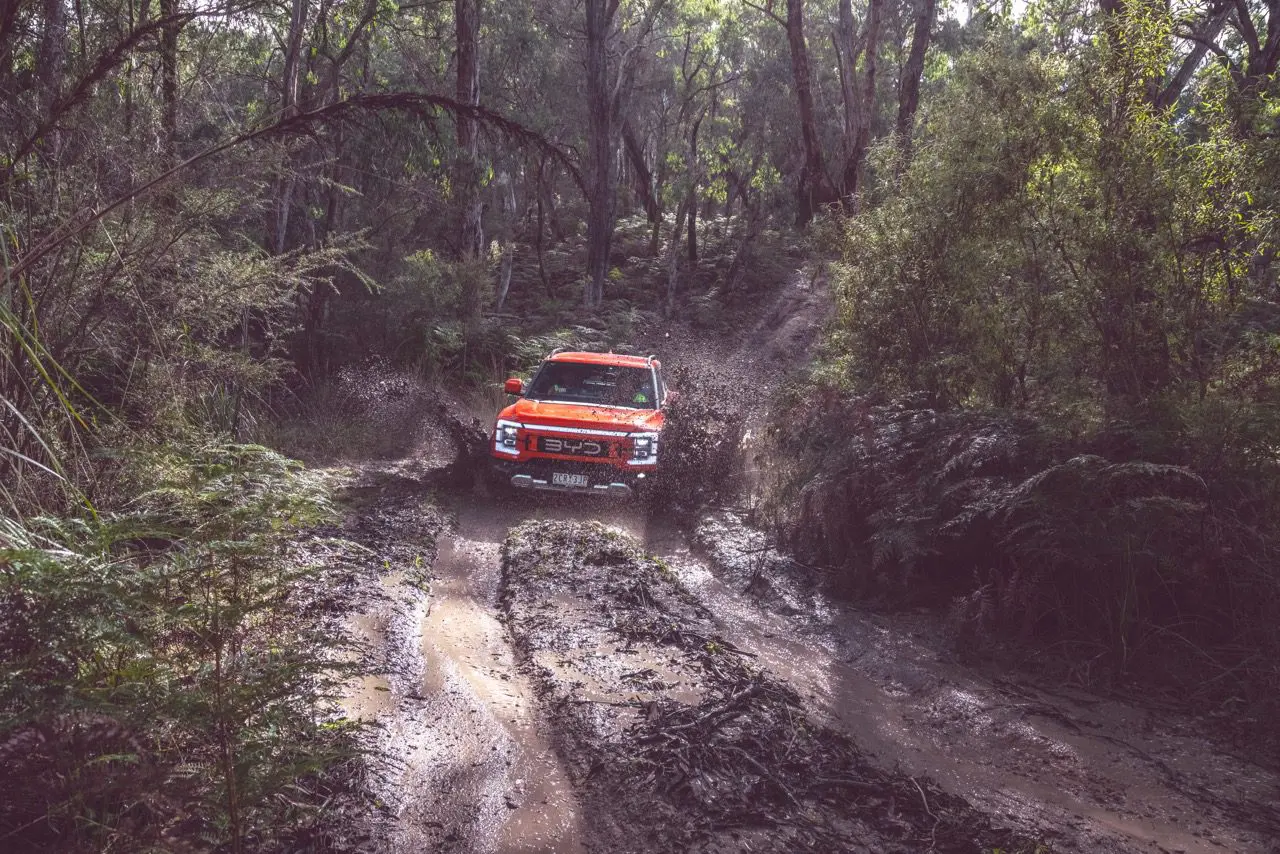
Picture this: A battery electric BYD Shark ute featuring 600+ km range, combined with flash charging technology for 10 – 97 % charging in 9 minutes.
If BYD can bring an electric ute like that here for the right price, I think it would easily become not just the best selling EV, but the number 1 selling vehicle full stop. Now let me explain why.
For this article I tried to put myself in the shoes of a BYD product planner, thinking about BYD’s existing vehicle lineup and how an electric Shark might fit in. From here on I will refer to this potential ute as the Shark 7 for simplicity, which makes sense given the company’s Sealion 6-7 SUV naming scheme.
BYD officially says there are no immediate plans for a Shark 7, but they have left the tailgate open for one to appear in the future. During the updated Shark 6 launch, fellow contributor Riz Akhtar asked about a battery electric Shark. BYD responded by saying they don’t believe the market is ready, although they are not finished with the Shark lineup yet.
Based on surging EV demand and my recent experience talking about EVs with a group of 4WD enthusiasts, I think BYD are either underestimating the level of interest in this segment, or they just don’t have the product quite ready yet. I hope it’s the latter, and they are secretly working on a Shark 7 behind the scenes for release sometime soon.
In terms of the technical capability for BYD to produce a Shark 7, the Shark 6 platform uses a ladder frame chassis and double wishbone suspension on the front, the same as traditional diesel utes. The double wishbone rear suspension differs from a solid live axle found on other utes though. Additional battery capacity could occupy space that appears to be empty between the chassis rails.
Despite suspension differences, the updated Shark 6 seems to have the features that people expect in a vehicle like this. The new Performance variant is now capable of towing up to 3.5 tonnes and comes with multiple off-road specific drive modes for mud, snow and sand. There is also a Crawl Mode that continuously adjusts torque to the wheels to improve traction and prevent slipping.
The potential market for the Shark 7 is huge. During a talk on light commercial EVs during the Smart Energy conference earlier in May, the speaker pointed out that utes make up roughly 25 percent of the Australian market. This equates to over 300,000 new utes per year, based on 2025 total sales figures of more than 1.2 million vehicles.
Today, battery electric utes make up a tiny fraction of this. Up to the end of April 2026, KGM has sold 138 Musso EVs and LDV has not sold any of their eT60s. EV utes represent just 0.3 percent of total EV sales, or a tiny 0.04 percent of the total passenger, SUV and light commercial vehicles sales so far in 2026.
I discovered this next fact while writing an article discussing the exponential growth of EV sales and how Australia could already be on track to hit 80 % EV sales by 2030. BYD currently sells 4 times as many Sealion 7 battery electric SUVs compared to the equivalent Sealion 6 plug-in hybrid, even though the Sealion 7 costs roughly $10,000 more.
Assuming the price difference between Shark drivetrains would be bigger, due to them needing larger battery packs than the Sealion, it may be possible for BYD to offer it for somewhere between $70,000 to $80,000. This puts it in the same ballpark as top-spec diesel utes and a fair bit cheaper than a Ford Ranger Raptor.
Next up, let’s look at sales for the BYD Shark 6 to try and predict how a Shark 7 may sell if it follows a similar pattern. As Renew Economy’s David Leitch often says on the Energy Insiders podcast with Giles Parkinson, “Forecasting is always difficult, particularly about the future.”
So this is nothing more than a thought exercise, and it could be totally wrong, but I think it’s interesting nonetheless. BYD has sold 4,851 Shark 6 utes up to the end of April 2026. If we assume the Shark 7 would also sell at the same ratio as the Sealion SUVs, BYD could potentially have sold over 19,000 of them year to date.
This would firmly put a Shark 7 ute as the top selling EV, and it would not even close, as the Tesla Model Y is currently sitting at 6,719 units. In 2025, BYD sold a total of 18,073 Shark 6 utes, and quadrupling those numbers results in more than 72,000 Shark 7s for a whole year.
Comparing these hypothetical figures with the Ford Ranger, which is currently Australia’s best selling vehicle, shows that a Shark 7 could potentially overtake the Ranger by some margin. Ford sold 15,841 Rangers up until April 2026 and a total of 56,555 over the course of 2025. Even a tripling of Shark 6 figures would put a Shark 7 neck and neck with the Ranger.
I have no doubt a Shark 7 would cannibalise some Shark 6 sales, but perhaps BYD wouldn’t care if they had the best selling vehicle in the country. If BYD are smart they will make all of the existing Shark 6 accessories compatible, to reduce development costs and offer an upgrade path for Shark 6 owners who want to keep their existing modifications.
BYD has ambitions to become a top-3 brand in Australia by the end of 2026, as well as overtake Toyota for the number 1 spot eventually. If I actually were a product planner at BYD, then a battery electric Shark 7 ute would most definitely be on the cards.
See The Driven’s detailed EV sales data here: Australian electric vehicle sales by month in 2026; by model and by brand.
Sign up for The Driven’s free daily newsletter and get the latest EV news and analysis delivered straight to your inbox.