
We drive electric cars all the time. It’s all we drive these days. We don’t own any petrol or diesel cars despite living in regional Australia, and clocking up more than 140,000 km in electric driving in the three years or so since we bought our second EV and sold the Yaris to a friend.
In all, we have done more than 250,000 km in our EVs since we bought the first one 7 years ago. So, we are kind of comfortable when it comes to charging – mostly at home, occasionally at the local shopping centre, and where we can with Superchargers when we go interstate or to the nearest capital, and with a little planning when we need other options or a going further afield.
When we do go on a long-distance holiday, we always try and hire an EV rather than an internal combustion engine vehicle. It’s generally quieter, more relaxing, and has significantly lower running costs and is, of course, cleaner.
We’ve done this successfully and pleasurably in Tasmania, in France, and in England, and we’ve really had no problem finding somewhere to charge, although on occasions we did have look at a map and/or an app, and figure out where best.
Nowhere, though, has this been easier than in New Zealand, where we recently spent 18 days on the North Island, and still managed to clock up more than 2,200 km of driving in a Hyundai Ioniq 5 (one of my favourite EVs), even with devoting five days for an extended canoeing trip down the wonderful Whanganui River (I’d recommend that too).
EVs in New Zealand took off a lot earlier and quicker than they did in Australia, thanks to the fact that you could easily import new or second hand EVs from Japan, and the Nissan Leaf was the favourite.
The legacy of that initiative is still visible. There are Nissan Leafs all over the place and again – unlike Australia – nearly every EV charger has a CHAdeMo plug (used by Nissan Leafs and Mitsubishi Outlanders).

For the first time, after seven years of driving an EV, I even found myself sharing a charging station with a Leaf – they on the CHAdeMo plug, and our Hyundai Ioniq 5 on the CCS.
The best thing of all about driving electric in New Zealand (unless you have a low-range first generation Leaf) is that you don’t have to worry about where to charge.
Granted, you do have to find out where they are, particularly if it is your first time there, but they are so plentiful they are in virtually every town. Which means that even when you come across a broken down or malfunctioning Tritium first generation charger, which we did, there is usually another option.
Remarkably, New Zealand actually has few EV fast chargers per EV than Australia, which also trails the rest of the world. But New Zealand is a small country, so the density of EV chargers per square kilometre must be a lot better.
And that situation is about to get even better. The NZ conservative government, having nearly killed the rate of uptake of EVs after suddenly removing all rebates and other incentives, has witnessed the stunning three-fold boost in sales on the back of the fossil fuel supply crisis.
It has now vowed to double the number of EV chargers across the country, and particularly in places where people live in apartments or otherwise don’t have the option for home charging.
The striking thing about fast-charging in New Zealand is its relative low cost. On average, they charged 80c-85c a kilowatt hour, but that needs to be compared to the price of petrol in New Zealand, which was already at $NZ2.60/litre when we were there and has since surged past $NZ4/litre thanks to the events in the Gulf. (Fast-charging costs have only risen 5c/kWh since that time).

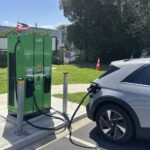

The other major difference between Australia and New Zealand is the network ownership. In Australia, this is dominated by Tesla, because they have the biggest, lowest cost and most reliable EV charging stations. Tesla are not so dominant in New Zealand and we did not need to use them once, because there were plenty of other options.
Many petrol stations in cities and towns feature EV charging stations too, not just on the open road.
We didn’t just fast-charge. We used a type 2 charging cable with an AC-charger in the town of Ohakune, under the watchful eye of New Zealand’s biggest volcano, Mt Ruapehu, and discovered to our delight that it was free, which we thought was fair compensation for having to stuff around with a broken Tritium charger in the same town.
We fast-charged at Whangarei and Kawakawa when we went north from Auckland, and trickle-charged at one AirBNB (for convenience sake and for a payment of $NZ10 overnight), and fast-charged again at Auckland when heading south.
We also fast-charged at Raglan, New Plymouth, and Whangarei, where – after giving up trying to figure out the BP charging app (our one major frustration) we found the double bonus of an EV fast-charger right next to a laundromat.

After that we charged once more at a new and working Tritium charger from the biggest network operator ChargeNet (with whom we did most of our business) and that was it.
All told, we did 2,200 kms, and put in 340 kWh, which is about consistent with the efficiency rating of an Ioniq 5 of around 15-16 kWh/100 km. The total cost was just under $NZ240 (thanks to the extended trickle charge and the one free top up).
If you had done the same trip in a petrol or diesel car that was reasonably efficient and consumed an average of 7 litres/100kms, that would have cost more than $NZ400 then, and more than $600 now.
And, of course, you wouldn’t have the added advantage of vehicle-to-load, now a relatively standard offering in most EVs although the Ioniq 5 was one of the very first to do offer this when it was released in 2021. And because we camped for a couple of nights, that was particularly useful.
Indeed, the Ioniq 5 best exemplifies another of the great attractions of driving an EV on an extended holiday – where the front of the car can seem overwhelmed by the number of drink bottles, coffee cups, maps, brochures and open travelling bags.

Firstly, there is usually a frunk (a trunk in the front), and this is where our camping equipment went.
But the best aspect is the sense of interior space, which is actually real, because the design of EVs allows for a flat floor, for greater interior space because the wheels can be pushed out further to the car extremities (and are not constricted by a big internal combustion engine).
The Ioniq 5 also has the advantage of a retracting centre console, which can provide even more space and an area to dump the maps, brochures and keep cups. And it has good range – the new models boast a bigger battery but the model we had boasted 560 kms, and you could count on at least 400 kms on a freeway.
That’s a bit moot, because far as we could tell, there’s not actually 400 kms of freeway on the North Island. Maybe I am wrong about it, and if I am, I still reckon you would be mad to do that in one go – there is too much to stop and marvel at in between.
And that takes us to the other great pleasure of EV driving in a place like New Zealand. Like Tasmania, most New Zealand roads are single lane (in each direction), and winding, which makes the handling, traction and silence of an electric vehicle an added attraction. You can even hear the birds.
And, like Tasmania, where there is traffic, you find a bit of tail-gating going on. But you can put some space between you going up hill, and accelerating out of tight turns. The petrols and diesels simply can’t keep up.

So, where did the Ioniq 5 take us? To some stunning scenery, such as the slopes Mt Taranaki and Mt Ruapehu, where you can marvel at the even more dramatic Mt Ngauruhoe, the “mountain of Doom” in Lord of the Rings.
We also visited and camped at the Kai Iwi fresh water lakes, and watched the first blades being transported to the new wind farm that is being built nearby, and wondered at the last remnants of the ancient and massive Kauri forests in the north, including trees that are more than 3,500 years old.
There’s a lovely little story to go with that. A Scottish couple were brought out to manage New Zealand’s forestry operations in the North Island in the late 1800s and were shocked at the devastation of these magnificent trees. So they turned forest defenders and helped protect the last remnants, which are now under the management of local iwi.
The drive there was one of the most winding, and needless to say an absolute pleasure in the EV, as was the drive alongside the winding and beautiful Whanganui River (although it is best seen in a canoe), and the roads to the surf of Raglan.
See The Driven’s detailed EV sales data here: Australian electric vehicle sales by month in 2026; by model and by brand.
Sign up for The Driven’s free daily newsletter by going to the button on the bottom right of the website’s home page at www.thedriven.io