Vehicle to grid (V2G) is a very exciting technology, with the potential to reshape the electricity grid and also put money into the pockets of EV drivers. Many people, myself included, thought the floodgates would open after the Australian standards for V2G were approved back in November 2024.
At the time, Federal energy and climate minister Chris Bowen said, “If you’ve got a car with V2G capability and a bidirectional device, you could be using that car to power your house before the end of this year.”
In reality however, the availability of bidirectional charging equipment and vehicles that have been approved by their manufacturers for V2G use remains limited. A select few people may already be living the V2G dream, but these early adopters are potentially opening themselves up to safety and reliability concerns according to Hyundai.
During the recent Hyundai Elexio launch, I had the opportunity to sit down with Scott Nargar, Hyundai Senior Manager of Future Mobility & Government Relations and project lead on V2G, to learn more about these safety and reliability concerns and what Hyundai is doing to overcome them.
Essentially, the issues boil down to the underlying communication protocols used between the charging equipment and electric vehicle, which is an entirely different thing compared to the Australian AS4777.2 inverter requirement standards that were updated to include V2G at the end of 2024.
ISO 15118 is the international standard defining the vehicle to grid communication interface, and manufacturers of bidirectional charging equipment are mostly relying on hacks or workarounds in these protocols that trick the car into discharging power from the battery while the car appears to be charging.
More specifically, existing equipment relies on variations of ISO15118-1 or ISO15118-2, rather than second generation protocols defined by ISO15118-20. Part 20 includes all the messages and sequence requirements for bidirectional power transfer, the limitations of how much can be exported and all important cyber security protocols.
Hyundai summarised their key findings from independent V2G testing in a formal response to the ongoing government review on the electric car discount as follows. “HMCA encourages the ACT government to ensure all V2G trials utilise EV manufacturer approved technology compliant with ISO15118-20.
“Some V2G chargers currently available in Australia achieve bi-directional charging operation by bypassing OEM software and hardware, which is not recommended due to potential safety risk, vehicle damage and impacts on manufacturer warranties and building insurance.
“Ensuring reliable interoperability between vehicles and V2G chargers remains a priority. Testing to date has identified communication and inconsistency issues across several V2G charger platforms. Further development and validation are required to deliver a safe and reliable consumer experience.”

Nargar said the Hyundai V2G testing team have witnessed their own vehicles and other manufacturer vehicles being discharged when the car doesn’t know it is discharging. For example, the car dash might indicate charging has started but the charging rate is displayed as 0 kW.
One of the biggest concerns with electric vehicles in this unknown state is that they may not necessarily have any control over the charging protocols, and the car may not be able to stop a discharging session if there is an issue.
When the system has been hacked to work like this, there is also no way of knowing what safety systems or other subsystems of the vehicle have been modified or disabled to get the battery pack to discharge, such as critical battery monitoring, protection or cooling systems.
This situation could potentially lead to battery or vehicle damage, or in the worst case thermal runaway and a fire risk to life and property if there has been impact damage to a car, like after an accident repair where the battery has not been properly checked for faults.
Several other worrying behaviours have been observed by Hyundai during their V2G testing, including large discharge amounts of up to 30 kW and the ability for batteries to continue discharging past their built in safety buffers right down to absolute zero, bricking the battery pack beyond repair.
In terms of reliability issues, the connection between the charger and car is not always established properly, meaning it can take several replug attempts to start a charging or discharging session. To overcome this, charging equipment engineers continually release patches and updates that potentially find new pathways to hack systems into discharging.
All up, the current state of V2G leaves early adopters of the technology with a lot of uncertainty. In terms of whether or not their equipment will behave as expected, who is to blame in the event of damage to the vehicle and what is or isn’t covered by various warranties, especially if a vehicle manufacturer has not certified their car for V2G.
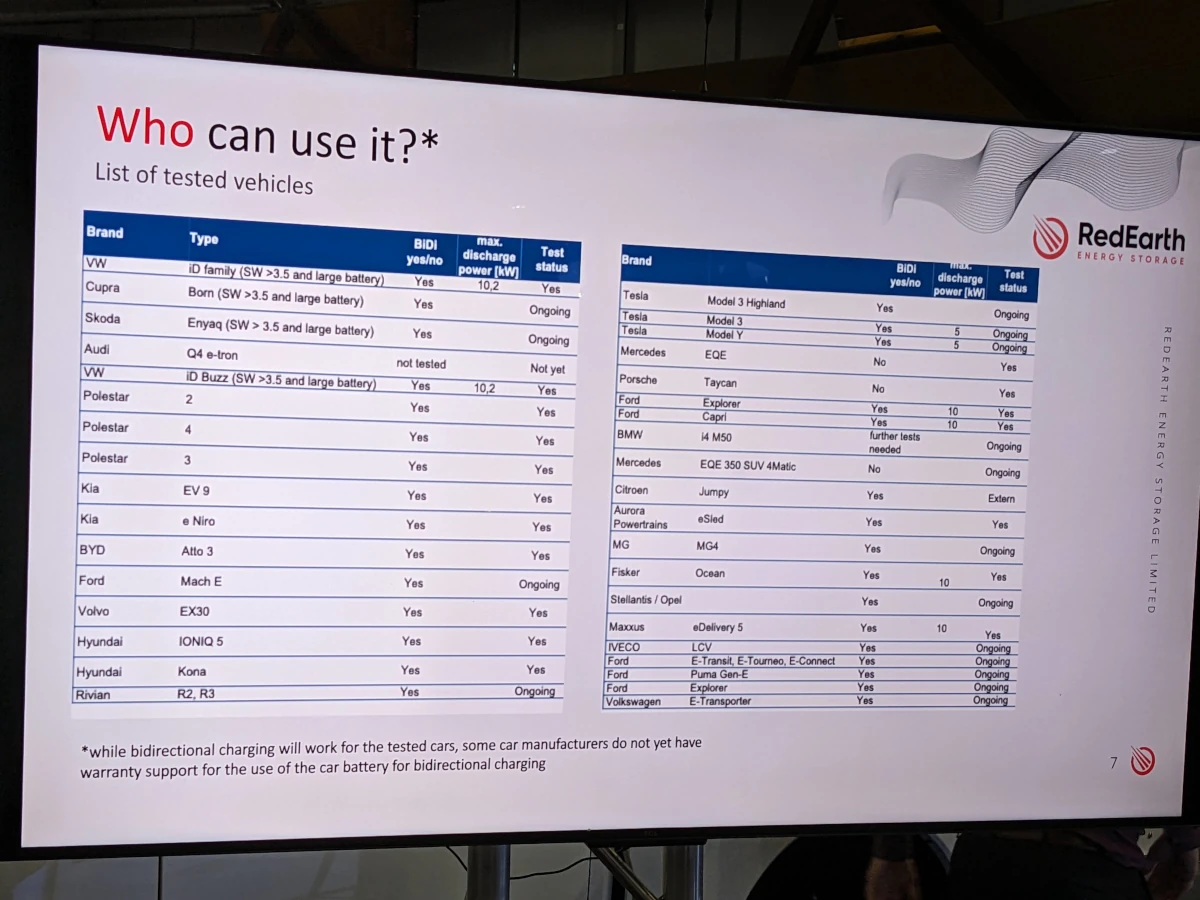
Some manufacturers of bidirectional charging equipment have cars from several brands listed on their websites as being compatible with V2G, for example RedEarth pictured below. Hyundai has asked for their vehicles to be removed from those sites and encouraged other manufacturers who are unaware to do the same.
To overcome these issues and ensure a reliable and safe experience for consumers, Hyundai continues to test their vehicles and bidirectional charging equipment from various brands at Essential Energy facilities in Port Macquarie. They are also working through approvals to get chargers installed at their head office in Macquarie Park.
Nargar confirmed there is at least one Hyundai Ioniq 9 that has been flashed to the latest software including ISO15118-20 protocols and they will use it to continue testing and validation work. The factory in South Korea is also looking at what is possible for older Ioniq vehicles, whether they could be reflashed or need hardware upgrades.
Through government submissions such as the quote above, Hyundai is also urging governments and groups like ARENA to ensure that all future trials or investments utilise ISO15118-20 and a clear testing and validation framework is established so everyone is working towards the same goal.
To help spread the awareness of issues with V2G and smooth the pathway forwards, ARENA established the Vehicle-Grid Network (VGN) project at the end of 2025, with the aim of fostering greater industry collaboration, knowledge sharing and ultimately solve the issues that Hyundai describes.
Two energy companies in Australia have already opened expressions of interest for customer V2G trials, Origin Energy with a subscription offer for a BYD Atto 3 and StarCharge V2G Halo bi-directional charger. AGL has partnered with Hyundai, Kia, BYD, and Zeekr to offer 50 participants a discounted bi-directional EV charger plus installation.
While writing this piece I reached out to both of these companies to see if they were aware of the issues Hyundai describes and if so, how they are handling them. An Origin spokesperson responded, “We’re continuing to work closely with BYD and StarCharge on vehicle-to-grid trials, which are progressing well.”
“Technology is constantly evolving and the purpose of our current trials is to ensure safety, reliability and customer value under controlled, real-world conditions. Our aim remains to expand this process to customer trials during 2026.”
Therefore, it sounds like the Origin trials are still in the early stages and have not been rolled out to customers just yet.
An AGL spokesperson also responded after this article was initially published, “Vehicle to Grid (V2G) is an exciting and emerging area. We understand the importance of not locking in a single technology solution to enable its operation.”
“As part of our testing ahead of the trial, we installed multiple V2G charger types, testing charging and discharging with different EV models, and validating system integrations to meet AGL’s safety and performance standards. These learnings have ensured we’re well prepared to begin installing chargers in customers’ homes.”
Lastly, if you want to get deep into the protocol weeds, take a look at the video embedded below which simulates and dissects a bidirectional charging session using ISO15118-20.
Article has been updated to include the response from AGL.