
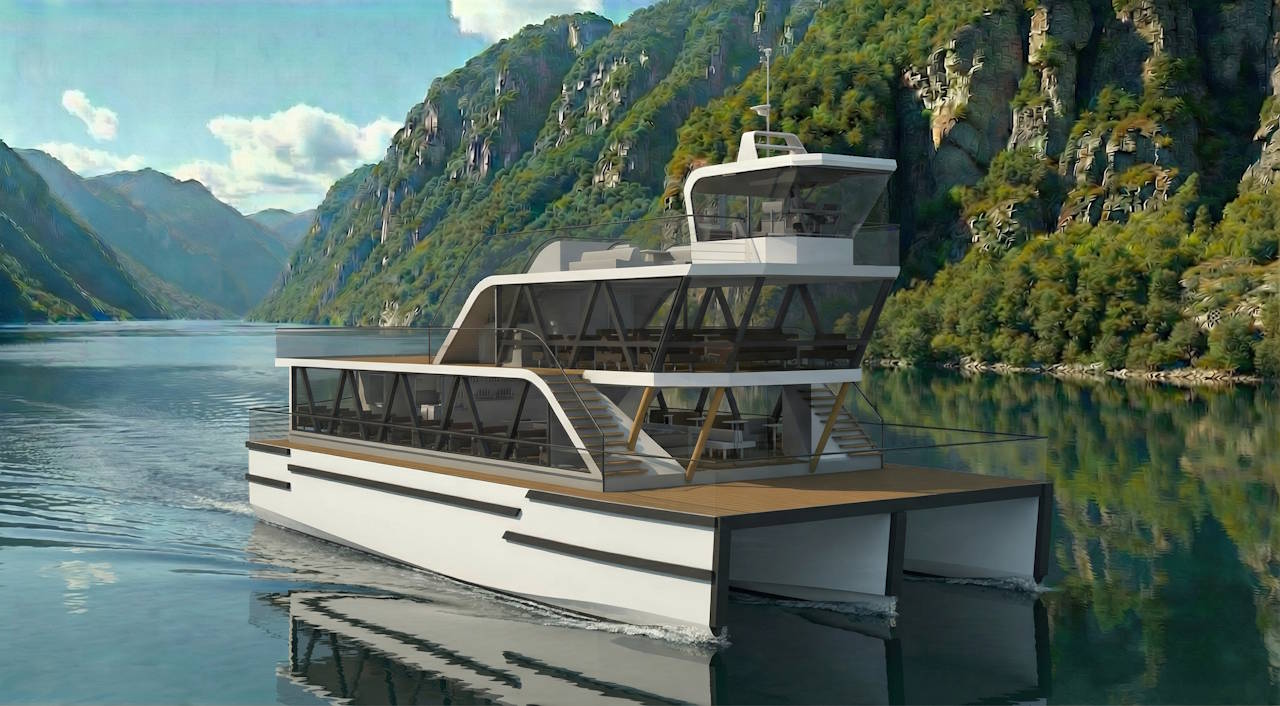
Norwegian tourism and technology company Brim Explorer announced this week that it has signed contracts to build two fully electric trimarans that the company says will be the world’s most efficient battery-powered vessels.
Based in Oslo, Norway, Brim Explorer bills itself as a tourism and technology company that provides “silent and sustainable ocean excursions” aboard a fleet of electric and hybrid electric boats.
Each vessel is purpose-built to be quiet, sustainable, and provide immersive tourist experiences at sea, utilising either electric or hybrid-electric propulsion. The company currently operates five vessels, including three hybrid-electric and two battery-only.
And Brim Explorer will aim to add two more fully electric vessels to its fleet in the first half of 2027 following this week’s announcement of contracts signed for their construction.
Designed by its in-house technology division, Brim Tech, the two new vessels will each boast capacity for 180 guests and provide emission-free and silent sightseeing and experience cruises in some of Norway’s most beautiful locations.


Each vessel, measuring in at 24 metres in length and a beam of 11 metres, will boast a battery-only range of 100 nautical miles, or approximately 200 kilometres, at a speed of up to 20 knots.
The trimaran hulls have been designed by Wind Naval Architects and will be built using advanced composite technology by Herde Kompositt in Hardanger, Norway. System integration and interior work will be completed by Horten Shipyards south of Oslo.
Brim Explorer’s total investment in the two new trimarans adds up to around NOK 200 million, or just shy of $A30 million.
“This is a milestone for both Brim Explorer and the Norwegian maritime industry,” said Agnes Árnadóttir, CEO and co-founder of Brim Explorer.
“We are not only proving that it is possible to combine zero emissions, high speed and long range – we are developing and building the vessels in Norway, with Norwegian suppliers.
“We have been using our existing vessels as test platforms for several years, which has given us unique insights,” added Espen Larsen-Hakkebo, CTO and co-founder of Brim Explorer.
“We know what actually works in real-world conditions, not just in simulations. That’s the difference between developing something that looks good on paper and something that delivers in practice every single day.”