
When it comes to EV adoption, the Australian Capital Territory (ACT) has already been nicknamed ‘Little Norway’ because of the way it has consistently supported the EV transition.
And, like Norway, (who have effectively reached 100% BEV sales) that consistency is showing fruit with June sales of new full-battery passenger EVs (BEVs) hitting 43.5%.
With the addition of plug-in hybrid EV (PHEV) sales of 12%, total plug-in passenger EV sales hit 55.5% in the ACT, meaning new plug-in EV sales outnumbered sales of new fossil-fuelled vehicles for the first time.
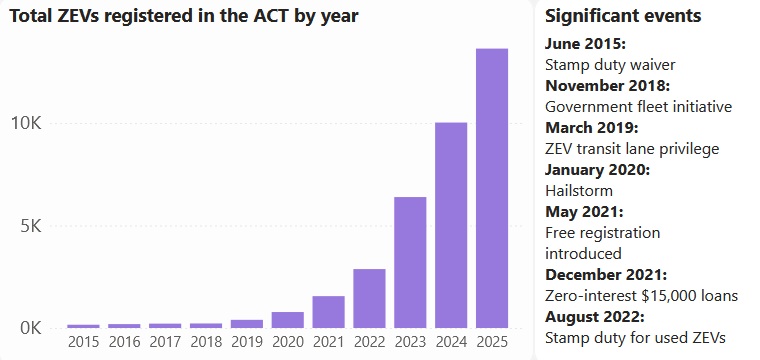
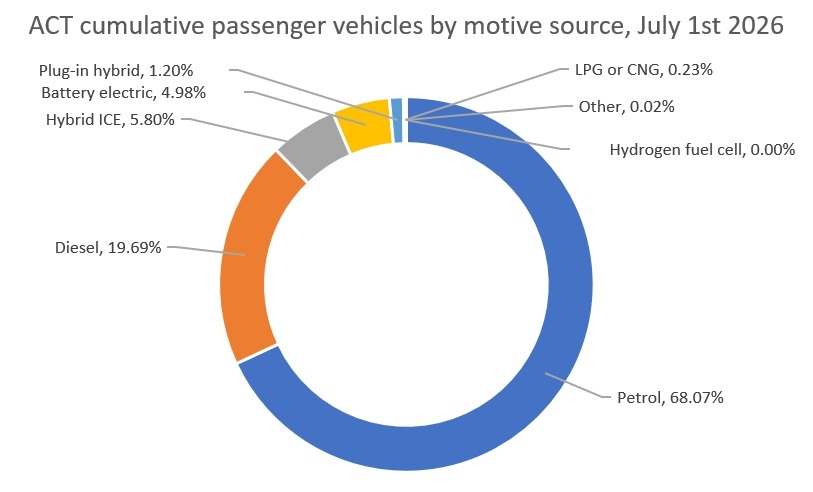
The end of June also saw the ACT hit another milestone in the EV transition, reaching over 17,000 BEVs registered there. That equates to one in 20 (5%) of all passenger vehicles registered in the ACT. Percentage-wise, this puts the ACT at more than double the Australian average of around 2%.
Whilst it is reasonable to argue that some part of the recent uptick can be put down to people reacting to the rising supply uncertainty (and prices) of petrol and diesel, a lot of it is also potentially down to Australian EV uptake crossing the divide from Early Adopter to Early Majority.
EVs are now normalised and seen as a viable option, with many people noticing EVs on the road and in their neighbour’s driveways. It is no longer a scary leap into an unknown tech to go EV.
Even the Federal Chamber of Automotive Industries (FCAI) – who to now have taken a relatively ‘EV sceptical’ approach to rising EV sales data – have acknowledged that a ‘sea-change’ in buyer attitudes towards EVs seems to have taken place.
Another interesting point in the ACT data is the falling proportion of PHEVs to BEVs. In the ACT it is now 1 in 4, compared to the Australia average of 1 in 3.
This also occurred in Norway, where PHEV sales have fallen to barely 1% as pure battery EV sales reached 98%.
It would appear that PHEVs have their peak where EV adoption rates are still in the early stages of the early majority, but slide once enough people see more of/become more familiar with full BEV technology to overcome the need to ‘hedge their bets’ with a PHEV.
Overall, consistency of policy would appear to be a major factor to the successes of the EV transitions in Norway and the ACT (and for that matter, the UK), as are their supportive policies and incentives to remove environmentally polluting vehicles from their roads.
Hopefully, the other Australian states and territories will take a good look at the ACT when formulating their next round of EV Transition related policies.
Whilst the overall Australian new EV sales rates in June were greatly improved on previous years (as of June 30: 24% BEV and 12% PHEV – totalling 36% overall) a more even uptake around Australia would make setting overall policies easier to apply nationally.
This would include such things as EV charger support and tax incentives (as well as the inevitable roads user charge/RUC to replace declining fuel excise).
See The Driven’s detailed EV sales data here: Australian electric vehicle sales by month in 2026; by model and by brand.
Sign up for The Driven’s free daily newsletter and get the latest EV news and analysis delivered straight to your inbox.