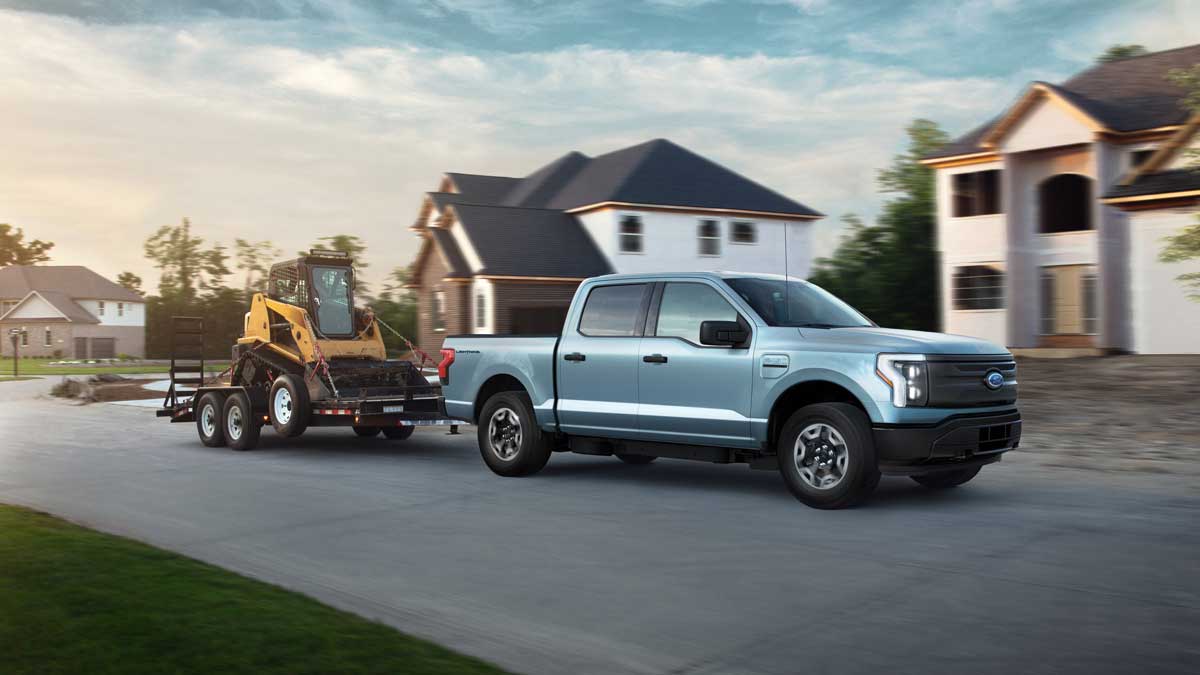
US car giant Ford has officially ditched its full battery electric ute – the F150 Lightning – and replaced it with a new version that uses an onboard fossil fuel generator to boost its range.
The new product – Ford calls it an EREV (extended range electric vehicle) – was announced as part of a massive restructuring of the company and its plans for EVs, and a total write-down of $19 billion of what to date has been a failed strategy.
The company halted production of the electric Ford F-150 lightning in October, blaming the decision on both a factory fire as well as increased demand for its hybrid and ICE versions. Only a week or so later it was reported that Ford executives were considering scrapping production of the F-150 Lightning entirely.
The writing was obviously on the wall, as Ford confirmed on Monday that production of the current F-150 Lightning would end “this year” and that a new, next-generation F-150 Lightning would instead use the EREV technology.
EREV cars are just another type of hybrid car, but unlike a hybrid EV (HEV) or plug-in hybrid EV (PHEV), the internal combustion engine (ICE) never sends power directly to the wheels, acting purely as an onboard generator for the battery.
This means that an EREV still benefits from the upside of an electric motor – with excellent torque – driving the wheels but supposedly eliminates potential “range anxiety” and eliminates the need for charging during long distance drives.
Ironically, as analysts McKinsey & Company highlighted earlier this year, “EREVs were part of the first wave of electrification a decade ago, but they didn’t take off, because innovation-driven early EV adopters were mostly only interested in pure BEVs.”
However, in order to assuage range anxiety and cost concerns among current owners of ICE vehicles, carmakers in China, followed by those in Europe and the United States, are now reevaluating the supposed benefits of EREV technology.
This was certainly represented in Ford’s Monday press announcement which overflowed with praise for EREV technology, claiming that the next-generation F-150 Lightning would be “a truck engineered to redefine what an electric pickup can do.”
According to Ford, next year’s EREV-powered F-150 Lightning will “offer the best of both worlds”, which is apparently “the seamless, instant power of an electric powertrain and the freedom of a generator-backed estimated range of more than 700 miles [(1,125 kilometres)]”.
The company provided no details of what exactly this “generator” would be, with more details about the vehicle and a launch timing to be announced at a later date.
Ford is so enamoured of the technology that they doubled down on their praise, promising future owners that they would “get the pure EV driving experience they love — including rapid acceleration and quiet operation — while eliminating the need to stop and charge during long-distance towing.”
The next-generation F-150 Lightning will also still offer vehicle-to-grid (V2G) and vehicle-to-load (V2L) functionality.
“The F-150 Lightning is a groundbreaking product that demonstrated an EV pickup can still be a great F-Series,” said Doug Field, Ford’s chief EV, digital and design officer.
“Our next-generation F-150 Lightning EREV will be every bit as revolutionary.
“It delivers everything Lightning customers love — near instantaneous torque and pure electric driving. But with a high-power generator enabling an estimated range of 700+ miles, it tows like a locomotive. Heavy-duty towing and cross-country travel will be as effortless as the daily commute.”
Scrapping the F-150 Lightning BEV in favour of the EREV model was just one of several announcements Ford made on Monday that saw it double down on offering what the company described as a “broad choice with gas, hybrids, and EVs”.
Any long-term ambition to transition entirely away from polluting ICE and hybrid models has obviously been thrown out the proverbial window, with the company proudly boasting that it is targeting 50 per cent of its global volume of cars to be hybrids, EREVs, and EVs by 2030.