
For those who haven’t heard of Formula SAE – it is a set of design criteria set up for engineering students to develop their hands-on engineering skills by building an open-wheeler race car. It started off with fossil fuels, but is now mostly focused on electric drivetrains.
The completed cars are then judged (and raced) at an annual event. Now run all around the world, FSAE started in the USA around 1980 and expanded to an international program in 1982. The inaugural Australasian region event (run by the Society of Automotive Engineers-Australasia) being in 2000.
It is worth noting here that FSAE is designed to be more of an engineering competition than a driver’s one.
The teams are given the competition scenario of a fictional manufacturing company contracting a student design team to develop a small formula-style race car. ‘Winning’ is therefore based on more than just outright places in the track events and a team can take a number of paths to gain an overall win.
Points towards determining the overall competition winner are scored for what are called the ‘static’ and ‘dynamic’ stages. Days one and two are devoted to the static events.
These include presentations of a business case and cost report, plus another on the vehicle design. Days three and four comprise the dynamic stage, which includes four track events culminating in an ‘endurance’ event where the vehicles must complete a set number of laps of the Calder raceway. (Located on the western outskirts of Melbourne).
Days one and two also include a rigorous series of scrutineering steps. The vehicles must pass these to be deemed safe (and rules compliant) before proceeding to the dynamic events.
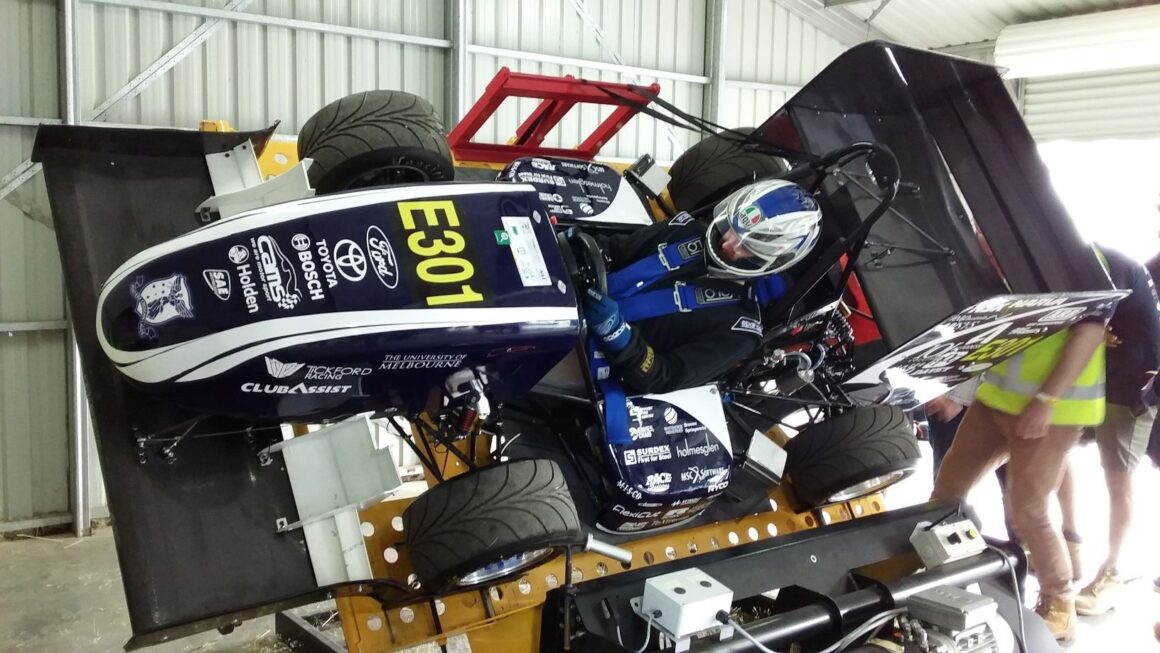
Another significant part of the FSAE experience is the presence of international teams. These not only enable sharing of engineering ideas from around the world, they set the stage for potential future cross-border partnerships.
International entrants this year include Institut Teknologi Sepuluh Nopember from Indonesia, Tokyo Denki University from Japan, the National Taiwan University of Science and Technology, as well as several teams from New Zealand.
FSAE is also an evolving microcosm of the automotive industry. Initially an exclusively internal combustion (IC) engine event, the IC engine has all but disappeared from the FSAE arena. Only 5 of the 30 competing vehicles at this year’s event are IC, with two of those fuelled with ethanol (a bio-fuel) rather than using fossil fuel!
This year’s event kicks off on Thursday December 11 and runs through to Sunday December 14 at Calder Park Motorsport Complex, Calder Park, Victoria. (Entrance off the Calder freeway). Best day for viewing the event is Sunday 14th when the endurance event is running.
For more information on the competing teams and their vehicles, see: https://www.saea.com.au/fsaea-2025-teams
Full disclosure: Bryce has been involved with a number of University FSAE EV teams over the years – both as a safety instructor and as an industry advisor. This year he has worked with both the University of Melbourne and Monash University motorsports teams.