The deployment of rapid-charging infrastructure could be the key to all-electric taxi fleets achieving cost-parity with petrol equivalents, according to new research from the Massachusetts Institute of Technology.
The findings have been detailed in research analysis completed by researchers from MIT’s Energy Initiative and published in the journal Sustainable Cities and Society.
The researchers completed an economic analysis of an all-electric taxi vehicle fleet, using real-world data based on a taxi fleet operating in Beijing, and concludes it could be cheaper to run an all-electric fleet as soon as 2022.
The researchers examined a range business models using different methods of recharging electric taxis, accounting for cost, the time taken to fully recharge a vehicle and the ability to keep vehicles on the roads serving customers.
These included different business models using fleets charged with standard charging facilities (using a 7kW charging unit), a fleet combined with fast charging and a fleet paired with battery swapping facilities.
The research found that the latter two options, which allowed for fast recharging of vehicles, provided the best economic return as it kept electric taxis on the road for longer, and could soon be cost competitive with petrol fueled equivalents.
Key to reaching cost competitiveness is the use of rapid charging systems, that while being more expensive up front, ensure taxis remain on the road as much as possible and avoided the need to operate additional vehicles to maintain the same level of customer service.
The researchers identified battery swapping systems as the most economical, closely followed by rapid charging systems, which both allow taxis to complete multiple shifts within the day.
“Although vehicle electrification offers a wide range of societal benefits, high opportunity costs tied to the charging times remains an impediment to widespread electric fleet adoption. These costs are not insignificant, raising concerns about the technology’s commercial viability,” the research paper says.
“This paper demonstrates the potential for alternative BEV recharging modes to assuage these concerns.”
“We expect that an electrified taxi fleet relying on the right recharging systems/operations could achieve cost parity with a gasoline-powered taxis system by 2022.”
While the analysis found that slower charging systems would involve lower up front costs, they came with considerable opportunity costs as a result of reduced service availability and customers.
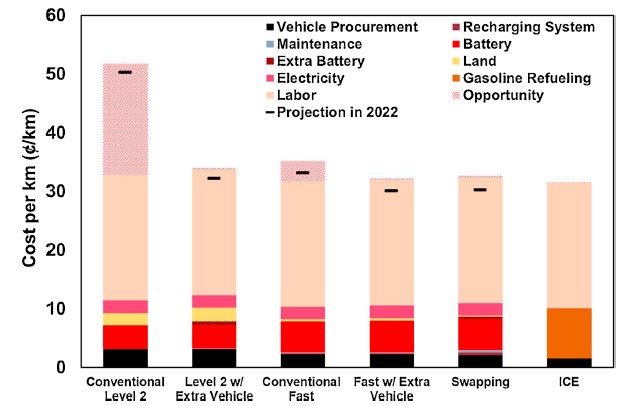
Due to longer charging periods where taxis were off the road longer, and slow charging required would likely necessitate the maintenance of a larger vehicle fleet to maintain the same level of customer service by operating a higher number of vehicles.
The researchers found that with the right charging arrangements, it was likely that an electric taxi fleet could reach cost parity with petrol fueled equivalents as soon as 2022.
All-electric taxis are becoming an increasingly attractive option for fleet managers, with the potential to deliver substantial savings as the increased daily use of the vehicles emphasizes cost-reductions that can be achieved through avoided fuel use.
Last year, the London EV Company, which manufactures the classic “London Taxi” announced that it had produced more than 2,500 models of its all-electric version.
The city of Shanghai, the Chinese power company Southern Power Grid (SPG), working in partnership with state-owned Potevio and China’s largest electric vehicle manufacturer BYD, unveiled a massive electric taxi charging station, with capacity for more than 600 taxis to be recharged using fast-charging services.