
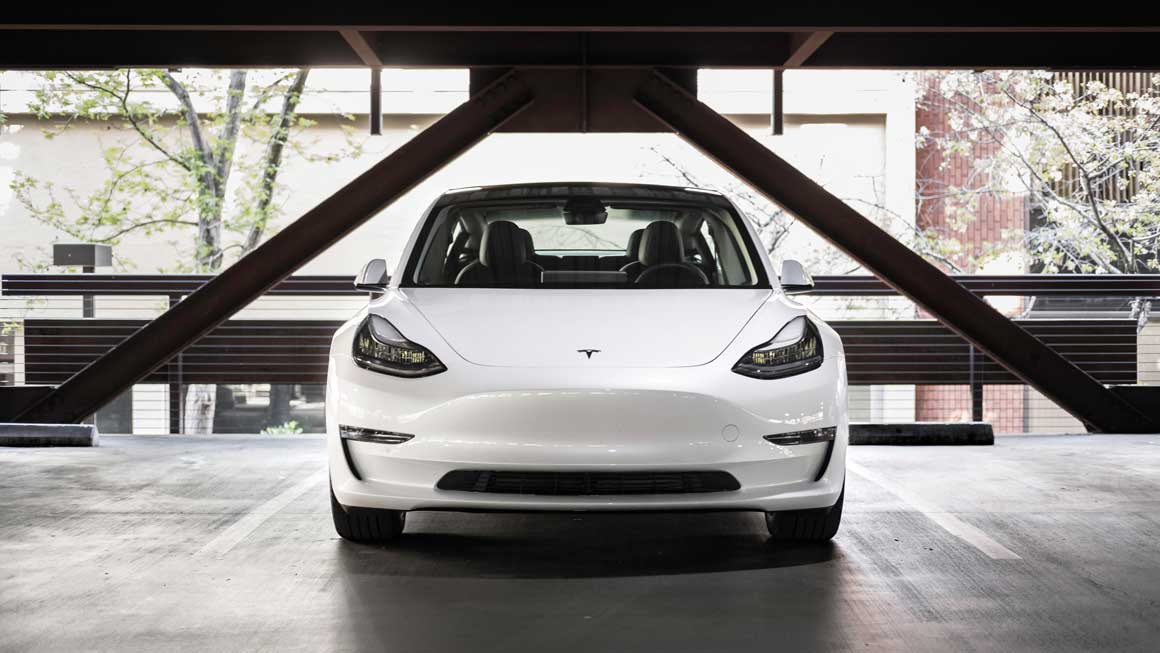
New electric vehicle battery technology from Tesla to be outlined at its upcoming Battery Day in April will involve a combination of dry cell and supercapacitor technology, sources in China have revealed.
When Tesla acquired battery tech developer Maxwell Technologies in 2019, a document released in May 2019 noted that Maxwell’s dry battery electrode technology used to manufacture its ultracapacitors “could be a ground breaking technology for lithium-ion batteries, particularly in the electric vehicle market”.
Now, Chinese automotive news site Krypton 36 reports that a person close to Tesla told Chinese media that: “The new battery independently developed by Tesla is a combination of dry battery technology and supercapacitor. The specific composition is expected to be explained at the Tesla Battery Conference in April.”
Tesla did not immediately respond to a request to confirm this report, but if it proves correct it could put Tesla – already 6 years ahead of other electric vehicle makers with its version 3 hardware, according to Japanese engineers – even further ahead of the game.
Anticipation about what Tesla will reveal for its next generation of batteries is high; recent news indicated that “advanced talks” with battery maker CATL were progressing and that “Made-in-China” Model 3s may be built with a cobalt-free lithium iron phosphate (LFP) chemistry made by CATL.
It has since been confirmed by CATL that it has indeed signed a volume production agreement as reported by the Chinese Securites Journal (CS), though this report indicates the newly signed agreement ensures only a mass supply of lithium-ion batteries.
Tesla later said on the evening of February 21 (China time) via its Chinese official account on Douyin (known as TikTok in Australia and overseas) that “Cobalt-free does not necessarily mean lithium iron phosphate.”
According to CS, Tesla will instead announce “cobalt-free” batteries at its Battery Day in April, saying it is “probably a new type of lithium ion produced by Maxwell using a new high nickel positive electrode + pre-lithiated negative electrode + dry battery technology + supercapacitor battery and two products of super lithium iron phosphate battery using CTP technology” (translated from Chinese).
Maxwell’s dry electrode technology can increase the cell’s energy density to more than 300Wh/kg, and it is expected to further increase to 500Wh/kg in the future, or break the current bottleneck of 300Wh/kg of ternary lithium batteries.
However, it remains to be seen whether Maxwell’s cobalt-free batteries can be commercialized at this stage – bring on Battery Day.
A previous version of this article incorrectly stated that an increase in energy density, and hence driving range, as well as increase charging speed may be an outcome of a combining dry cell and supercapacitor technology.