Battery-electric vehicles (BEVs) now displace 1.2 million barrels of oil per day, roughly 1.2 per cent of global oil consumption and more than five times the amount displaced five years ago.
European clean transport and energy organisation T&E (Transport and Environment) has published a new analysis to commemorate the start of the latest UN Climate Change Conference, COP31, which starts in Antalya, Türkiye this week.
Five years ago, at COP26 in Glasgow, Scotland, 24 countries and a group of leading car manufacturers committed to ending the era of fossil-fuel powered vehicles by 2040 “or earlier”.
In that time, the world has endured two energy crises and fluctuating ambition from carmakers.
Despite this, new analysis from T&E shows that oil savings from EVs globally are up fivefold and are easily the single most effective way of cutting oil demand, improving energy security, and reducing emissions.
“Right now the only winners in our oil addiction are fossil-fuel giants and petrostates,” said Antony Froggatt, senior director at T&E.
“Places with near 100 per cent sales of EVs like Norway, Denmark and Hong Kong have effectively insulated themselves from future shocks. Five years after Glasgow, EVs stand as one of the clearest victories in global climate history.
“At this year’s COP, world leaders must set binding electrification targets. Not just for the climate, but for national security.”
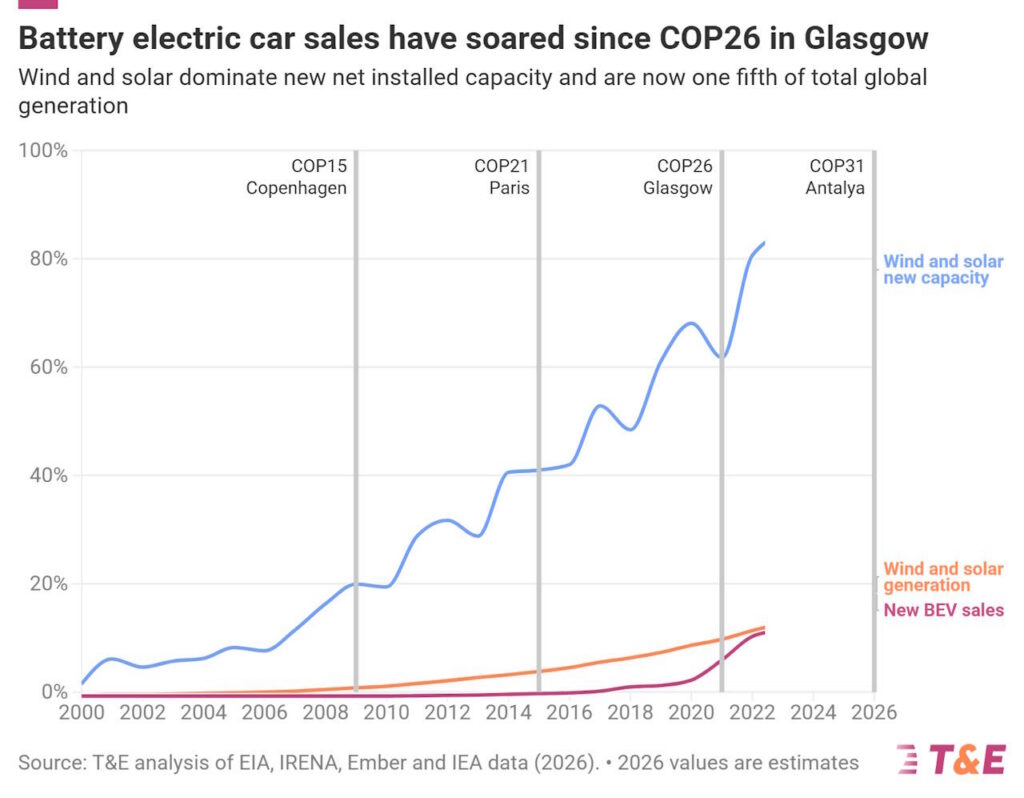
According to T&E’s analysis, even though BEVs represent only 4.2 per cent of the global fleet of vehicles, they account for 25 per cent of all new car sales worldwide – up from only 6.6 per cent five years ago.
This surge in EV deployment has resulted in oil displacement increasing from 215,000 barrels a day in 2021 to 1.2 million barrels a day today, or roughly 1.2% of global consumption. Moreover, current policies put BEVs on track to displace approximately 5.8 million barrels of oil per day by 2034.
Electric passenger vehicles are not the only electrification game in town, with electric buses now accounting for 5 per cent of the global fleet. Similarly, while battery-electric trucks only account for 1 per cent of the global fleet, in some countries they are exceeding 50 per cent of new sales.
And according to T&E, electric buses and trucks are now displacing as much as 320,000 barrels of oil per day.
With electrification expected to take centre stage at this year’s COP, and road transport burning close to half of all the world’s oil, accelerating EV adoption will be crucial to reducing our dependency on oil and preventing future oil shocks.