Sometimes I get the best questions from the most unexpected sources! I recently received the below query from a group of Year 6 students doing a project on electric vehicles. As a set of questions, they make a great starting point for people coming to the EV market for the first time. I could almost go so far as saying it would be hard to go past them.
Following a set of emails back and forth with the group and their teacher – I came up with the answers below and, as an afterthought, that it might be worth sharing them with readers of The Driven in the hope that a few more good comments would come from doing so.
However, whilst I am also sure you, the reader, would love to add more comments and thoughts to help the group, please keep in mind they are year 6 students – so please, no trolling or sarcasm, and stick to facts or opinions that can be verified through reputable sources.
Dear Bryce Gaton
[We are a group of] year 6 students [and are] working on an end-of primary school exhibition. … We found out that you are an expert in EVs and we are requesting for your help. Some questions we have come up with for our topic are:
• How might EVs run out of power so quickly?
• Why might EVs have such a slow charging time?
• How will the new roadster change EVs in the future?
• How can the environment be impacted if there are huge increases in EV use?
• What will the battery disposal process be?
• How can EVs use recyclable batteries in the future?
Thank you and we hope to hear from you.
Jayden, Tony, Owen and Mason.
Hi there Jayden, Tony, Owen and Mason – that sounds like a very worthwhile project. To answer your questions in turn:
1. How might EVs run out of power so quickly?
I’ll start this answer with a little bit of EV history. Back in 2010, EVs had small, and very expensive batteries. This resulted in driving ranges of little over 120 km for the two mass-produced EVs available then – the Nissan Leaf and the Mitsubishi iMiEV.
As a result, they gained the reputation of being ‘city cars’ that were of little-to-no use beyond that. EVs have moved on a lot since then. (To The Driven readers: although some writers seem to have not noticed …)
To return to the present day: EV driving range now compares favourably with that of ICE Internal Combustion Engine (ICE) vehicles.
Most petrol cars carry enough litres of fuel to cover 500 km to 700 km, and many EVs these days have batteries big enough to do similar distances. There are differences in the way their range varies with driving conditions though.
Petrol cars burn fuel more efficiently at higher, more constant speeds, so give better fuel economy on the highway and worse fuel economy at the slow speeds and stop-start conditions of suburban travel where they burn fuel at less-than-optimal efficiency for the fuel burning process – perhaps 15% to 20% more fuel use than their rated number in the city and the same less that the rated number on the highway.
EVs are far more efficient with their energy use, so it’s wind resistance that most affects their rate of energy use. (The higher the speed, the more energy needed to push the air out of the way as you travel).
As a result, EVs do better than their rated range in the city (due both to reduced wind resistance and recovering energy through ‘regenerative braking’ when slowing down in stop-start conditions), and less than the rated range on the highway due to higher wind resistance and less regenerative braking due to little slowing down/speeding up happening. (Adds up to about 10% to 15% more range in the city and the same less range on the highway).
That is perhaps ‘too much information’, but it hopefully explains that modern EVs do not ‘run out of power quickly’.
(Editor’s note: Remember that most of the energy burned in petrol and diesel engines is lost as waste heat).
2. Why might EVs have such a slow charging time?
EV charging is very different to petrol refuelling. It is no longer ‘one size fits all’ in terms of how quickly a fuel bowser pumps fuel into the tank while you stand around holding the trigger.
Instead, EV ‘refuelling’ is something that happens when you are NOT standing around waiting for it to finish. Where an EV is being used for suburban trips, recharging is best done overnight when you are at home asleep. For that sort of charging, a slow trickle charge from a standard power point is plenty. Over 12 hours, that will give around 150 km charged overnight.
If you need to recharge more than this in one session: you would install a dedicated home charger. These can give 500 km to 600 km and more recharged before morning in a typical overnight session, or 100 km recharged in about two hours.
If you are travelling regionally and need to recharge during the trip, you use a different sort of charger, called a DC fast-charger (DCFC). For the fastest DC charging rates now available in some cars, 100 km of range can be regained in a few minutes and can give a near full-charge in less than 10 minutes. In fact, the new BYD ‘flash-charge’ system can recharge 100 km in just under a minute.
That is perhaps ‘too much information’ again, but it hopefully explains that modern EV ‘refuelling’ is a different way of doing things. To say they are ‘slow to charge’ is to think of recharging as being done the same way as petrol refuelling. EV recharging is as different from petrol refuelling as petrol refuelling was to feeding and watering the horses they replaced back in the early 1900s.
3. How will the new Roadster change EVs in the future?
Note: My response to this question is perhaps more of a personal observation than a data driven answer – however, I am not alone in these sentiments, plus I think there are enough examples of poor Tesla decision making of late to support it.
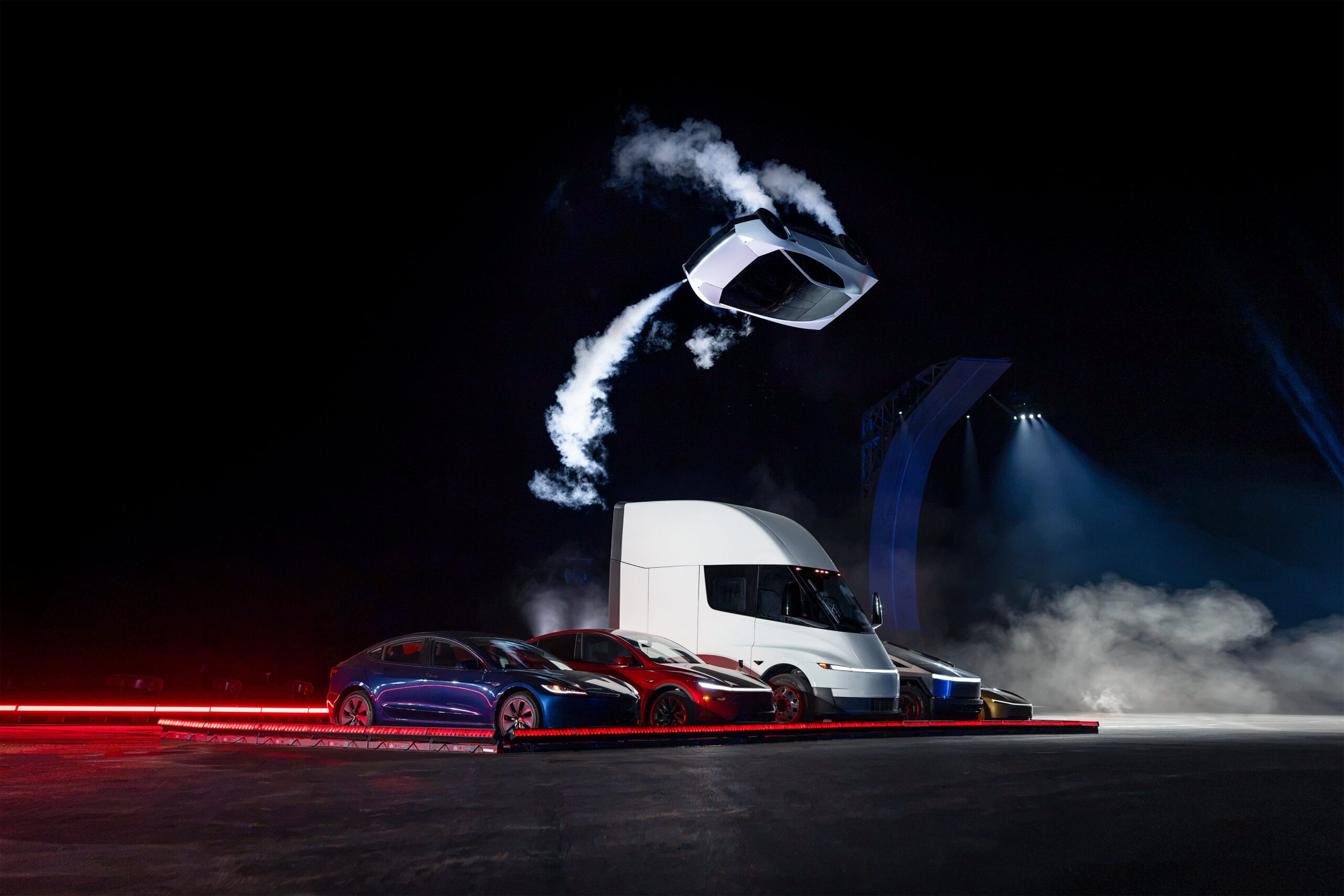
I am sorry to say that the new Tesla Roadster revealed recently is no more than a showy gimmick. For safety reasons, the flying and road-hugging features shown in the reveal will not be allowed on the road. Also, just like the Roadster 2.0 revealed in 2017, this latest iteration (even without the gimmicky fans and jets) is highly unlikely to ever reach production.
Whilst Tesla were the early leader in the EV race, the company has one major flaw – the company direction is driven by a single person whose business decisions are often not logically based. (As just one of many examples, his focus on building the widely derided … and poor selling … Cybertruck and, as a result, effectively canning the 2017 Roadster 2.0 and ‘Tesla Model 2’ projects that were in the project pipeline at the time).
As a result of Tesla failing to innovate properly, they have been overtaken in terms of design and EV technology by many other automotive manufacturers. I would look at companies like Xpeng (including Xpeng’s robot and ‘flying car’ projects), Hyundai/Kia group (with their V2L and V2G systems, as well as their high performance EVs) or Renault (who offer several driver-focused ‘fun to drive’ EVs) to see what the future of automotive technology is more likely to be.
There are plenty of other examples too. Even in autonomous car development, Tesla is starting to lose the race with many more prototype autonomous cars on the road from other manufacturers now.
4. How can the environment be impacted if there are huge increases in EV use?
In short: positively! Local tailpipe pollution will be entirely eliminated. Provided they are run on renewable electricity sources, pollution from coal and gas generation plants will also be removed, as will the long-term issues of needing to deal with nuclear waste for millennia.
Waste from used engine oil, filters and exhaust system components will also be gone. Brake replacements will also be much reduced. (Brakes wear in an EV is much less due to the use of regenerative braking massively reducing the wear of the expensive friction pads and discs in brake systems).
5. What will the battery disposal process be?
EV batteries are large and contain valuable materials. They will be easy to collect (unlike button batteries and AA, AAA etc cells). As such, there will be a market for retrieving, reusing and ultimately recycling them. The main reason there hasn’t been much recycling of them done yet is they are lasting so long in the cars.
Used EV batteries BTW have a useful second-life as storage battery systems. Only once their capacity falls below a useful level will then need to be recycled. Lithium batteries in EVs are around 96% recyclable.
6. How can EVs use recyclable batteries in the future?
Two ways. The first is checking and replacing faulty cells in a battery pack. (In the rare event of an EV battery failure, it is often caused by one or two cells that have fallen in capacity). Many manufacturers build battery packs that can be serviced in this way.
The second is building new EV batteries from recycled materials. For instance, some people have predicted that by 2050, most of the lithium, cobalt etc in batteries will be recycled and there will not be the need for the current levels of mining.
As a final note, in these days of mis- and dis-information about EVs (and, sadly, about most other things), please remember when using any of my responses as part of your discussions and conclusions, to always look for and footnote the sources so others can check your conclusions are data driven … including by the way, checking all my statements for reputable sources and verifiable facts too. 😉.
Good places to go include the US based Union of Concerned Scientists and the EU based International Council on Clean Transport (ICCT), the Australian Electric Vehicle Council and Australian Electric Vehicle Association.
Hope that all helps? God luck with the project!
Kind regards
Bryce
If you have any other questions, send them to [email protected]