
In January 2024 Toyota chairman Akio Toyoda suggested that battery EVs would reach at most 30% market share, with the rest going to hybrids, hydrogen and combustion cars. Norway battery-electric vehicles already held about 89% of Norway’s new-car market in that year..
Plug0in hybrid vehicles are conditional transition vehicles. They earn their environmental case through verified electric kilometres, not through the presence of a charging port.
Mature markets tell the more revealing story. Once battery-electric vehicles offer sufficient choice, charging confidence and competitive economics, hybrids do not settle into a permanent share of the market. Hybrids may lead early, peak, and then retreat.
—
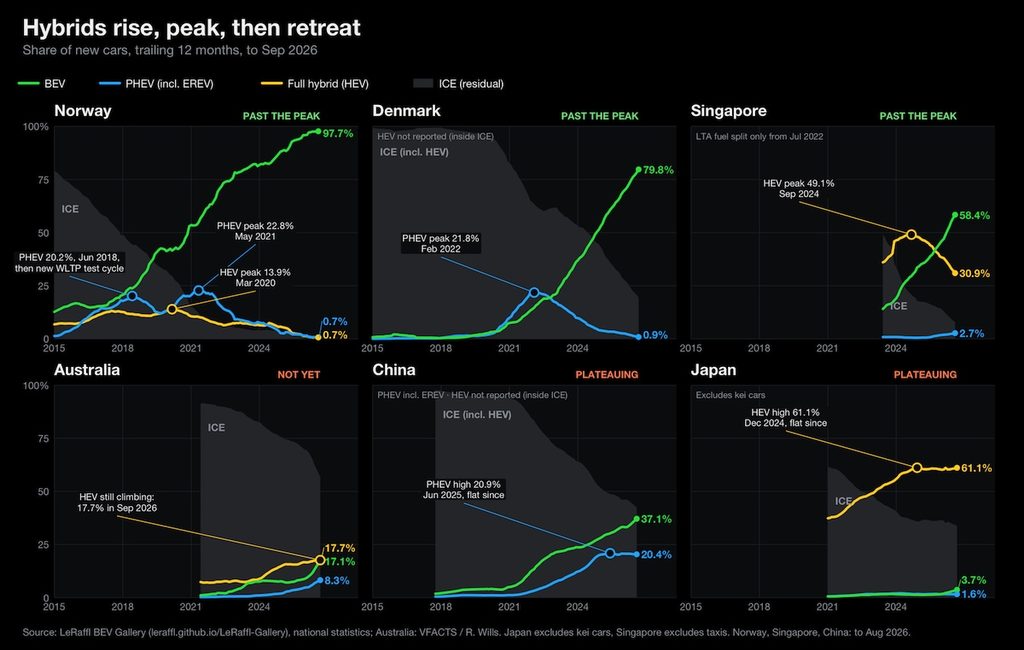
Take the car of Norway. In 2015, hybrid vehicles had gained material market share and plug-in hybrids were beginning to arrive in volume. In 2017, PHEVs accounted for about 18% of new registrations. BEV growth temporarily paused, while hybrids benefited from familiar factories, familiar supply chains and familiar consumer expectation.
After another PHEV surge in 2020 and 2021, the direction changed. By 2026, both conventional hybrids and PHEVs had become marginal in Norway’s new-car market: PHEVs were down from a peak of about 23% of new registrations in 2021 to no more than 1%, while full hybrids peaked, then a fall to below 1%.
It would be easy to dismiss Norway as a special case: a small, affluent and subsidy-supported market.
Then look at Singapore.
Singapore has a distinctive vehicle-ownership system, built around Certificates of Entitlement, high ownership costs and tightly managed taxation. Yet the market pattern is recognisable. Full-hybrid share rose to just over 49% of new registrations in September 2024, then fell to 25% in August 2026.
Denmark provides another example. Its private-buyer market is now moving rapidly towards a predominantly battery electric outcome. PHEV share peaked in the realm of 22% in 2021 and down below 1% as of August 2026 while BEVs were 88.6% of all Danish cars and 97.3% for their private registration subset.
These three markets are not identical, and their policies are not interchangeable. But they show a repeating shape. In leading electrification markets, hybrid share has not settled into a stable plateau. It has risen, peaked and then declined.
That is what a waypoint looks like.
For years, Norway was treated as the exception: small, rich, subsidy-heavy and unrepresentative. But its basic market pattern is now appearing wherever electrification has advanced far enough.
Different routes, same direction
Once the pattern is visible in several unrelated countries, the question becomes whether it is appearing more widely, including in markets still early in the transition.
Trailing-twelve-month registration data across the selected markets show not a world divided between “BEV countries” and “hybrid countries,” but markets at different stages of electrification and following different routes.
Some move relatively directly from combustion vehicles to BEVs. Others pass through a stronger hybrid phase, then a PHEV phase, before BEVs become dominant. In China, PHEVs and range-extended EVs have gained strength alongside BEVs, supported by rapid product cycles, intense domestic competition, expanding charging networks, regulatory settings and strong domestic manufacturers.
This is not a claim that hybrids have already peaked everywhere. Across the European Union, hybrid vehicles still held 36.6% of new registrations and PHEVs 10% in the first eight months of 2026 – evidence of a transition that remains uneven across countries, buyer types and vehicle segments.
The route differs. The starting point differs. The pace differs. The picture that comes out isn’t “some countries like BEVs, others like hybrids.” The underlying direction is always consistent: as BEVs meet more consumer needs in markets where purchase prices, electricity and charging conditions make them competitive, the market available to combustion-based hybrids necessarily shrinks.
There is a practical implication for buyers. A hybrid purchased today in a market that has not yet reached its tipping point may face greater residual-value risk when it arrives on the used market. If new-car demand shifts rapidly towards BEVs while used supply reflects today’s hybrid-heavy sales, resale values may come under pressure.
Fuel prices, tax settings, used-BEV supply, charging access and export markets will impact, but it is a risk buyers, fleets and financiers should acknowledge.
Why the story is often misunderstood
If the pattern is visible in the data, why does public discussion so often present hybrids as a permanent pillar of the future vehicle market?
One reason is that the transition is uneven – the future is here, it’s just not well distributed yet. In many countries, people have only seen the rising half of the hybrid curve. The peak and decline have not yet arrived. It is easy to mistake “still growing” for “here to stay.”
Another is that manufacturers with decades of investment in combustion and hybrid platforms have commercial reasons to extend the life of those systems. That behaviour seems rational. Hybrid platforms preserve familiar engines, suppliers, dealer servicing and factory investments.
But that commercial logic is not evidence that hybrid demand will remain durable once BEVs can do the same job more effectively. As with everything, the biggest cost may come not in going too fast, but in going too slow.
It is also important not to overstate the case against PHEVs. A PHEV that is routinely plugged in can cover much of its owner’s daily driving on electricity. The problem is that many of those PHEVs are not used that way.
European Commission data from 320,000 PHEVs first registered in 2021 found real-world CO₂ emissions averaging 3.5 times their official type-approval values. The Commission concluded that these vehicles were not being charged and driven electrically as frequently as assumed in laboratory testing.
Company vehicles are a particular problem. Petrol may be employer-paid, immediate and simple to use, while home charging is paid by the employee, workplace charging is unavailable, and reimbursement is cumbersome. Under those conditions, the petrol engine becomes the default.
A PHEV is a bridge—but only if people use it to cross from the petrol side to electricity side.
A shrinking role
The registration data do not say that every hybrid buyer has made the wrong decision. Some households and fleets still need a transitional option. Some regional, towing, remote-area and high-kilometre uses remain difficult for today’s BEV models and charging networks.
But those are specific use cases that are not representative of the mass market and thus not a reason to preserve combustion systems for everyone.
Conventional hybrids reduce petrol consumption, particularly in stop-start urban driving, but every kilometre still depends on fuel. PHEVs can replace a substantial share of petrol with electricity, but only if they are regularly charged, have enough real-world electric range and do not unnecessarily run their engine.
BEVs eliminate routine petrol use and are the most energy-efficient option for the expanding share of households and fleets whose driving and charging conditions suit them.
The role of policy is not to pretend that all drivers are identical. It is to make electric driving easier: reliable charging at homes, apartments, workplaces and regional routes; electricity reimbursement as straightforward as fuel reimbursement; and real-world reporting of petrol use and electric kilometres in PHEV fleets.
The market is not likely to move from combustion to BEV in exactly the same way everywhere. But as battery-electric vehicles become cheaper, more capable and easier to charge, the addressable market for hybrids contracts.
Hybrids can help drivers transition from the combustion era into the battery electric era.
But that is all they are. A waypoint towards an electric future.