
The latest European evidence on plug-in hybrids has generated a predictable headline: PHEVs are greenwashing, because real-world emissions and fuel use are far higher than laboratory labels suggest, even if they are a little bit cleaner than regular internal combustion engine cars.
The numbers are concerning.
A large Fraunhofer Institute analysis using on-board fuel-consumption-monitoring data from 981,035 European PHEVs found average petrol use just over 6 litres per 100 kilometres, compared with an average official figure of 1.57 L/100 km. A later European dataset for PHEVs registered in 2024 found average real-world emissions of 145 grams of CO₂ per kilometre, against an official rating of 24 g/km.
The lesson is not that plug-in hybrid tech is flawed – it’s that PHEV performance depends on how it is designed, sold, charged and managed.
A PHEV is not automatically a low-emissions vehicle because it has a battery and a plug. It’s about the kilometres that are genuinely driven on electricity. For the rest, it is just a petrol vehicle – but a heavier and more complicated one.
The problem is behaviour and management
European fleet policy has often rewarded the purchase of a PHEV based on a low laboratory rating, without ensuring that the electric system is actually used.
A business may issue a company PHEV and retain the conventional fuel-card system. Petrol is free, immediate and easy for the driver. Home charging may come from the employee’s own electricity account. Workplace charging may be unavailable. Public charging may be inconvenient. Expense claims may be fiddly.
The business gets the green fleet number at the time of purchase. The driver gets a car that the management system design may make it easier for them to operate on petrol.
Management by fuel card gives access, payment, reconciliation, reporting – and creates a simple default behaviour. If an enterprise wants its PHEVs to displace petrol, it needs an electricity-management system that is at least as simple.
That means confirming home or workplace charging before a PHEV is allocated, paying or automatically reimbursing the electricity, providing a usable public-charging account when needed, and monitoring actual petrol and electricity consumption. The driver should not have to become an electricity accountant to make a corporate sustainability claim real.
The question for fleets is simple: if petrol is easier and free while electricity is inconvenient and personally paid, why would anyone expect the plug to be used?
It is not only charging
The Fraunhofer data adds an important qualification. The study found that PHEVs used an average just under 3 L/100 km even when the battery is being used.
That’s not a substantial amount of petrol use in everyday EV mode. But it means that real-world outcomes cannot be explained solely by drivers failing to charge.
Some PHEVs start their petrol engine for heating, demisting, battery conditioning, high power demand, higher-speed driving, steep grades, or particular software-control strategies. The vehicle may also preserve battery reserve or combine engine and electric power in ways that are not obvious to the driver.
That makes transparent reporting essential. Buyers and fleet managers should be told not only the headline “combined” fuel-consumption figure, but also:
- Electric range under a stated test cycle.
- Battery-depleted petrol consumption.
- Petrol use in nominal electric or charge-depleting operation.
- Charging speed and practical charging time.
- Actual electric-kilometre share over time.
A PHEV should be judged by measured energy use, not a laboratory label built on an optimistic assumption about driver behaviour.
Right-size the battery
The answer is not to fit a huge battery to every PHEV in order to cover every rare long trip electrically.
Most routine car travel is short. Victorian travel data show that even in Melbourne’s outer suburbs, where car travel is longest, around 90% of people travelled 80 km or less by car on a survey day. Regional Australians do travel further on average and often have fewer charging options, but that does not mean every household needs a large battery engineered around infrequent long-distance trips.
The sensible target is to cover the routine majority of daily driving, not the exceptional tail.
For many urban, suburban and regional households, a PHEV with roughly 80 km of real-world electric range could cover the commute, school run, shopping, local business travel and ordinary weekend trips. It needs a practical margin for air conditioning, weather, speed, hills, loads and battery ageing.
Can PHEVs work?
A typical experience from Townsville illustrates a PHEV working as intended. The owner was not ready to commit to a full battery electric vehicle (despite particularly good advice from her father), but she did choose a PHEV with about 80 km of electric range. Her usual daily driving is mostly 50–60 km. She has so far used it virtually as an electric car (except for one holiday trip between Townsville and Cairns).
And subsequently two of her friends in Townsville quickly followed – as is appropriate in Australia after sharing a couple of weekend BBQ stories. All three owners of new Chinese PHEVs, purchased after this latest oil crisis, have displaced almost all of their routine petrol use.
Oh, and all three previously owned Japanese ICE cars.
That is a sensible PHEV use case. The battery meets normal life. The engine provides occasional flexibility. There is little reason to impose the cost and weight of enough battery for every rare journey on every household.
Higher-kilometre regional users, regular long-distance travellers, towing users and remote-area operators may need a different vehicle: a longer-range PHEV variant, a suitably capable BEV with reliable route charging, or a purpose-selected combustion vehicle where alternatives are not yet adequate.
Australia may not be Europe – yet
Early Australian evidence is more encouraging. An Electric Vehicle Council survey of 625 private PHEV owners found that most said they charged nightly and drove electrically on around 65% of trips. BYD has separately said servicing data indicate its Australian PHEV owners drive electrically for about half their kilometres.
Neither provides independent monitoring across the whole Australian PHEV fleet, but they point to a plausible difference. Australia’s early PHEV buyers are more likely to have off-street parking, home charging and a deliberate reason for buying a plug-in vehicle.
In Europe, many PHEVs have been distributed as company cars under systems that make petrol effortless and employer-paid but leave charging inconvenient or personally paid.
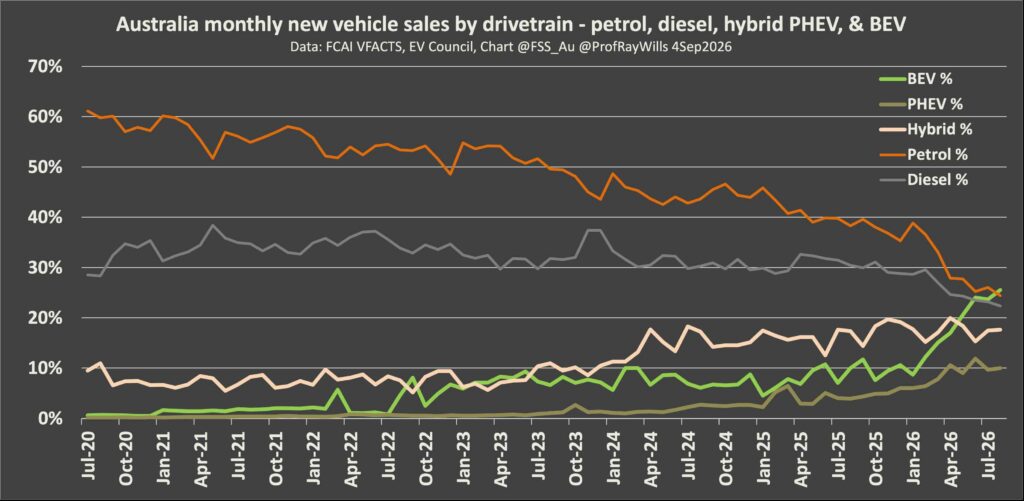
Figure 1: Australia monthly new vehicles sales share by drivetrain – petrol, diesel, hybrid, PHEV and BEV
The policy task is to get serious about the degree of electric use so we can preserve the good Australian result as the market expands:
- Measure actual petrol and electricity use in vehicles for use by planners and owners;
- Ensure home, workplace and apartment charging is facilitated;
- Reimburse electricity as easily as petrol; and
- Require fleets to report their actual electric-kilometre share so we know the reality of PHEV (and whole of fleet) benefits.
The petrol tank is not free
The same common sense should apply to the fuel tank.
A PHEV driven electrically most days should not necessarily carry a full petrol tank for months. Petrol is weight—roughly 0.74 kg per litre—and a 50-litre tank can mean about 37 kg of fuel carried unnecessarily during routine electric travel. Stored fuel also ages, which is why some PHEVs periodically run their petrol engine or prompt drivers to consume old fuel.
The petrol tank should be treated as a contingency reserve, not as a permanently full second energy system.
A smarter PHEV could track fuel age and quantity, use navigation and calendar information to identify upcoming long trips, preserve an appropriate safety reserve, discourage habitual overfilling, and alert the driver when fuel needs to be used before it degrades. This must never compromise safety in regional or remote Australia, where prudent fuel margins remain essential. But in ordinary metropolitan use, filling the tank by reflex makes little sense when the next week’s travel is already covered by electricity.
A clear hierarchy
Conventional hybrids reduce petrol use, particularly in stop-start urban driving, but every kilometre ultimately remains powered by petrol.
PHEVs can replace a substantial share of petrol with electricity—but only when they are:
- Routinely charged,
- Have sufficient genuine electric range, and
- Do not unnecessarily start the engine.
BEVs eliminate routine petrol use altogether and are the most energy-efficient option for the many households and fleets whose travel and charging conditions suit them. A fully battery electric fleet is the ultimate goal for vehicle transport once the recharging system is fully in place. In the meantime PHEVs are needed for some people and functions.
The European evidence should therefore not be used to dismiss every PHEV. It should end the fiction that a PHEV becomes low-emission simply when it is sold.
A PHEV is a managed transition technology. Get the vehicle size right, make charging the easy default, pay for electricity as simply as petrol, measure real energy use, and retain petrol for the trips that genuinely need it.
Otherwise, it may be just a petrol car carrying an unused battery plus engine.